CASE 16
This teaching note was prepared by James Tompkins and Robert Bruner. Please do not share the contents of this
note with students. Copyright © 2004 by the University of Virginia Darden School Foundation, Charlottesville, VA.
All rights reserved. To order copies, send an e–mail to sales@dardenbusinesspublishing.com. No part of this
publication may be reproduced, stored in a retrieval system, used in a spreadsheet, or transmitted in any form or by
any means—electronic, mechanical, photocopying, recording, or otherwise—without the permission of the Darden
School Foundation.
THE BOEING 7E7
Teaching Note
Synopsis and Objectives
In 2003, the Boeing Company announced plans to
build a new “super–efficient” commercial jet called the “7E7”
or “Dreamliner.” This was a “bet the farm” gamble by
Boeing, similar in magnitude to its earlier introductions of
the 747 and 777 airliners. The technological superiority of
the new airframe, as well as the fact that it would penetrate a
rapidly growing market segment, were arguments for
approval of the project. On the other hand, the current market for commercial airplanes was
depressed because of terrorism risks, war, and SARS, a contagious illness that resulted in global
travel warnings. Boeing’s board of directors would need to weigh those considerations before
granting final approval to proceed with the project.
The task for students is to evaluate the 7E7 project against a financial standard, the
investors’ required returns. The case gives internal rates of return (IRR) for the 7E7 project under
base-case and alternative forecasts. The students must estimate a weighted-average cost of
capital (WACC) for Boeing’s commercial-aircraft business segment in order to evaluate the
IRRs. As a result of that analysis, the students identify the key value drivers and distinguish, on a
qualitative basis, the key gambles that Boeing is making.
The general objective of this case is to exercise students’ skills in estimating a weighted–
average cost of capital and cost of equity. The need for students to estimate a segment WACC
draws out their abilities to critique different estimates of beta and to manipulate the levered-beta
formulas. Boeing competes in both the commercial aircraft and the defense business. Thus,
deriving the appropriate benchmark WACC for the 7E7 project requires isolating the commercial
aircraft component from Boeing’s overall corporate WACC. In doing so, students engage the
concept of value additivity.
Suggestions for complementary
cases on the cost of capital:
“Teletech Corporation, 1996”
(Case 15); “Nike Inc.” (Case 14)
and “Coke vs. Pepsi” (UVA-F-
1340)

156 Case 16 The Boeing 7E7
Tip: The instructor can streamline
the discussion considerably by
dictating “base–case” assumptions
for student use regarding cost of
debt, risk-free rate, and equity
market risk premium. Such
direction could be offered in the
assignment questions. Our
preference is not to dictate very
much, but rather, to let students
explore alternatives. The balance of
this note follows this path.
However, many schools have a
“house view” about the equity
market risk premium. For this
reason, the case does not cite an
EMRP—the instructor is assumed to
offer guidance here. At the date of
the case, the four main estimates of
EMRP were:
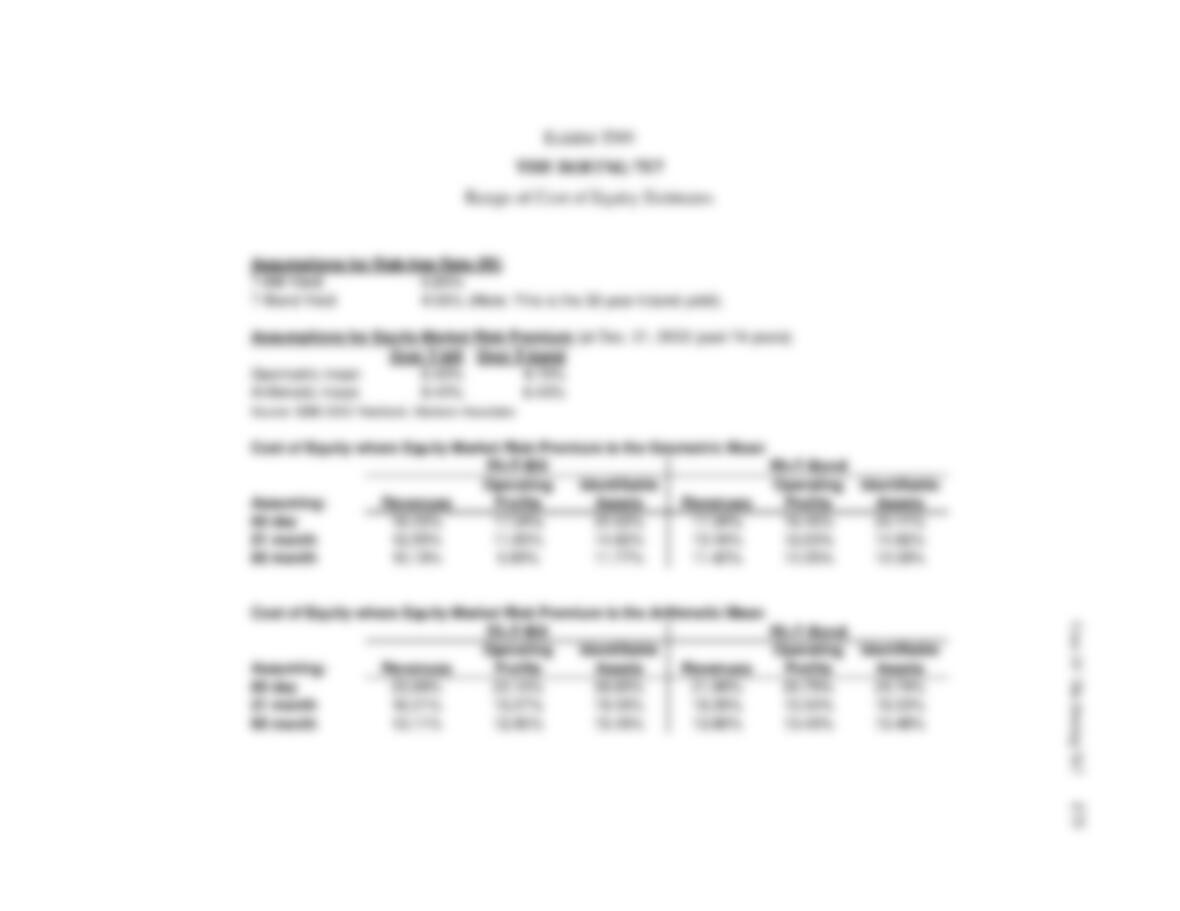
• 6.4%
(geometric mean over T-bills)
• 4.7%
(geometric mean over T-bonds)
• 8.4%
(arithmetic mean over T-bills)
• 6.4%
(arithmetic mean over T-bonds)
See the Appendix for definition and
discussion of the geometric and
arithmetic EMRPs. The calculation
in Exhibit TN8 illustrates the use of
the arithmetic mean over T-bills.
Suggested Questions for Advance Assignment to Students
1. What is an appropriate required rate of return against
which to evaluate the prospective IRRs from the
Boeing 7E7?
a. Please use the capital asset pricing model to
estimate the cost of equity. At the date of the case,
the 74-year equity market risk premium (EMRP)
was estimated to be ___. Which beta and risk-free
rate did you use? Why?
b. When you used the capital asset pricing model,
which risk-premium and risk-free rate did you
use? Why?
c. Which capital-structure weights did you use?
Why?
2. Judged against your WACC, how attractive is the
Boeing 7E7 project?
a. Under what circumstances is the project
economically attractive?
b. What does sensitivity analysis (your own and/or
that shown in the case) reveal about the nature of
Boeing’s gamble on the 7E7?
3. Should the board approve the 7E7?
Supporting Excel Spreadsheets
Student analysis of the case is supported by the spreadsheet file, “Case_16.xls,” available
from Darden Business Publishing (sales@dardenbusinesspublishing.com). Instructor analysis is
supported by “TN_16.xls.” It is a condition of accessing this file that you agree not to share the
contents of the instructor file with students.
Hypothetical Teaching Plan
The following questions offer an outline for discussion leadership. These can be easily
condensed or expanded to meet a discussion time as short as 80 minutes and as long as 4 hours,
depending on the depth to which the instructor wishes to address the issues.

Case 16 The Boeing 7E7 157
1. Why is Boeing contemplating the launch of the 7E7 project? Is this a good time to do so?
This opening summarizes the basic facts, broad motives for the project, and the risks. The
objective for this part of the discussion is to set the tone for the case discussion, especially the
need to prepare a recommendation for Boeing’s board of directors.
2. Should Boeing’s Board approve the 7E7?
The instructor can take the students’ vote and then solicit a few opinions and summarize
key arguments on the chalkboard. One can ask specific students for their estimate of the cost of
capital and write it next to their yes or no vote. The students will show some division of opinion,
but in our classroom experience, they tended to lean toward approval. The instructor could easily
take a “devil’s advocate” approach toward the prevailing sentiment and invite defense of the
students’ opinions. In any event, acknowledgment of a range of estimates builds drama and
confirms that there are competing views among students—this motivates a detailed discussion of
the financial analysis.
3. How would we know if the 7E7 project will create value?
Students may be familiar with the classic NPV criterion. This case invites them to focus
on the internal rate of return (IRR). If the IRR is greater than the project cost of capital, the 7E7
is a positive net present value project.
1
A discussion of why this is true provides a solid “big
picture” foundation for the case decision. The project IRRs are presented in case Exhibit 9.
Therefore, the focus of student analysis should be on determining the benchmark against which
to evaluate the IRRs. Thus, this part of the discussion helps to motivate the analysis of WACC.
Some students may have voted in a manner that contradicts the IRR versus the cost of capital
decision rule. This sets up the next question.
4. Okay, let’s examine the details of how to estimate the WACC. Let’s go step-by-step.
Where shall we get started?
The instructor can ask one student (or team of students) to walk the class through the
detailed calculations. The presenter(s) may make one or more errors or adopt some controversial
practice in making the calculations. This presents a strategic teaching question for the instructor:
interrupt and correct at the first mistake, or do it after they are done? The latter is preferable if
you are in a discussion-based learning environment. Thus, the instructor could keep a careful
record of the students’ calculations on the chalkboard,
2
let them finish, and then turn to the class
and ask, “Do you all agree? Why not?” Challenges and debates over specific issues will follow.
At this point, it is not important to judge the quality of the assumptions (they can be good or
1
Of course, this assumes initial negative cash flows followed by positive cash flows.
2
This class is ideally suited for the chalkboard. PowerPoint or other digital media make it difficult to
summarize the complete analytic process in plain view of the students and simply puts the success of the whole class
in the hands of the presenters. The instructor needs to remain in control of the discussion—continuing to hold the
chalk is the best way to do this.
158 Case 16 The Boeing 7E7
bad). The task of the instructor is to work through the WACC calculation in an orderly manner.
A number of thought-provoking questions about techniques can lead to rich classroom
discussions. By the close of this segment of the discussion, the instructor should aim to have on
the chalkboard a finished WACC calculation that highlights aspects about which there may be
some disagreement.
5. The weighted-average cost of capital is a simple formula. Yet it seems that reasonable
people can disagree about the estimates. How can there be such a range of cost of capital
estimates? Please summarize the issues.
This segment asks the students to summarize the thorny questions of estimating WACC
and to contrast the issues in practice with the underlying simplicity of the weighted-average cost
of capital formula and the capital asset pricing model. The reason for varying estimates is that
students will have made different assumptions as they apply the formula. This will be apparent
on the chalkboard if the instructor has faithfully recorded the assumptions of the main
presenter(s) and any alternate assumptions that may have surfaced. The next step is to do
sensitivity analysis on each assumption. If the sensitivity analysis reveals that the decision
outcome is significantly impacted by the assumption, only then is it worth spending more time,
energy, and dollars on improving the quality of the assumption. This is another judgment part of
financial analysis and decision-making. A good analyst will make the board aware of critical
assumptions, so that it can, in turn, make more informed and better decisions.
6. Have we thought of everything? Is there anything else the board of directors should
consider in assessing the financial appeal of this project? Why might the board vote
“yes” on the 7E7, when the cost of capital estimate is greater than the IRR? Why might
the Board vote “no” if the cost of capital estimate is less than the IRR?
This segment of the discussion should aim to introduce the basic idea that determinate
cash flow forecasts do not capture contingent values. Real option valuation is beyond the scope
of this case, but students should be reminded that a large capital project such as the 7E7 is
probably riddled with rights that can enhance the value of the project—rights to new yet-to-be
discovered technology, rights to grow and/or enter new markets, and rights to cross-pollinate
other projects’ new intellectual property from the 7E7. In addition, the 7E7 might create
intangible value for Boeing’s brand and strategic value for cross-selling. The potential
significance of qualitative issues can be an eye-opening point for some students who consider
finance to be a “numbers” class. In the end, the board of directors must weigh both the
determinate cash flow values and the contingent and intangible values in the project.
7. What should the board do?
The instructor could bring closure to the discussion with another student vote. Making
careful note of students who may have changed their minds, the instructor could invite one or
two to comment on what they learned. Airing the reasoning behind some of the vote changes will
reinforce the learning objectives underlying the decision-making process.

Case 16 The Boeing 7E7 159
Question 1: Why is
Boeing contemplating the
launch of the 7E7 project?
Is this a good time to do
so?
Question 4: Let us
examine the details of how
to estimate the WACC. Let
us go step–by-step. Where
shall we get started?
The instructor could close the class with a brief commentary on development of the 7E7
project since the date of the case. The epilogue presented in this note recounts the board’s
decision to proceed with the 7E7 project. Further developments may be gleaned from Boeing’s
Web site and others.
Case Analysis: Estimation of the Project-Specific WACC
Launch and timing of the 7E7
The motives for the project are laudable: the 7E7 is entering
a good growth segment of the industry. Higher performance and fuel
efficiency will position Boeing favorably in the market, and perhaps,
take back some market share from competitors. R&D on this project
may create inventions that will prove to be valuable to other Boeing
products. At the same time, the consequences of error are staggering:
this is a bet-the-ranch kind of investment.
But, as most entertainers know, timing is everything. Here, the timing could not be
worse: war, airline-focused terrorism, SARS, and the weak financial condition of airlines all
challenge the approval of the project. “Why now?” is a question that the board must answer. In
part, the answer depends on the long development cycle (four years) and very long product
lifecycle (20 years). The board is making a bet less on conditions that prevail today than on
conditions that are expected to prevail many years into the future.
Calculating WACC
The instructor could use the formulas for WACC and the
capital asset pricing model as a format for organizing the calculation
section of the discussion.
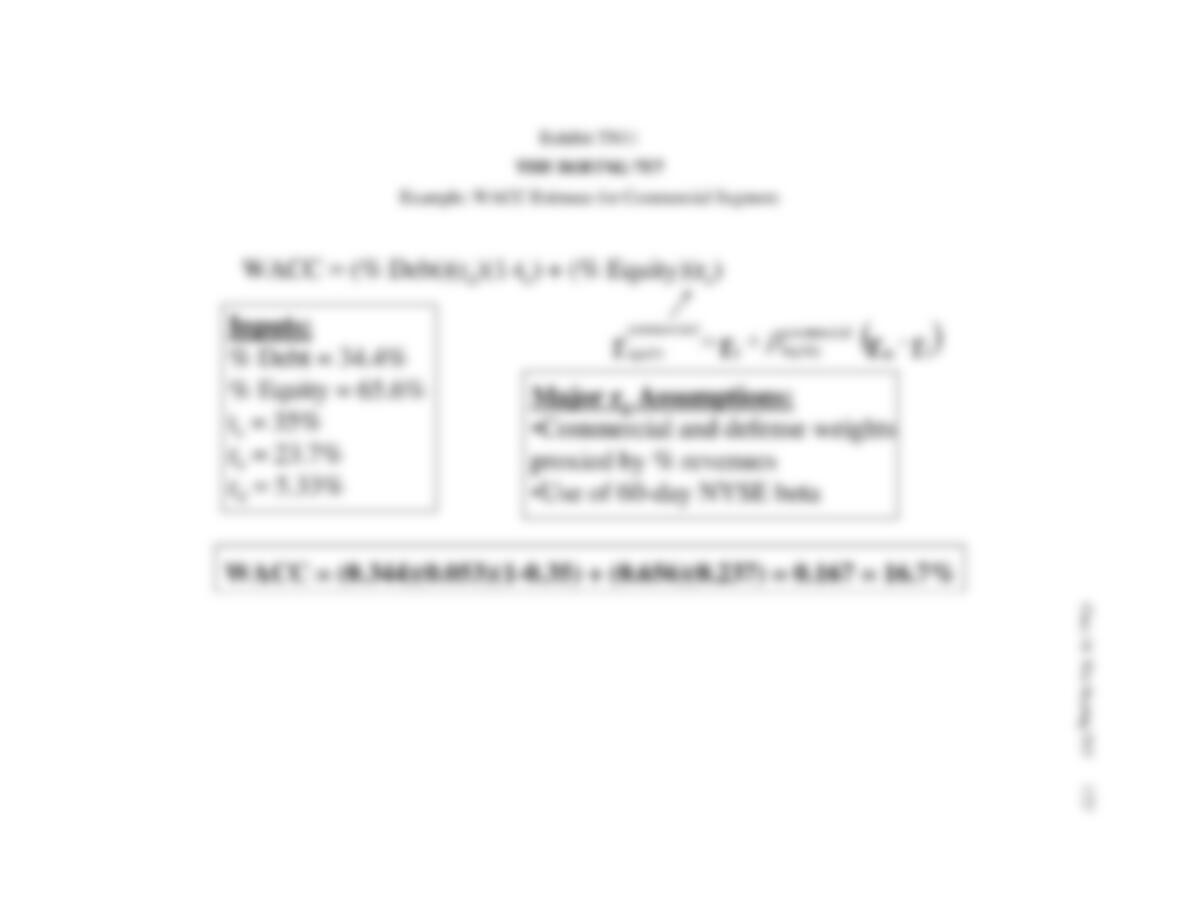
1. WACC = (% debt)(rd)(1 – tc) + (% equity)(re)
where: rd = required rate of return of debt
re = required rate of return on equity (cost of equity)
tc = marginal effective corporate tax rate
% debt = debt divided by sum of debt plus equity, measured at market value
% equity = equity divided by sum of debt plus equity, measured at market
value. Market value of equity is simply share price times number of shares.
Many analysts simply approximate market value of debt with its face or book
value. In most instances, this is not an unreasonable practice: for floating-rate
debt issues (such as bank loans) market value will equal book value; for fixed–
rate issues, book value may be a close substitute for market value, where the

160 Case 16 The Boeing 7E7
Question 5. The weighted-average
cost of capital is a simple formula.
Yet it seems that reasonable people
will disagree about the estimates.
What are the points of contention in
estimating the cost of capital?
Please summarize the issues.
bond was issued at face value, and the credit quality of the issuer and the
general level of interest rates have not changed since date of issue.
2. Calculating the cost of equity (re)
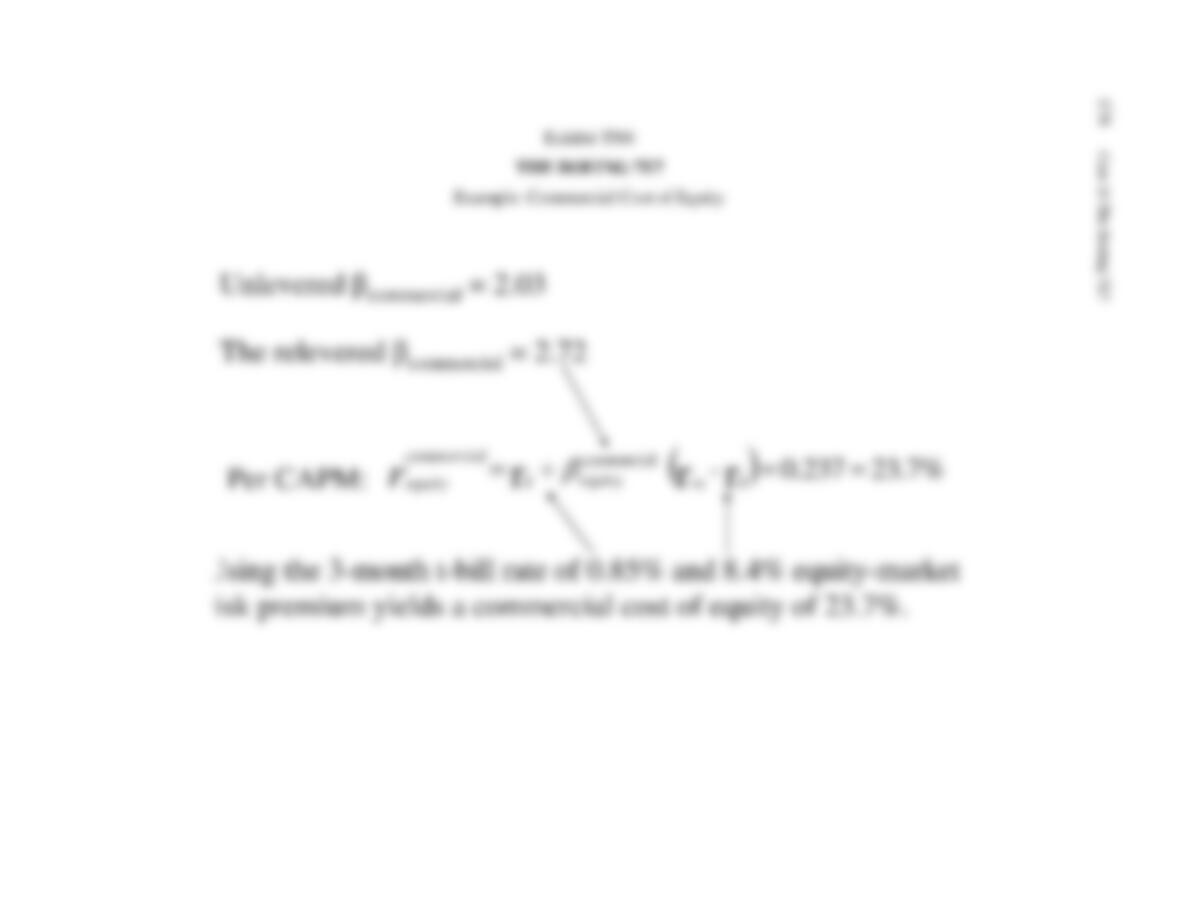
Per the CAPM, re = rf + βe (rm – rf)
Where rf is the risk-free rate, rm – rf is the market-risk premium and βe is the beta of
equity.
One can leave the formulas on the board so that students are
able to see what the class is working toward, as a simple
organizing framework; but this simplicity is deceptive. The
theory says relatively little about the practical application of
those models. Reasoning from first principles, one can make
good headway in estimating the cost of capital. The kinds of
issues that will occupy the student include the following:
Choice of models: Students may wonder why the capital asset pricing model is not used
to estimate the firm’s cost of capital directly. The answer is that it can be used in such a fashion,
but in practice is almost never used for that purpose. A true asset beta is unobservable because
the items on the left-hand side of the balance sheet are ordinarily not traded in liquid markets. In
theory, one could derive a beta for debt and a beta for equity and then weight them according to
the market values of their securities—this should give an estimate for the firm’s asset beta.
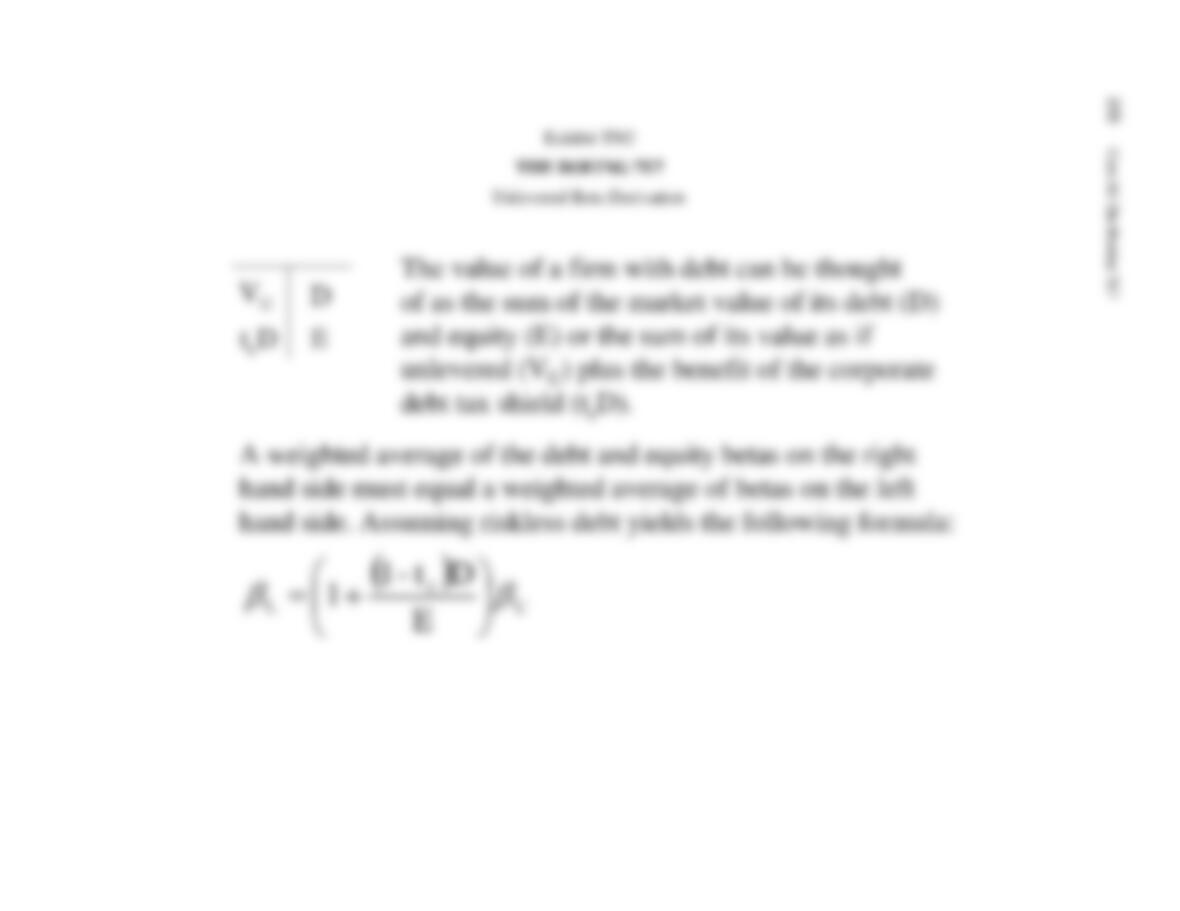
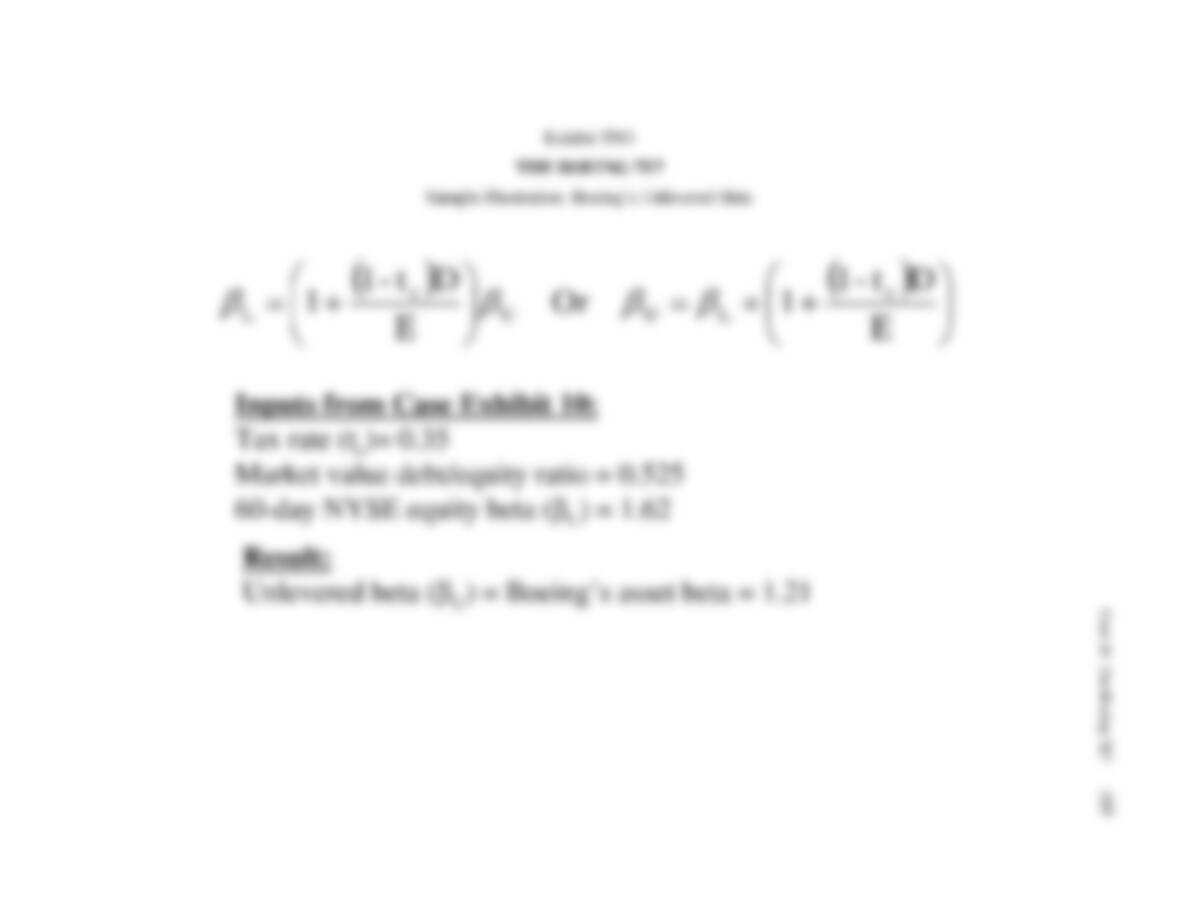
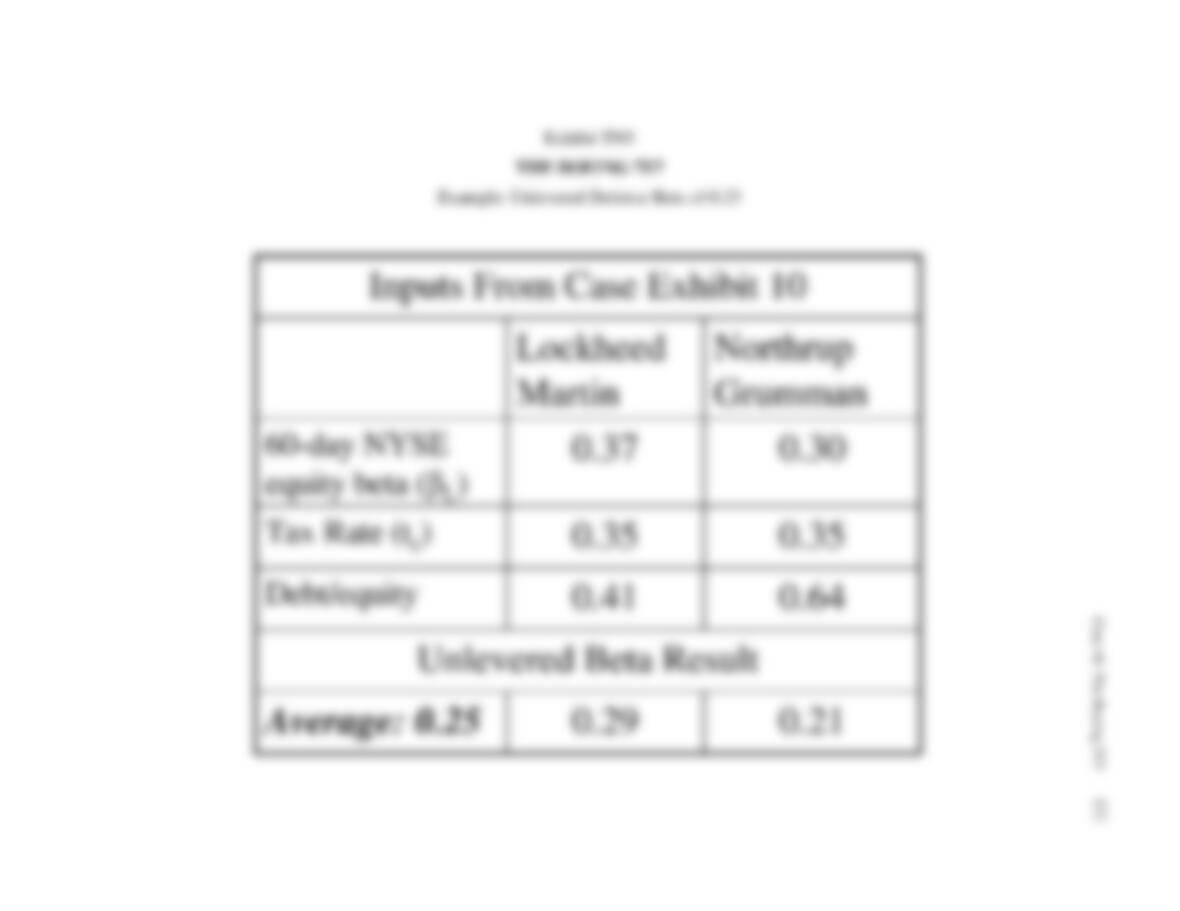
Alternatively, one could unlever the equity beta to get an asset beta. Inserting the asset beta into
the CAPM would, in theory, yield an estimate of the firm’s cost of capital. But these latter two
methods invite estimation error. A survey of “best practice” firms,
3
however, revealed a total
preference for using the WACC formula and for restricting CAPM to estimating the cost of
equity.
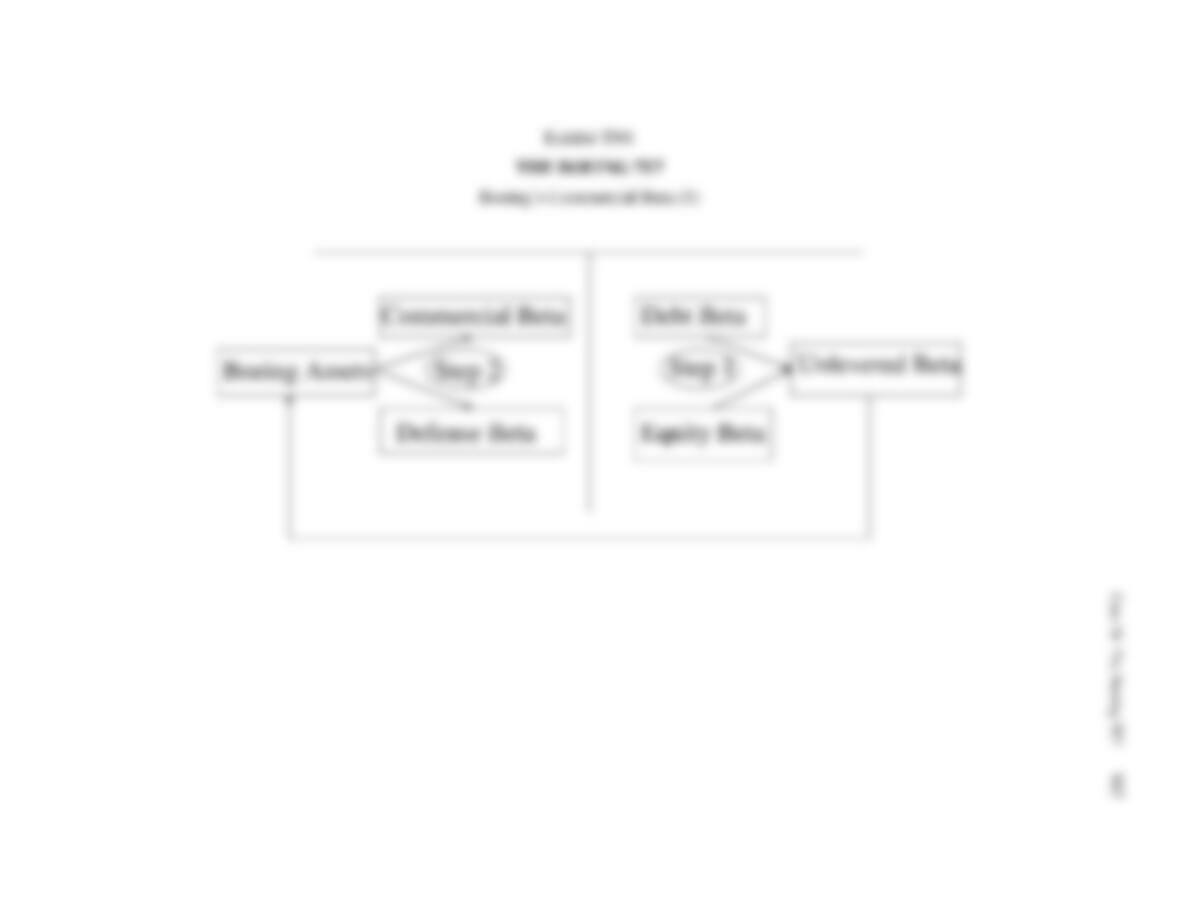
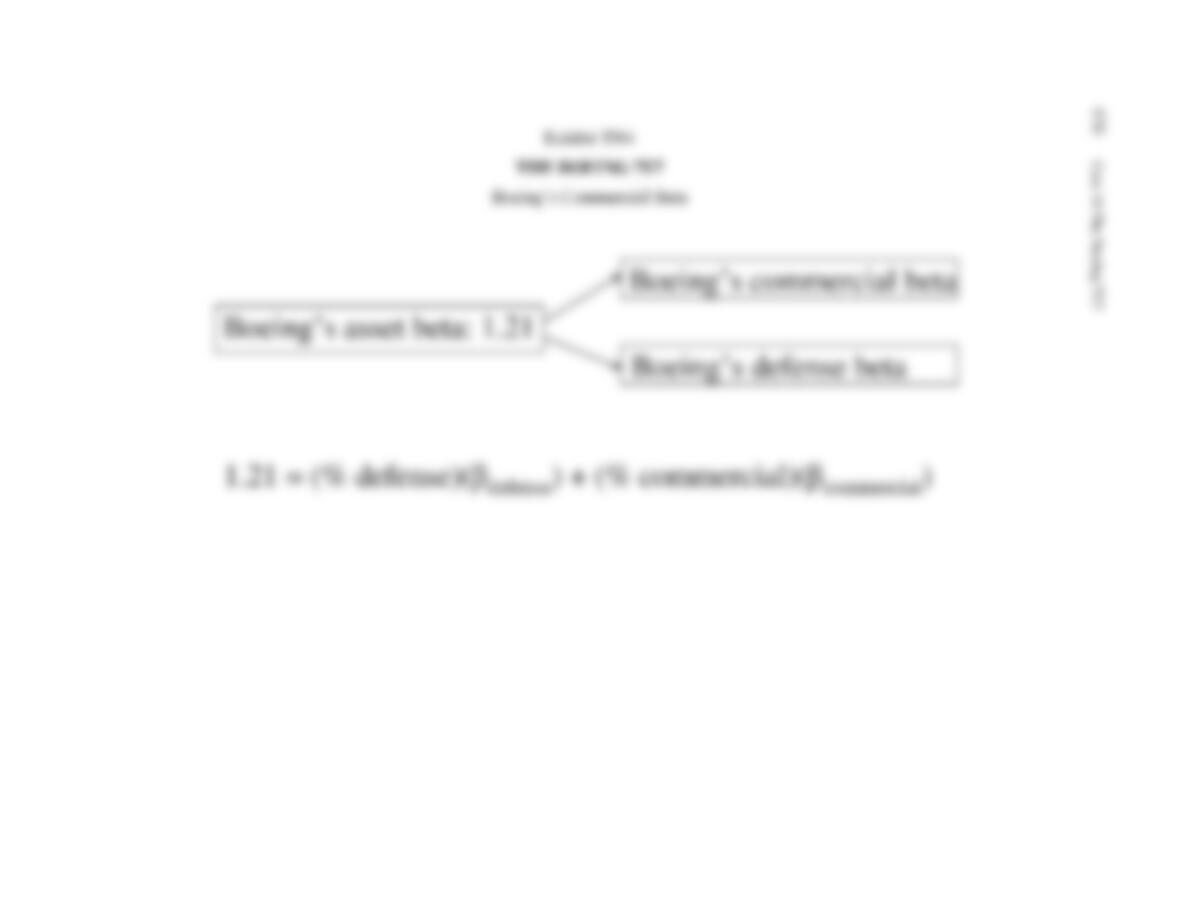
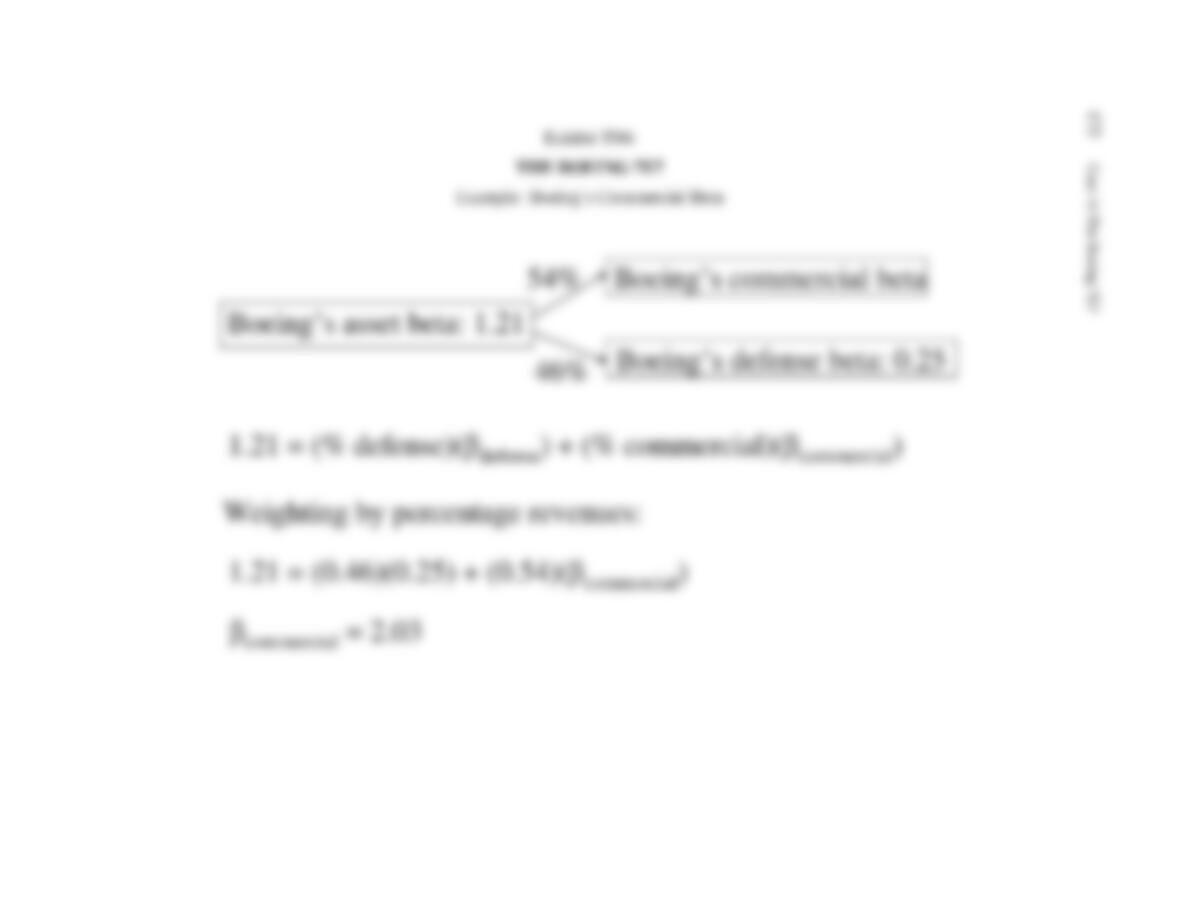
Beta for the 7E7 project: The tendency of novices will be to use Boeing’s equity beta
from case Exhibit 10 as an input to the CAPM. This would be inappropriate since this would
assume that Boeing’s commercial aircraft risk is equal to Boeing’s firm risk. However, Boeing’s
firm risk is a blend of both commercial and defense risk. Somehow, for the cost of capital to be
meaningful we have to back out the commercial risk from the defense risk and use a beta
reflecting commercial risk in the CAPM. The class could discuss whether one would expect a
commercial beta to be higher or lower than a defense beta and why—a strong case could be
made that defense would have a lower beta, reflecting the zero default risk of Boeing’s
government clients and the long cost-plus contracts. It is useful to exercise students’ intuition
about risk.
3
See the study ‘Best Practices’ in “Estimating the Cost of Capital: Survey and Synthesis,” Financial Practice
and Education (Spring/Summer 1998) by Robert F. Bruner, Kenneth M. Eades, Robert S. Harris, and Robert C.
Higgins.

Case 16 The Boeing 7E7 161
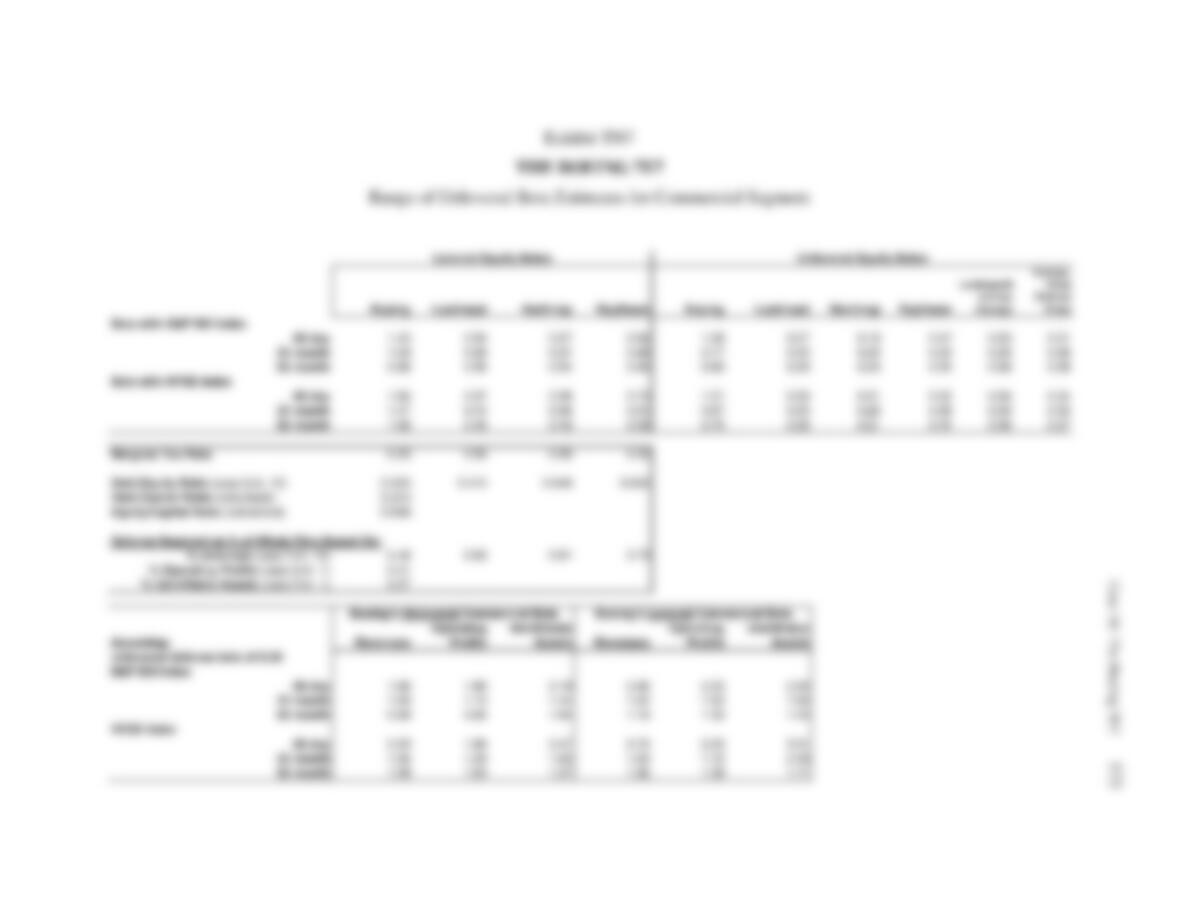
Estimates of beta: Case Exhibit 10 poses two basic choices: first, what to use as a proxy
for the market when regressing equity returns on market returns; and second, over what period of
time the beta should be measured.
Ideally, beta should be derived by regressing Boeing’s equity return against the return on
the basket of global assets (i.e., the market return). Measuring the return on the global asset
portfolio is, as a practical matter, proxied by returns on equity market indexes. In bridging theory
with practice, the greater the value captured by the index, the more closely it matches the theory.
In case Exhibit 10, students have a choice between the New York Stock Exchange (NYSE)
composite index and the S&P 500 index. Of those two, the NYSE is a broader and higher value
index. This provides a beta range between 1.00 and 1.62.
Next, students have to choose whether to estimate beta across the 60-day, 21-month, or 5-
year period. Beta is the market’s instantaneous perception of risk and moves on a second by
second basis just like stock prices. However, since this is unobservable, we are forced to use
historic data to estimate the market’s perception of risk today. The question therefore is what
historic period best reflects the risk of the commercial aircraft industry as perceived by the
market at the time of the decision?
Using a 60-day beta regression includes the trading dates between March 20 and June 16,
2003. This time period includes the Iraq war as well as the peak of the SARS travel warnings.
The 21-month beta runs from September 17, 2001, and therefore includes significantly more
terrorism risk. The 60-month beta dilutes terrorism, war, and SARS risk by going as far back as