Chapter 17
PARTNERSHIP LIQUIDATION
Answers to Questions
1Dissolution of a partnership terminates the partnership as a
legal entity, but the partnership business may continue under a
new agreement. When a partnership is liquidated, however, the
partnership is terminated both as a legal and as a business entity.
Thus, a partnership may be dissolved without liquidation, but it
may not be liquidated without dissolution.
2A simple partnership liquidation is the liquidation of a solvent
partnership in which all partners have equity capital and all
gains and losses are realized and recognized before any
distributions are made to the partners. In simple partnership
liquidations, only one cash distribution is made and the amounts
distributed to individual partners are equal to their
predistribution capital account balances.
3The priority ranking for the distribution of assets in liquidation
pursuant to UPA is
Rank I Amounts owed to creditors other than partners and
amounts owed to partners other than for capital and profits
Rank II Amounts due to partners after all assets have been
liquidated and liabilities paid.
4Normally if a partner has loaned money to the partnership,
those liabilities are repaid before any capital distributions.
However if a partner is owed money and they have a debit
(negative) capital balance, the liability is deducted from the
capital shortfall, rather than be distributed.
5The assumptions for determining distributions to partners prior
to recognition of all gains and losses on liquidation are (1) all
partners are personally bankrupt such that no partner could
contribute personal assets into the partnership and (2) all
noncash assets are possible losses and should be considered
actual losses for purposes of determining amounts to be
distributed. In addition, liquidation expenses and probable loss
contingencies should be estimated and assumed to be actual

losses for purposes of determining advance distributions.
6Capital balances represent one factor in determining a partner’s
equity, but loans and advances payable to and receivable from
the partnership are factors that must also be considered in
calculating safe payments. Partner equities, rather than capital
balances, are used in safe payment schedules in order to avoid
making distributions to partners that may end up with debit
capital balances; i.e., owing money to the partnership.
7Safe payment computations per se do not affect ledger account
balances. Actual cash distributions based on safe payments
computations do reduce partnership assets and equities and
require recognition in ledger accounts.
8A statement of partnership liquidation is a summary of
transactions and balances for a partnership during its liquidation
stage. Such statements provide continuous records of liquidation
events. Interim liquidation statements are particularly helpful in
showing the progress that has been made toward liquidation to
date and in identifying remaining assets to be liquidated and
liabilities to be paid. Interim liquidation statements are helpful to
partners and creditors in providing a basis for current decisions
as well as future planning. Liquidation statements are important
legal documents for partnership liquidations that come under the
jurisdiction of a court.
9Available cash may be distributed to partners according to their
profit and loss sharing ratios only when nonpartner liabilities
have been satisfied and partner equities (capital and loan
balances combined) are aligned with the relative profit and loss
sharing ratios of the partners. In the absence of loans or
advances payable to or receivables from individual partners,
cash can be distributed to partners in their profit and loss sharing
ratios when capital balances are in the relative profit and loss
sharing ratios of the partners and all nonpartner liabilities have
been paid.
10 Vulnerability ranks are an ordering of partners on the basis of
the adequacy of their equities in the partnership to absorb
possible partnership losses. The ordering is typically from the
most vulnerable to the least vulnerable. Vulnerability ranks are
used in the preparation of assumed loss absorption schedules,
which, in turn, are used in the construction of cash distribution
plans.

11 Partnership insolvency occurs when partnership liabilities
exceed partnership assets. In this case, all available cash is
distributed to partnership creditors. Individual partners will be
called upon to use their personal assets to satisfy the remaining
claims of the partnership creditors.
12 Partners with credit capital balances after all partnership
assets have been distributed in liquidation have a claim against
partners with debit capital balances. If the partners with debit
balances are personally solvent, they should pay amounts equal
to their debit balances into the partnership so that partners with
credit balances can receive their partnership claims in full. If
partners with debit capital balances are insolvent, the partners
with credit balances will absorb the losses of the insolvent
partners with debit capital balances in relation to their relative
profit and loss sharing ratios.
SOLUTIONS TO EXERCISES
Solution E17-1
Schedule of Capital Balances
60% Folly 40% Frill
Capital balances January 1, 2011 $40,000 $20,000
January losses: Lumber
($40,000 book value- $25,000 sales
price)
$15,000 (9,000) (6,000)
Receivables
($25,000 – $21,000 collection)
4,000 (2,400) (1,600)
Capital balances before
distribution
$28,600 $12,400
Cash distribution:
Accounts payable $15,000
Folly 28,600
Frill 12,400
Total cash $56,000
Cash balance: Beginning balance, $10,000 +
$25,000 + $21,000 = $56,000
Solution E17-2
Sale of inventory
Cash $10,000
Inventory $10,000
To record sale of inventory items.

Distribution of cash
Accounts payable $ 5,000
Cash $ 5,000
To record payment to creditors.
Mike capital $12,600
Nan capital 6,200
Okey capital 25,200
Cash $44,000
To record distribution of available
cash to partners computed as follows:
Capital Possible Loss from
Balance –Unsold Inventory =Balance
Mike capital $15,000 $2,400 $12,600
Nan capital 8,000 1,800 6,200
Okey capital 27,000 1,800 25,200
Totals $50,000 $6,000 $44,000
Solution E17-3
30% Fred 30% Ethel 40% Lucy
January 1 balances $85,000 $25,000 $90,000
Contingency fund of $10,000 (3,000) (3,000) (4,000)
Possible losses on
asset disposal ($120,000) (36,000) (36,000) (48,000)
46,000 (14,000) 38,000
Loss on Ethel’s possible
defaulta divided 3/7 and 4/7 (6,000) 14,000 (8,000)
Available cash is distributed 40,000 0 30,000
a Notice that Ethel would have a debit balance
in her capital account if the contingencies
occurred and if the assets were a total loss.
In order to determine how much cash is
available for distribution, Fred and Lucy’s
balances must absorb Ethel’s debit balance.
Solution E17-4
Creditors 50% Jan 30% Kim 20% Lee
Beginning balances $60,000 $59,000 $29,000 $52,000
Offset Kim’s loan (20,000)
Loss on sale of assets
($180,000 – $120,000) (30,000) (18,000) (12,000)
Additional liability 5,000 (2,500)(1,500)(1,000)
65,000 26,500 (10,500) 39,000
Distribute Kim’s debit
balance 5/7, 2/7 (7,500)10,500 (3,000)
Cash distribution $65,000 $19,000 0 $36,000
Kim owes $7,500 to Jan and $3,000 to Lee.

Solution E17-5
Schedule to Correct Capital Accounts
Ali Bart Carrie
Capital
(40%)
Capital
(20%)
Capital
(40%)
December 31, 2011
balance
$60,000 $25,000 $65,000
Undervalued inventory ($15,000) 6,000 3,000 6,000
Corrected balances $66,000 $28,000 $71,000
The capital balances are adjusted for the
error in computing net income in the partners’
residual equity ratios.
Solution E17-6
Evers, Freda, and Grace Partnership
Safe Payment Schedule
40% Evers 40% Freda 20% Grace Total
Partner equities $100,000 $250,000 $170,000 $520,000
Loss on sale of assets (52,000)(52,000)(26,000)(130,000)
48,000 198,000 144,000 390,000
Possible lossesa(84,000)(84,000)(42,000)(210,000)a
(36,000) 114,000 102,000 180,000
Allocate Evers’ loss 36,000 (24,000)(12,000)
0 $ 90,000 $ 90,000 $180,000
aRemaining noncash assets of $200,000 plus contingency fund of $10,000 equals $210,000
possible losses.
Cash to distribute: Beginning cash balance of
$100,000 plus $170,000 from sale of assets
less $10,000 contingency fund equals $260,000.
Distribution of cash: Accounts payable $ 80,000
Freda 90,000
Grace 90,000
$260,000
Solution E17-7
Schedule for Phase-out of the Partnership
30% Alice 40% Betty 30% Carle Total
Capital balances $ 20,000 $(120,000 $ 70,000 $(30,000)

)
Creditors’ recovery
from Betty 30,000 30,000
20,000 (90,000) 70,000 0
Partnership recovery
from Betty a 20,000 20,000
20,000 (70,000) 70,000 20,000
Write-off of Betty’s
deficit
(35,000) 70,000 (35,000)
(15,000) 0 35,000 20,000
Partnership recovery
from Alice 10,000 10,000
(5,000) 35,000 30,000
Write-off of Alice’s
deficit
5,000 (5,000)
0 30,000 30,000
Cash distribution to
Carle
(30,000)(30,000)
0 0
a Betty’s personal net assets after partnership
creditor recovery are $80,000 personal assets
– $60,000 personal liabilities = $20,000.
Solution E17-8
Daniel, Eric, and Fred Partnership
Schedule for Phase-out of Partnership
40%
Daniel
30% Eric 30% Fred
Capital Capital Capital Total
Capital balances $10,000 $60,000 $(90,000) $(20,000)
Fred’s payment to
creditors
20,000 20,000
10,000 60,000 (70,000) 0
Fred’s payment to the
Partnership 40,000 40,000
10,000 60,000 (30,000) 40,000
Write-off of Fred’s
deficit in the relative
profit sharing ratio of
Daniel and Eric 4/7:3/7 (17,143)(12,857) 30,000
(7,143) 47,143 0 40,000
Daniel’s payment to the
partnership for his
Deficit 5,000 5,000
(2,143) 47,143 45,000
Write off of Daniel’s
deficit to Eric 2,143 (2,143) 0
0 45,000
Payment to Eric (45,000) (45,000)
0 0
aFred’s personal assets of $100,000 less the $40,000 owed to his personal creditors,
and less the $20,000 paid to partnership creditors, equals $40,000 available for his
debit capital account balance.
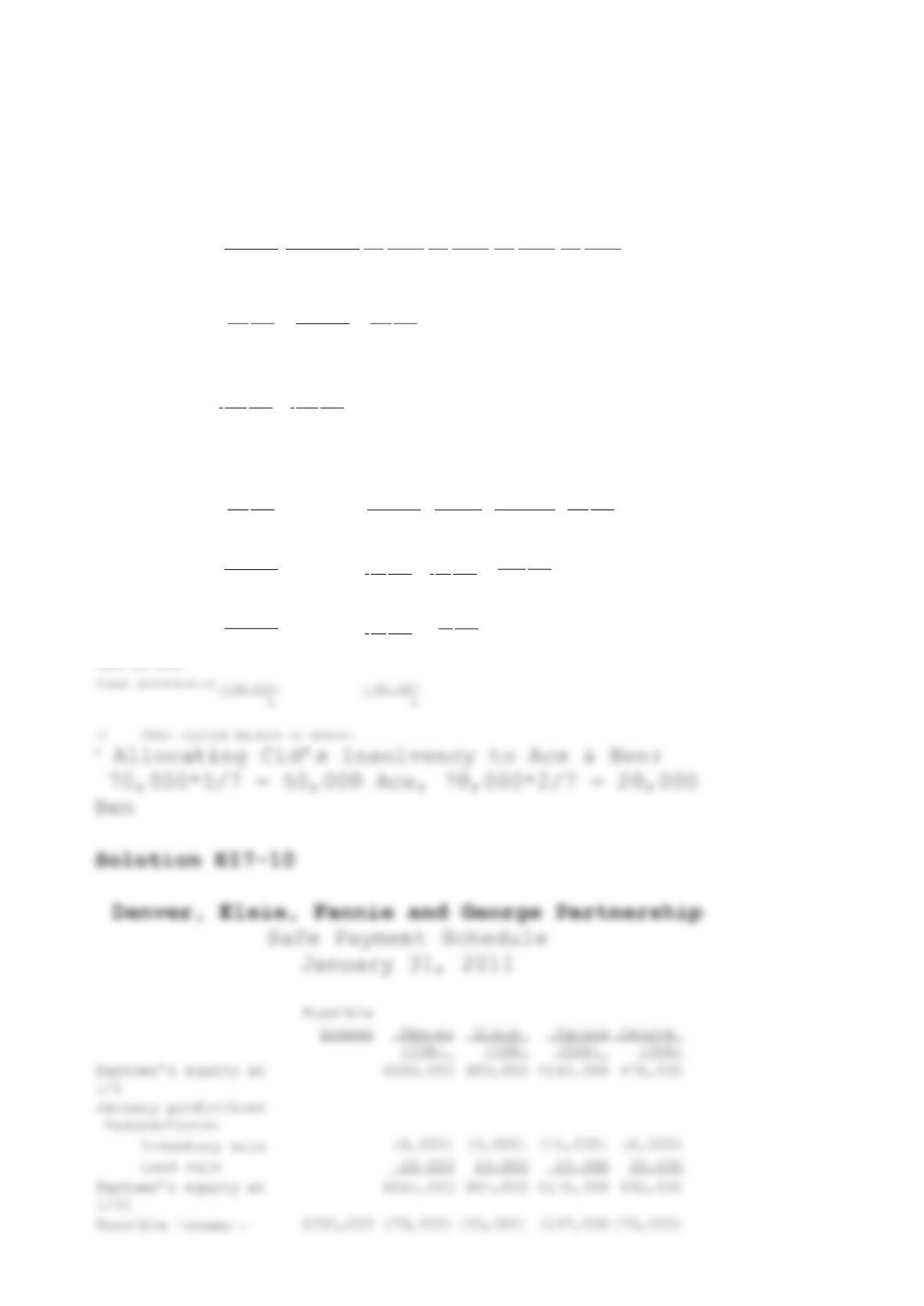
Solution E17-9
Ace, Ben, Cid, and Don
Statement of Partnership Liquidation
for the period June 30 to July 31, 2011
Ace (50%) Ben(20%) Cid (20%) Don (10%)
Cash Liabilities Capital Capital Capital Capital
Balances
June 30, 2011 $200,000 $400,000 $ 40,000 $10,000 $(170,000) $(80,000)
July 1, 2011
Investment of Ace 200,000 200,000
400,000 400,000 240,000 10,000 (170,000) (80,000)
July 1, 2011
Payment of
Liabilities (400,000) (400,000)
Balances
July 1, 2011 0 0 240,000 10,000 (170,000) (80,000)
July 15, 2011
Investment of Cid 100,000 100,000
Investment of Don 80,000 80,000
180,000 240,000 10,000 (70,000) 0
Loss on Cid’s (50,000) (20,000) 70,000
Insolvency a180,000 190,000 (10,000) 0
Loss on Ben’s (10,000) 10,000
Insolvency 180,000 180,000 0