MODULE #2
THERMOREGULATORY MECHANISMS OF ANIMALS
LEARNING
OUTCOMES
After reading this module, the learner should be able to:
1. Define thermoregulation
2. Discuss the body heat management and modes of heat transfer in farm
animals
3. Explain the different physiological responses of animals to thermal
stress
INTRODUCTION
Temperatures not within the thermal comfort of livestock and poultry are among
the most important environmental stressors in animal agriculture. If not given
proper attention, this environmental stressor will negatively affect the
production performance of the animals and consequently incur significant
economic losses in the industry. This module will introduce the basics of
thermoregulation in animals, with emphasis on the physiological responses of
homeothermic animals to heat and cold. This will enlighten the students on the
importance of providing comfortable environment to animals as well as provide
ideas in mapping out mitigation strategies to combat thermal stress in livestock
and poultry.
This learning module is a compilation of notes and information directly obtained from print and online
sources and is only intended for use by MSU–General Santos students taking ANS149 (Environmental
Physiology of Farm Animals).
ABSTRACTION
Thermoregulation
• Most animals that live on land need to regulate their body temperatures
in order to survive and promote the maximum efficiency of their
enzymes.
• The process of managing temperature is called thermoregulation.
• Thermoregulation is defined as the regulation of heat in an animal,
usually keeping it within a specific range.
• Generally, there are two different types of thermoregulators based on
whether their heat primarily comes from an external source or an
internal source: endotherms and ectotherms.
• An endotherm is able to regulate its body temperature via metabolic
processes, these are commonly known warm–blooded animals. These
animals create their own heat (e.g. mammals and birds).
• An ectotherm‘s body temperature is dictated by the environment
surrounding it, the animals are commonly known as cold–blooded.
These animals receive heat primarily from external sources (e.g. reptiles,
amphibians, and fishes).

2
• Moreover, animals can be divided into three categories based on how
they regulate their temperature: poikilotherms, homeotherms and
heterotherms.
• Poikilotherms are animals that do not require a fixed body temperature,
their temperatures can fluctuate with little to no adverse effects to their
overall health. The body temperature of these animals changes
depending on the environmental temperature.
• Fish, amphibians, and reptiles are poikilotherms, as are most
invertebrates. The only mammal known to be poikilothermic is the
naked mole rat.
• Homeotherms are animals that maintain a constant body temperature
across a wide range of environmental conditions. Most mammals and
bird are homeotherms.
• Heterotherms can maintain a constant body temperature, but have
specific periods in which their temperature is different, such as during
hibernation. As mentioned, most mammals are homeotherms, the ones
that are not (except for naked mole rat) are heterotherms such as ground
squirrels and bears.
• The chief benefit for ectotherms is that these animals do not need to
expend too much energy generating their own heat. The downside is
that they are at the mercy of their environmental temperature, and their
cells must be able to function over a wide range of internal temperatures.
• In contrast, endotherms, benefit from staying at a constant optimal
temperature. This allows all of their enzymes can work at full efficiency
all of the time. They are also capable of withstanding extreme
temperatures for a short time without a serious detrimental effect.
Unfortunately, though, they need to spend a great deal of energy on
temperature regulation.
Body Heat Management and Modes of Heat Transfer in Animals
• When it comes to regulating body temperature, animals typically have
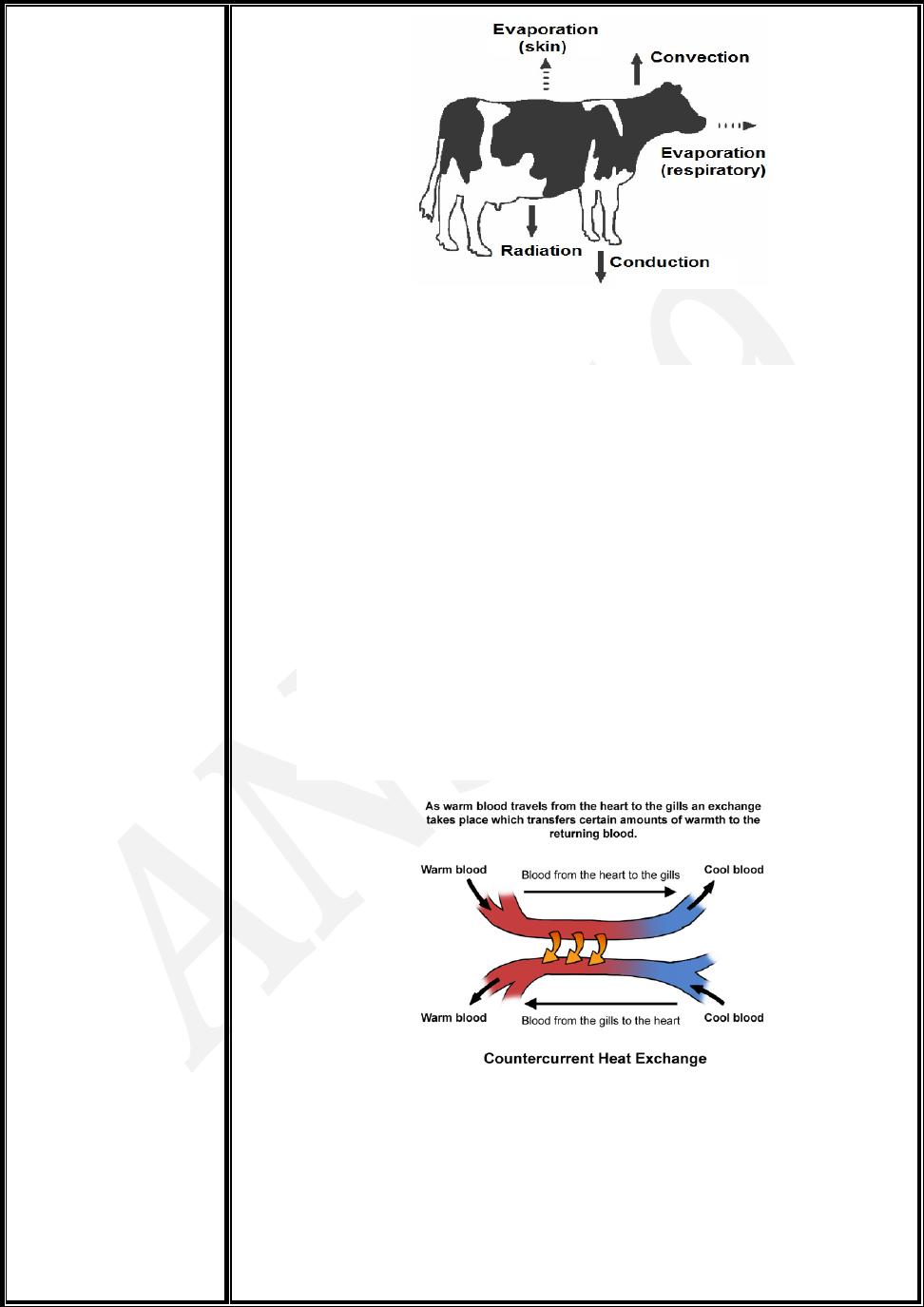
four methods: radiation, conduction, convection, and evaporation (Figure
1).
• Radiation is heat gain or heat loss via radiation waves entering or leaving
the body, particularly infrared waves.
• Conduction is the gain or loss of heat through direct contact with an
object, for example, if a hot animal comes into contact with a cold rock,
the rock will get warmer while the animal gets colder.
• Convection is heat gain or loss by moving air or water of a different
temperature over the animal.
• Evaporation is heat loss caused by the endothermic reaction of water
evaporating off of an organism; this is the only process that can only
cool.
3
Figure 1. Different modes of heat transfer in cattle
Ectotherms
• Since ectotherms don’t produce their own heat, they have to regulate
their temperature in other ways.
• The circulatory system plays a big role in temperature regulation.
• The blood gets everywhere in the body, so if the blood is nice and
warm, it will keep the cells comfortable. For this reason, ectotherms
have their blood vessels close to the skin for quick heat exchange,
and they usually do not have hair or feathers.
• Most heat exchange occurs in the extremities, such as its feet or tail.
• When it’s cold, they can restrict blood flow to those regions and
concentrate on keeping the vital organs warm.
• If the body is too warm, sending the blood to the peripheries can let
off some steam.
• Fish can conserve heat using something called a counter–current
heat exchanger.
Figure 2. The countercurrent heat exchange setup of blood vessels
in fish.
• The blood circulates past the gills for gas exchange, which also
implies that blood gets closer to the cold water.
• To retain heat, the blood vessel going to the gills run parallel and
opposite to vessels returning from the gills. Warm blood goes
towards the gills and passes cool blood that is heading for the body

4
(Figure 2). The heat from the warm blood transfers to the cool blood
and the fish is left with lukewarm blood.
• Another way for ectotherms to regulate their temperature is by just
changing their behavior. If a lizard is cold, it just hangs out on a
sunny rock. If it is too warm, it can move over to the shady rock.
• There are many other examples of ectotherms adapting their
behavior to conserve, receive, or lose heat. Fish dive to cooler waters
when they get too warm. Snakes dive into holes on hot days.
Butterflies and other insects sun their wings to warm up their flying
muscles.
• Ectotherms are capable of surviving at a range of temperatures, but
quick temperature changes can be deadly. When their internal
temperature drops, some enzymes become less effective and their
metabolism decreases. Lower metabolism means less energy, and
less energy means less movement.
Endotherms
• Endotherms can exhibit many of the behavioral changes for
temperature regulation as ectotherms.
• Pigs, for example, are notorious for soaking in a pile of cool mud on
a hot day.
• Endotherms can generate own heat through metabolism. For this
reason, endotherms need to consume more food than ectotherms,
and the metabolic rate for an endotherm is a lot faster than a similarly
sized ectoderm.
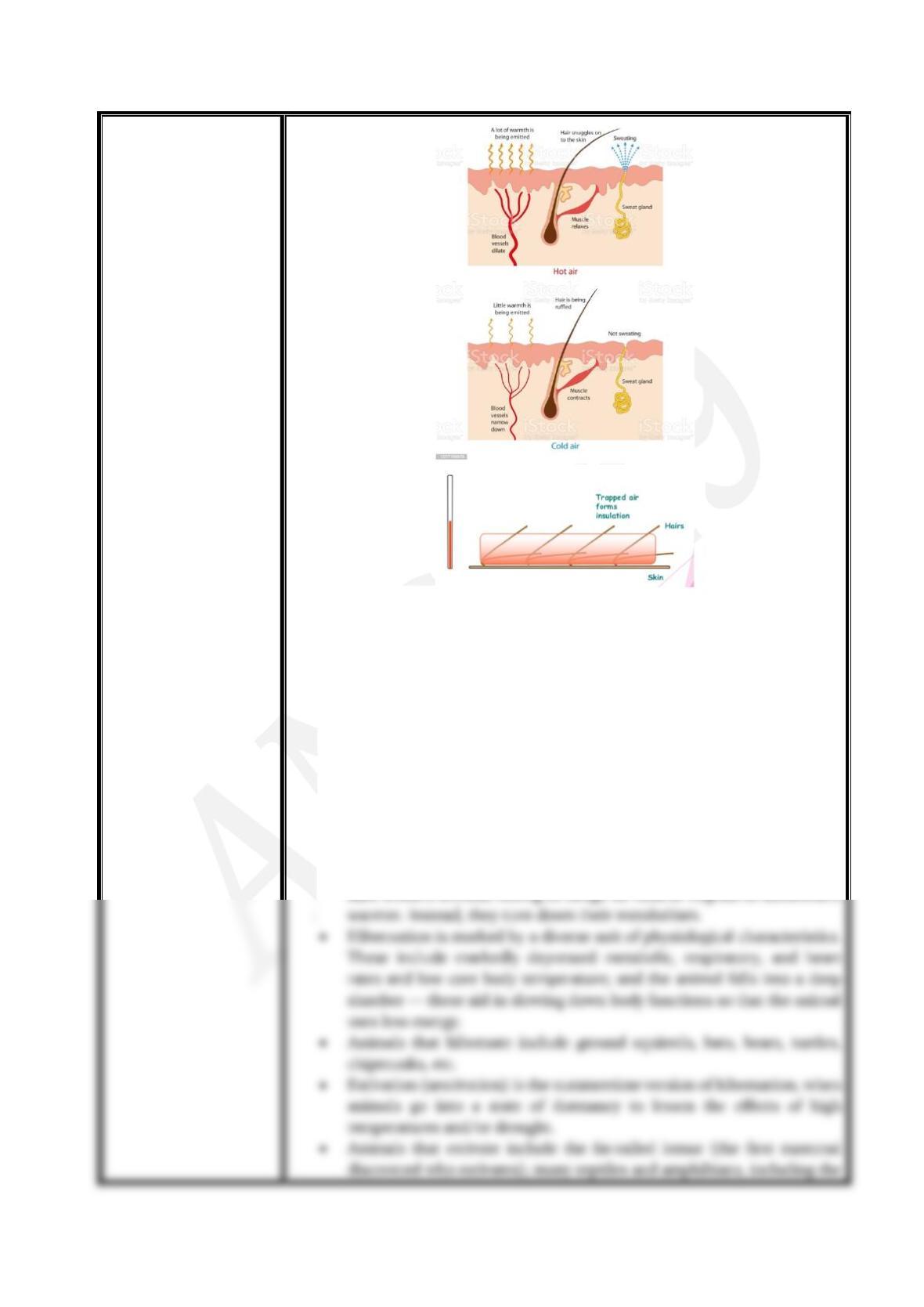
• Endotherms use blood vessel constriction or dilation to regulate their
temperature. Since endotherms spend all this energy creating heat
from within, these animals are keen on conserving it.
• One reason endotherms have hair and feathers is for them to keep
the body heat in and the environmental heat out.
• Instead of hair, marine mammals have a layer of blubber that keeps
them snug in frigid ocean water.
• Polar bears and other arctic species have several layers of fur to keep
the harsh winds off of their skin. They also can contract the hair
follicles to make the hair stand on end – piloerection – most mammals
can do it.
• Piloerection can be used to make an animal look bigger, but it has a
temperature regulation function too.
• Fluffing up fur or feathers allows warm air to become trapped close
to the skin.
5
Figure 3. Skin thermoregulatory mechanisms
• Shivering is another way in which body heat is generated. It is caused by
tiny muscle contractions, and those contractions create heat.
• When too hot, many mammals use evaporation to release heat from the
body. Sweat glands release liquid that gets evaporated from the skin,
taking heat with it.
• Panting is another evaporation trick. Dogs and other animals pant and
the saliva gets evaporated.
• Some animals can sustain periods of lowered body temperature. In the
winter, this is called hibernation, whereas in the summer, it
is estivation / aestivation.
• Hibernation (winter sleep) is a way for some animals to survive cold,