1
Economics 101
Fall 2010
Homework #5
Due: 12/14/2010 in lecture
Directions: The homework will be collected in a box before the lecture. Please place your name,
TA name and section number on top of the homework (legibly). Make sure you write your name
as it appears on your ID so that you can receive the correct grade. Please remember the section
number for the section you are registered, because you will need that number when you submit
exams and homework. Late homework will not be accepted so make plans ahead of time. Please
show your work. Good luck!
1. Perfect competition
A local microbrewery has total costs of production given by the equation TC=500+10q+5q2. This
implies that the firm’s marginal cost is given by the equation MC=10+10q (you do not need to be able
to show this). The market demand for beer is given by the equation QD=105 – (1/2)*P.
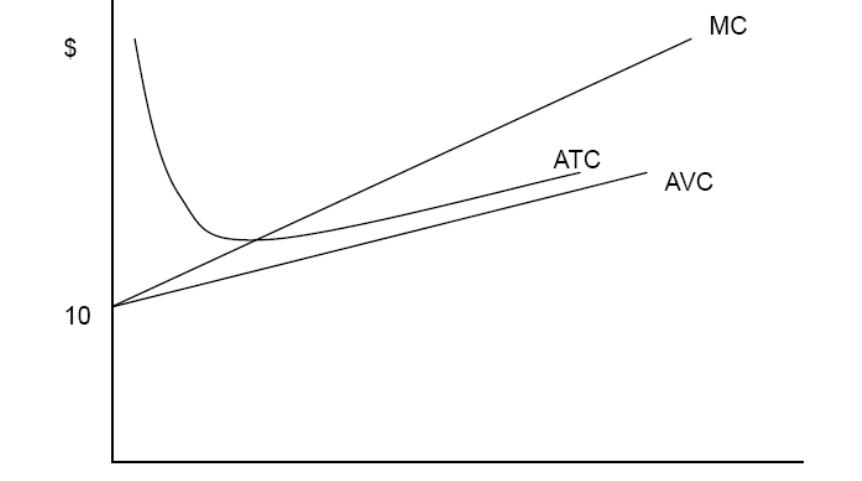
a) Write the equations showing the brewery’s average total cost and average variable cost and average
fixed cost, each as a function of q. Show the firm‘s MC, ATC and AVC on one graph.
ATC = TC/q = (500+10q+5q2)/q = 500/q+10+5q
AVC = VC/q = (10q+5q2)/q = 10+5q
AFC = FC/q = 500/q
b) What is the breakeven price and breakeven quantity for this firm in the short run?
Note that MC crosses ATC at its minimum. Hence, MC = ATC at that level of output that corresponds
to the intersection of the ATC and MC curves.
2
MC = 10 +10q = 500/q + 10 + 5q = ATC
5Q = 500/q
5q2 = 500
q2 = 100
q = 10
Then P = MC = ATC = 10 + 10q = 110
c) What is the shutdown price and shutdown quantity for this firm in the short run?
From the picture above, it is clear that AVC is minimized at q = 0.
P = MC = AVC = 10+5(0) = 10
Short-run Equilibrium
d) If the market price of the output is $50, how many units will this firm produce?
The firm will set MC=P=50. Thus, 10 + 10q = 50, hence q* = 4.
e) Given a market price of $50, how many firms are in this market?
Plug P = 50 in the market demand curve. Thus, we get QD = 105 – (1/2)50 = 80
Thus, the number of firms in the short run is equal to: N = 80/4 =20 firms.
Long-run Equilibrium
f) Assuming the beer industry is perfectly competitive, what output would be produced by the firm in
long-run equilibrium? What would be the long-run equilibrium price?
In long run equilibrium, there must be zero profits. Therefore, rewriting the profit function,
= TR – TC = P*q – ATC*q = (P – ATC) *q
We can see that zero profit requires that P = ATC. Since in perfect competition it is always the case
that P = MC for a profit maximizing firm, we need to find the price at which MC = ATC. Note that
this is the breakeven price and breakeven quantity for the firm found in part (b).
Long run equilibrium quantity for the firm: q = 10
Long run equilibrium price: P = 110
g) How many firms will be in the industry in long-run equilibrium?
We already know that the long run equilibrium price must be 110. From this information and the
demand curve we can find the quantity demanded in this market in the long run.
QD=105-(1/4)*P = 105 – (1/2)*110 = 50
In equilibrium, the market demand must equal the market supply. Thus, the number of firms:
N = QD/q = 50/10 = 5 firms
2. Monopoly
Suppose Charter Communications is a monopolist in providing cable television services to local
consumers in Madison. The market demand curve faced by Charter Communications is P = -Q + 30,
and Charter’s cost is given by TC=Q2/2 + 20, and Charter Communication’s marginal cost is given by
MC=Q.
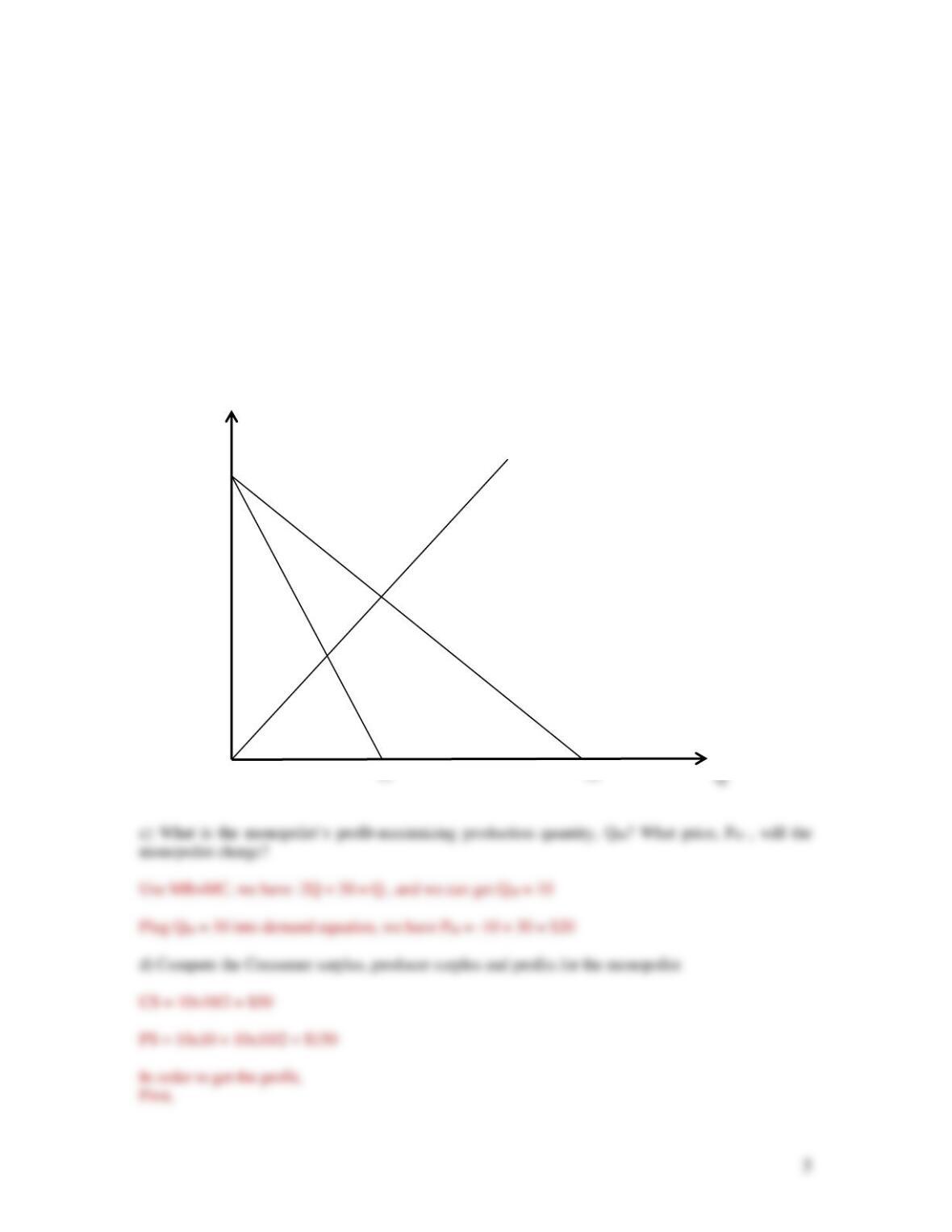
a) What is the equation for Marginal Revenue for this monopolist?
MR = -2Q + 30
b) Draw the Demand curve, Marginal Revenue curve, and Marginal Cost curve for this monopolist in
a graph.
30
30
$
MR
D
MC