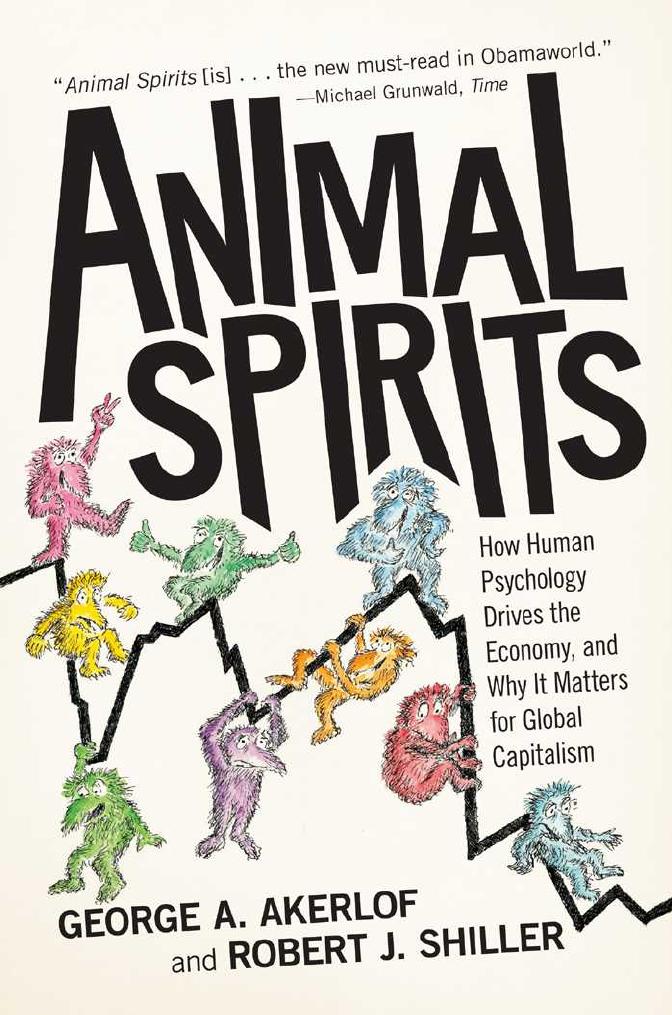
Animal Spirits
Akerlof.front 10/30/09 2:13 PM Page i
Akerlof.front 10/30/09 2:13 PM Page ii
Princeton University Press •PRINCETON AND OXFORD
Animal Spirits
HOW HUMAN PSYCHOLOGY DRIVES
THE ECONOMY
,AND WHY IT MATTERS
FOR GLOBAL CAPITALISM
With a new preface by the authors
GEORGE A. AKERLOF
AND
ROBERT J. SHILLER
Akerlof.front 10/30/09 2:13 PM Page iii
George Akerlof is the Daniel E. Koshland Sr. Distinguished Professor of Economics
at the University of California at Berkeley; co-director of the Program on Social In-
teractions, Identity and Well-Being of the Canadian Institute for Advanced Re-
search; and a member of the board of directors of the National Bureau of Economic
Research. Robert Shiller is the Arthur M. Okun Professor of Economics at the Cowles
Foundation for Research in Economics and Professor of Finance at the International
Center for Finance, Yale University; research associate at the National Bureau of
Economic Research; and co-founder and principal of two U.S. firms that are in the
business of issuing securities: MacroMarkets LLC and Macro Financial LLC. The
views expressed herein are solely those of the authors and do not necessarily reflect
the views of these institutions.
Copyright © 2009 Princeton University Press
Requests for permission to reproduce material from this work
should be sent to Permissions, Princeton University Press
Published by Princeton University Press, 41 William Street, Princeton,
New Jersey 08540
In the United Kingdom: Princeton University Press, 6Oxford Street,
Woodstock, Oxfordshire OX20 1TW
press.princeton.edu
All Rights Reserved
Ninth printing, and first paperback printing, with a new preface
by the authors, 2010
Paperback ISBN: 978-0-691-14592-1
The Library of Congress has cataloged the cloth edition of this book as follows
Akerlof, George A., 1940–
Animal spirits : how human psychology drives the economy, and why
it matters for global capitalism / George A. Akerlof and Robert J. Shiller.
p. cm.
ISBN 978-0-691-14233-3 (hardcover : alk. paper)
1. Economics—Psychological aspects. 2. Finance—Psychological aspects.
3. Capitalism. 4. Globalization. I. Shiller, Robert J. II. Title.
HB74.P8A494 2009
330.12′2019—dc22 2008052649
British Library Cataloging-in-Publication Data is available
This book has been composed in Adobe Galliard and Formata
by Princeton Editorial Associates, Inc., Scottsdale, Arizona
Printed on acid-free paper. ∞
Printed in the United States of America
10 9
Akerlof.front 10/30/09 2:13 PM Page iv

Contents
Preface to the Paperback Edition vii
Preface xxi
Acknowledgments xxvii
introduction 1
Part One: Animal Spirits
one Confidence and Its Multipliers 11
two Fairness 19
three Corruption and Bad Faith 26
four Money Illusion 41
five Stories 51
Part Two: Eight Questions and Their Answers
six Why Do Economies Fall into Depression? 59
seven Why Do Central Bankers Have Power over the
Economy (Insofar as They Do)? 74
postscript to chapter seven The Current Financial Crisis:
What Is to Be Done? 86
eight Why Are There People Who Cannot Find a Job? 97
nine Why Is There a Trade-off between Inflation and
Unemployment in the Long Run? 107
ten Why Is Saving for the Future So Arbitrary? 116
eleven Why Are Financial Prices and Corporate
Investments So Volatile? 131
twelve Why Do Real Estate Markets Go through Cycles? 149
thirteen Why Is There Special Poverty among Minorities? 157
fourteen Conclusion 167
Notes 177
References 199
Index 219
v
Akerlof.front 11/2/09 9:08 AM Page v
Akerlof.front 10/30/09 2:13 PM Page vi
This page intentionally left blank

Preface to the Paperback Edition
The worldwide recession that was raging just as the hardcover edition of
this book was published in February 2009 seems to many observers, as of
this writing in October 2009, to be coming to an abrupt end. There are
definite signs of improvement. These observers could be right. Maybe
this is just another recession that will eventually be forgotten among the
annals of business-cycle history. But the theory that we lay out in this
book gives us cause to worry that we may be in a sick economy over much
of the world for years to come. Even the stirring success stories of the past
decade or so in the developing world, notably China and India, may see
their economic growth reduced to a disappointing level.
We think this because we have an unusual view of the economy, a
view that animal spirits, as we define them in the Introduction, drive al-
most everything. Animal spirits are more than just confidence as meas-
ured by confidence indicators. We argue that declining animal spirits are
the principal reason for the recent severe economic crisis. And, despite
the recent positive economic indicators, we see no clear indication that
these spirits are yet revived.
The news media are singularly lacking in any explanation for the re-
cent resurgence of the world economy beyond the improvement in
leading indicators, such as stock market prices and retail sales numbers.
The reasons the leading indicators have improved remain mysterious.
The stimulus packages put in place by most countries do not seem to
have been big enough to be held responsible. By many popular ac-
counts, the nascent recovery merely reflects a new willingness to spend
all over the world, as if that is a primordial force of the economy that
defies any further analysis.
There seems, to a reader of these accounts, to be an unseen force
propelling the economy, driving it into its periodic booms and busts.
But this perception is nothing new. In his 1873 book Lombard Street,
Walter Bagehot said that it seems that in an economic recovery busi-
ness “leaps forward as if by magic”:
Most people who begin to think of the subject are puzzled. . . . Why
should there be any great tides of industry, with large diffused profit
by way of flow, and large diffused want of profit by way of ebb? The
vii
Akerlof.front 10/30/09 2:14 PM Page vii
main answer is hardly given distinctly in our common books of polit-
ical economy. These books do not tell you what is the fund out of
which large general profits are paid in good times, nor do they explain
why that fund is not available for the same purpose in bad times.1
Indeed, people are still puzzled today, in late 2009, by the sudden
improvement in our world economy. Textbooks of economics, while
vastly improved since Bagehot’s day, still do not give much enlighten-
ment about the ultimate drivers of the economy. They do not do so be-
cause the understanding of the drivers must lie somewhat outside the
traditional boundaries of economic research, in the realm of psychol-
ogy (as even Bagehot suggested), which is an intellectual tradition alien
to most economists. Macroeconomists have found it difficult to for-
malize the concept of animal spirits on their own terms, and so they
have largely neglected it.
The recovery we have been seeing of late certainly defies the analy-
sis of many economists who build structural econometric models and
see the sudden recovery as the result of “error terms” or “residuals” or
“innovations” in their equations. It defies the analysis of those econo-
mists of the “real business cycle” persuasion, who are in the habit of
thinking that all economic fluctuations are ultimately driven by exoge-
nous changes in “technology” and “productivity,” but cannot point to
a description of the cause of such a change right now. And of course, it
defies those who build purely statistical time-series models that quan-
tify past patterns in the data and calculate an optimal extrapolation of
recent wiggles in the same data.
Not only are we puzzled by the sudden turn toward recovery, we also
do not clearly see the longer-term threat to the economy. The longer–
term problem today remains that, after a terrible financial crash, the
coherence of our animal spirits and our economic institutions is shat-
tered. Humpty Dumpty is broken and cannot be put back together
again. We need a new egg. We have to reinvent our capitalist economy,
reestablish a genuine creative business spirit in people’s minds, and sup-
port their attitudes via institutions that really work and satisfy their def-
inition of justice. Instead, today we have, in their eyes, institutions “too
big to fail,” which are on life support from the government and our cen-
tral banks, operating as money-printing machines, and a general feeling
that business is corrupt and that the government support these institu-
tions receive has been arranged by evil lobbyists. We are facing the same
preface to the paperback edition
viii
Akerlof.front 10/30/09 2:14 PM Page viii
problem today that we faced in the later years of the Great Depression
(described in Chapter 6)—business today is inhibited by uncertainty
about the future, about the tolerance of an angry public, about a dis-
affected labor force, and about what further government actions may be
coming.
The basic theme of this book is that animal spirits are the force that
drives all of this, and that to understand animal spirits we have to use
methodologies outside of traditional economics, leading us to other
social sciences.
We identified five psychological factors, in Chapters 1through 5of
this book, that we thought were of particular importance. They are
confidence, fairness, corruption and bad faith, money illusion, and sto-
ries. Changes related to all of these factors are the ultimate reason for
the boom that preceded the world economic crisis, for the crisis and re-
cession in which we have been immersed, and for the apparent begin-
nings of recovery. These phenomena cannot be understood in terms of
traditional economic theory alone.
The last item, stories, bears closer scrutiny. We argue in Chapter 5
that human-interest stories that give vitality and emotional resonance
to economic views drive animal spirits. Since economic expansions and
contractions in the modern world tend often to be worldwide phe-
nomena, these are not stories confined to any one country. The stories
spread amidst a growing world culture, from country to country, since
the same salience that works for a certain kind of story in one country
will generally work in another country as well. The names and places
change, but the stories are similar.
For example, the U.S. television show The Apprentice, which first
aired in 2004, near the height of the boom, features a real-world busi-
ness tycoon who leads a competition among promising young would-
be tycoons. The tycoon is a tough man who shouts belligerently “You’re
fired” at the losers, but who, in his own harsh and distant but ethical
way, serves as a mentor to help them all. The story shows the challenges
of a go-go business world, but it also affirms the quality of the people
who inhabit it and of young people’s ambitions to make it big there,
if they can just take the heat. The U.S. version features the American
real estate magnate Donald Trump, a colorful figure who was already
famous even before The Apprentice ever aired.
This story spread rapidly all over the world through local remakes
during a time of economic expansion. The only thing that producers
preface to the paperback edition
ix
Akerlof.front 10/30/09 2:14 PM Page ix
needed to do to facilitate this spread was to substitute some locally fa-
mous tycoon or personality for Trump, to maximize the potential for
word of mouth and gossip in each local culture. In the United King-
dom, there came a version featuring British billionaire Alan Sugar and
an analogous program called The Rebel Billionaire with Richard Bran-
son. In Germany they substituted Reiner Calmund and called their
version Big Boss. In the Brazilian version, he was replaced by Roberto
Justus. In Colombia it was Jean-Claude Bessudo. The Turkish version
aired with Tuncay Özilhan. In Russia it was Arkadi Novikov. In Finland
it was Jari Sarasvuo. In Denmark, Klaus Riskaer Pedersen. In Norway,
Inger Ellen Nicolaisen. In Switzerland, Jürg Marquard. In India, Cyrus
Sahukar. In South Africa, Tokyo Sexwale. In Dubai, Mohamed Ali
Allabar. And in Indonesia, Peter Gontha.
With such contagion around the world, during the boom, of such a
motivational television story, is there any reason to doubt that conta-
gion of stories has economic significance, or that there could be world-
wide fluctuations in animal spirits? What kind of new story will gain
currency as we now go through the denouement of the financial crisis?
During the boom it was stories of people who were business and fi-
nancial geniuses that had us most inspired, promoting overconfidence.
After the bust, in 2008, it was stories about venerable financial institu-
tions on the verge of collapse, of shady characters drawing huge salaries
and bonuses at the expense of all of us. After the first signs of recovery,
in 2009, partly due to governments’ bailout and stimulus efforts, there
was a relative dearth of collapse stories. But, so far, we have not seen a
return of the confident stories, and sense of trust and opportunity in
business dealings, that we saw during the boom. Reestablishing these
stories is essential if we are to recover well from the severe economic
contraction, whatever those leading indicators may imply. If the econ-
omy is to grow from here, we must see the story evolving in positive
directions for economic cooperation and innovation.
The stories people tell are also stories about how the economy be-
haves. Indeed, it is in this last category, stories, where Animal Spirits
itself fits in, because the goal of the book is to give its own story about
how the economy behaves.
Its intent is to tell a more accurate story than the dominant one of
the past thirty years or so, ever since the free market revolution that
swept the world, under the leadership of Margaret Thatcher, Ronald
Reagan, Deng Xiaoping, Manmohan Singh, Mikhail Gorbachev, Brian
preface to the paperback edition
x
Akerlof.front 10/30/09 2:14 PM Page x
Mulroney, Bertie Ahern, Carlos Salinas de Gotari, Fernando Henrique
Cardoso, Carlos Menem, and others. These stories, embellished by oft-
told vignettes of newly successful people, and in their mostly justi-
fied enthusiasm for expanded free markets, led to too much economic
tolerance.
Underlying this revolution is the powerful principle of the “invisible
hand”—that market forces should be the fundamental framework of
resource allocation. Recognition of this principle has produced the surge
of economic growth that has defined our age. And yet, today, with the
recent economic crisis, unregulated free markets are being questioned.
We believe that the unvarnished invisible hand story, although right in
a fundamental way, is wrong at the level of detail and approximation that
is necessary to explain what we need to know about macroeconomies.
The old story about capitalism is correct: it gives us what we think
we want. But capitalism does not act as its own policeman if we fail to
watch over it and give it proper directions. It actively, competitively,
seeks the most profit-maximizing opportunities. Capitalism will follow
such opportunities wherever they lead us.
That, of course, is relevant for the recent world financial crisis. The re-
cession, deep as it has been, has been a tragedy for people around the
world. They have been losing their jobs, their houses, and their dreams.
But recessions do have at least one silver lining: the cut they take into
economic life reveals how capitalist societies really work. To give one ex-
ample, Keynes’ General Theory, written in the heart of the Great De-
pression, gave us for the first time an understanding of how macro-
economies really behave. That is why it was so inspiring, prompting Paul
Samuelson to say, in 1946, that the Keynesian revolution, which appeared
during the Great Depression, has infected the thinking of virtually every
economist. But as the memory of the Great Depression has faded, so too
has an appreciation and understanding of Keynesian theory.
For the past year we have been seeing a great deal of excellent re-
portage on how we got into the current mess. Economists and Wall
Street financiers invented new ways to carve up debt obligations, such
as mortgages. They would not only “securitize” the mortgages and pass
them on, but they would securitize them into different “tranches.” De-
pending on the level of risk that people wanted to assume, tranches
could be divided into senior, mezzanine, or junior. These could then be
sold off, and different people would own different parts of the payments
from the different mortgages. Gillian Tett, author of the 2009 book
preface to the paperback edition
xi
Akerlof.front 10/30/09 2:14 PM Page xi
Fool’s Gold, describes how initially this was an innocuous innovation
designed as an end run around the Basel capital requirements. Since tak-
ing on such mortgage debts seemed all but totally safe, the capital re-
quirement for holding them was very small. There was only one ques-
tion: who was going to hold the super-senior tranche, the remaining
fraction? This tranche, it was thought, would always pay at par, so it
would not have to pay much added interest.
Indeed, this is the same question that faces businesspeople in all
walks of life. Demolitionists, for example, who take down buildings to
make way for newer ones, are an important element of our economy,
and they illustrate well the shortcomings of unregulated capitalism.
Money can be made in demolition if one just demolishes the building
and sells off the scrap. But if one has to take care of the asbestos and
other environmental issues, by legal means, well, then it becomes diffi-
cult. So there is a powerful incentive for demolitionists to do some-
thing antisocial and illegally dump the asbestos, and a tendency all over
the world for demolitionists to be crooked. Honest ones generally can-
not survive, unless there are regulators watching the industry very
closely. Unfortunately, finance bears a resemblance to demolition in
this respect. In the early stages of the current financial crisis, financial
companies were able to insure the super-senior tranche. There were no
problems. But then this kind of mortgage securitization became more
widespread, demanding more and more placement of the securities in
investor portfolios. They were still able to sell the standard tranches at
prices that made it worthwhile, but not the super-senior tranche. And,
gradually, the banks and the shadow banks (which also borrow short
but hold long-term assets) came to think that their strategy was risk-
preface to the paperback edition
xii
Akerlof.front 10/30/09 2:14 PM Page xii
xiv
xv
xvi
xix


xxi
xxv