Angie’s Empanadas
Angie is a graduate has decided to start Empanadas and decided to start delivering to the
restaurants only. She researched about the product offering and decided about selling Empanadas
only, albeit of three options only. They are Vegetable based, Chicken based and beef based. She
made a proper budget. She thought that all the products will cost the same and so kept the single
price. The resultant success was overwhelming. However, Angie’s failed to consider the
different costs of each product type. As a result, she needs an expert to help him because
according to her accountant, in spite of his high level of sales, she hired outside experts to help
on the issue.
1. Given Angie’s budget and profit goals, suggest which metrics Angie should use to assess
the success of her new venture. Prices and costs are per tray, so use trays as the basic unit
when determining per-unit amounts.
The matrices that Angie should use in order to gauge and assess the performance of her business
venture are operating profit per tray type, contribution margin per tray type and net Profit per
tray type and Total Profit by tray type.
This is essential because the cost per tray is different and so the profitability per tray is also
different. A tray-type is providing better profits whereas others may be covering just the costs.
She is selling a tray at the same price irrespective of the cost whereas the costs of each type of
tray are different. The costs per tray and Gross margin per tray type is as follows,
Vegetarian
Chicken
Beef
Tray type
Selling price
11.5
11.5
11.5
Production cost
1.265
2.3
3.105
Gross Margin
12.765
13.8
14.605
It is evident from the above table that Vegetarian trays have the highest gross margin. However,
this information alone will not be sufficient to help Angie decide about which trays she needs to
focus on and whether she will be able to meet her profit goals of $4000 per month.
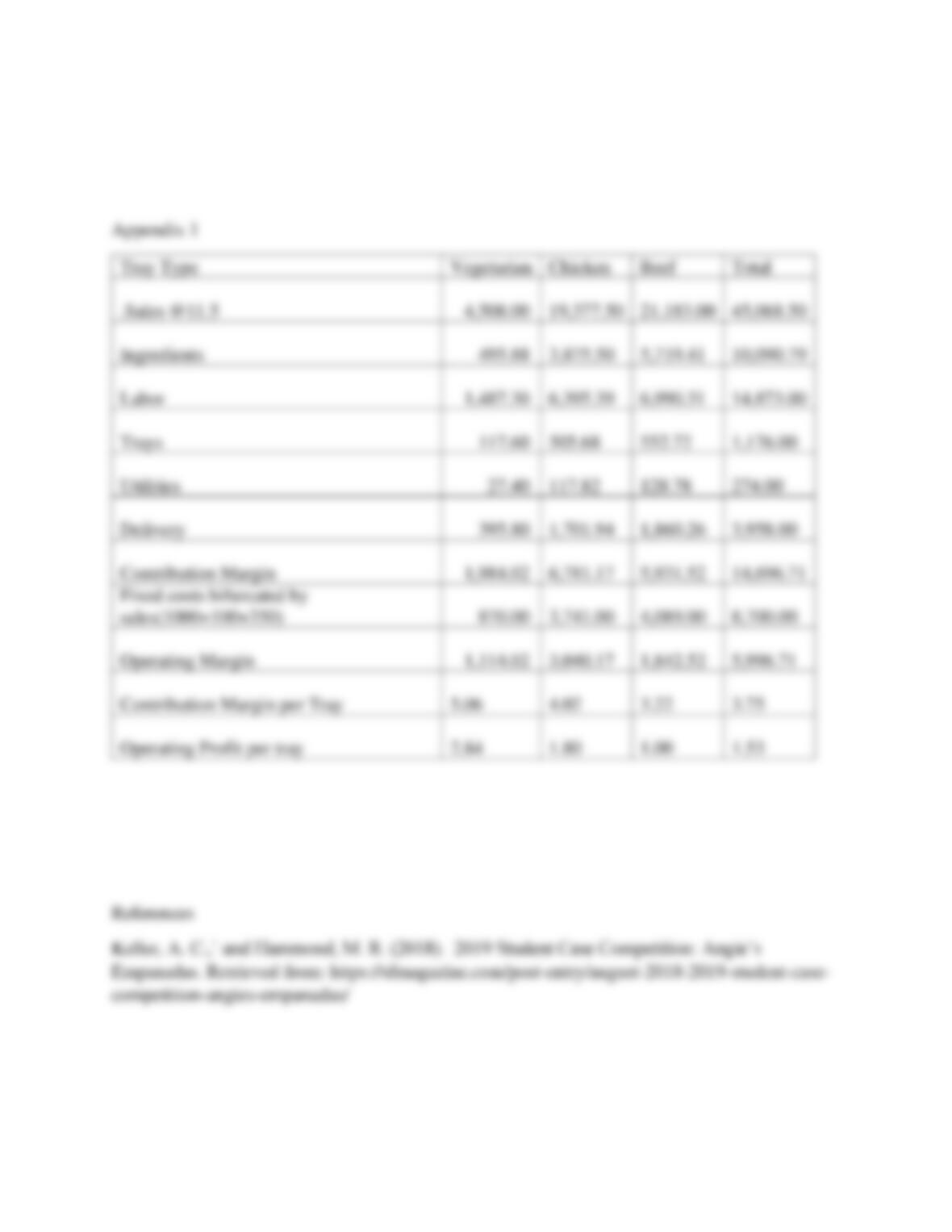
She needs a more sensitive analysis for that purpose. She needs to know what total contribution
margin per unit each try type provides. This information will provide her knowledge of whether
she is selling all tray types on profit. As evident from the Appendix-1, she is selling all tray type
on profit. Then as he needs to earn a certain profit, so she also needs information on what amount
of profit is derived by which tray types and what amount of costs are caused by certain tray
types. This would help her control her costs as well as knowing the potential of each product
type on which she needs to focus. Moreover, it would also help her pricing her products better so
that she can earn an appropriate profit from each tray type.
Tray Type
Vegetarian
Chicken
Beef
Total
Operating Margin
1,114.02
3,040.17
1,842.52
5,996.71
Contribution Margin per
Tray
5.06
4.02
3.22
3.75
Operating Profit per tray
2.84
1.80
1.00
1.53
In the above table, different metrics are calculated that would help Angie assess the performance
of her business. This information is consistent with the gross margin but also shows tray type is
unit wise highly profitable and which product type provides her largest overall profits.
2. Analyze and compare Angie’s overall actual results with her expected results to
determine why her accountant is concerned.
There is a fundamental issue in comparing her budgeted and actual results. She prepared her
budget on the premises that all product types cost her same and so the contribution margin and
profit from all tray types will be the same. Therefore, for her, she wanted to just sell as much as
possible and that would fulfill her target. However, the reality is different. As calculated by her
part-time accountant, the costs of ingredients per type of tray are different. As a result, the profits
per tray are also different. Due to this fact, the sales mix become highly important and that is one
thing she did not focus on during budgeting.