Analyzing the role of sexism in the unequal distribution of wealth.
Gender identities includes the conceptions, that of ourselves as being male or female. Sexism
operates at both an individual and an institutional level. Men and women differ in their access to
privilege and power. Traditionally, men always appear first in line when it comes to who gets
what, when, and how. “The average female full-time worker earns about 76 cents for every dollar
earned by a male full-time employee” (Berger, 2006). This data clearly illustrates the present
condition of inequitable distribution of wealth across the gender. Women considered lower than
men did, whether it is patriarchy or matriarchy. Labor, availability of women and motherhood
became some factors that have been stopping women to be on an equal platform with men.
Cultural suppositions involve of the more establishment in social constructions of what
should natural than in biological limitations. Generally, it’s continuing from past that, women are
considering lower than that of men. The social and cultural significance attached to those
presumed biological differences, called as gender. In general, men get more salary than women
do over their lifetimes. For better understanding, look at the widespread income inequality
throughout the United States. Unites States stands in 95th position out of 134 countries, which
shows how worse the income inequality has rooted his feet in the United States (Domhoff, 2005).
Whether it is racial or gender wealth gap, in all factors United States stands lower in list and
other smaller countries are ahead of it. This factor shows how a woman has to suffer to get the
equal wage to that of a man.
The degree of income inequality in the United States can be compared to that in
other countries on the basis of the Gini coefficient, a mathematical ratio that
386 Gregory Street, Bridgeport, Connecticut 06604
Phone: (203)-685-4401 Email: amahant@my.bridgeport.edu

allows economists to put all countries on a scale with values that range
(hypothetically) from zero (everyone in the country has the same income) to 100
(one person in the country has all the income). On this widely used measure, the
United States ends up 95th out of the 134 countries that have been studied — that
is, only 39 of the 134 countries have worse income inequality. The U.S. has a Gini
index of 45.0; Sweden is the lowest with 23.0, and South Africa is near the top
with 65.0 (Domhoff, 2005).
As going further in finding how gender wealth gap is concentrated in the United States. “From
elementary and middle school teachers to computer programmers, women are paid less than men
in female-dominated, gender-balanced, and male-dominated occupations. At every level of
academic achievement, women’s median earnings are less than men’s earnings, and in some
cases, the gender pay gap is larger at higher levels of education. While education helps everyone,
black and Hispanic women earn less than their white and Asian peers do, even when they have
the same educational credentials” (Hill, 2014).
Before having a discussion on wealth gap, first, have to know the difference between
wealth and income. The reason for discussion on the wealth gap consists that unequal
distribution based on wealth not income.
Wealth and income are related, but they are not the same. Income refers to the amount of
money received by an individual or household during a specific period, such as a month
or year. It usually comes in the form of earnings or wages from a job, but can take other
forms as well such as interest on savings or investment accounts (Peterson, 2010).
Men have access to the wealth more easily compared to women. Women get less access due to
386 Gregory Street, Bridgeport, Connecticut 06604
Phone: (203)-685-4401 Email: amahant@my.bridgeport.edu

the power and biological differences. Traditionally also, men got everything first, they want and
the rest is received by women after men. Men have the capabilities to change the income into
wealth more quickly than women do. Their wealth escalator ratio will always higher than women
do.
According to Chang, men enjoy greater access to the “wealth escalator,” which translates
income into wealth at a faster rate. This wealth escalator includes perks like fringe
benefits (paid vacation days, health insurance, stock options, etc.), favorable tax codes
(capital gains tax, tax credits, etc.), and government benefits (unemployment insurance,
social security, welfare, etc.). Women are systematically less likely to tap into the wealth
escalator because of the jobs they work in and their greater propensity to work part-time.
Men are more likely to attain jobs with benefits, receive higher incomes that allow them
to save more, work full-time throughout their adult lives, and possess the types of assets
that receive preferential tax treatment. Even if the income gap closed today, women
would not be able to turn their incomes into wealth as effectively as men would
(Perlberg, 2011).
In addition, women can never overcome the wealth gap, as because the world’s most percentage
of wealth holds by men and due to which they have appropriate resources to multiply their
wealth in whichever times they want to do. To produce wealth and to increase it, someone needs
proper resources for it and in general, men will always hold the most resources that help them to
turn income into wealth.
Women not only paid less than men do, but by race, also they have to face discrimination.
Gathered data on Sex and race shows, how much the earnings of the women and then compare it
386 Gregory Street, Bridgeport, Connecticut 06604
Phone: (203)-685-4401 Email: amahant@my.bridgeport.edu
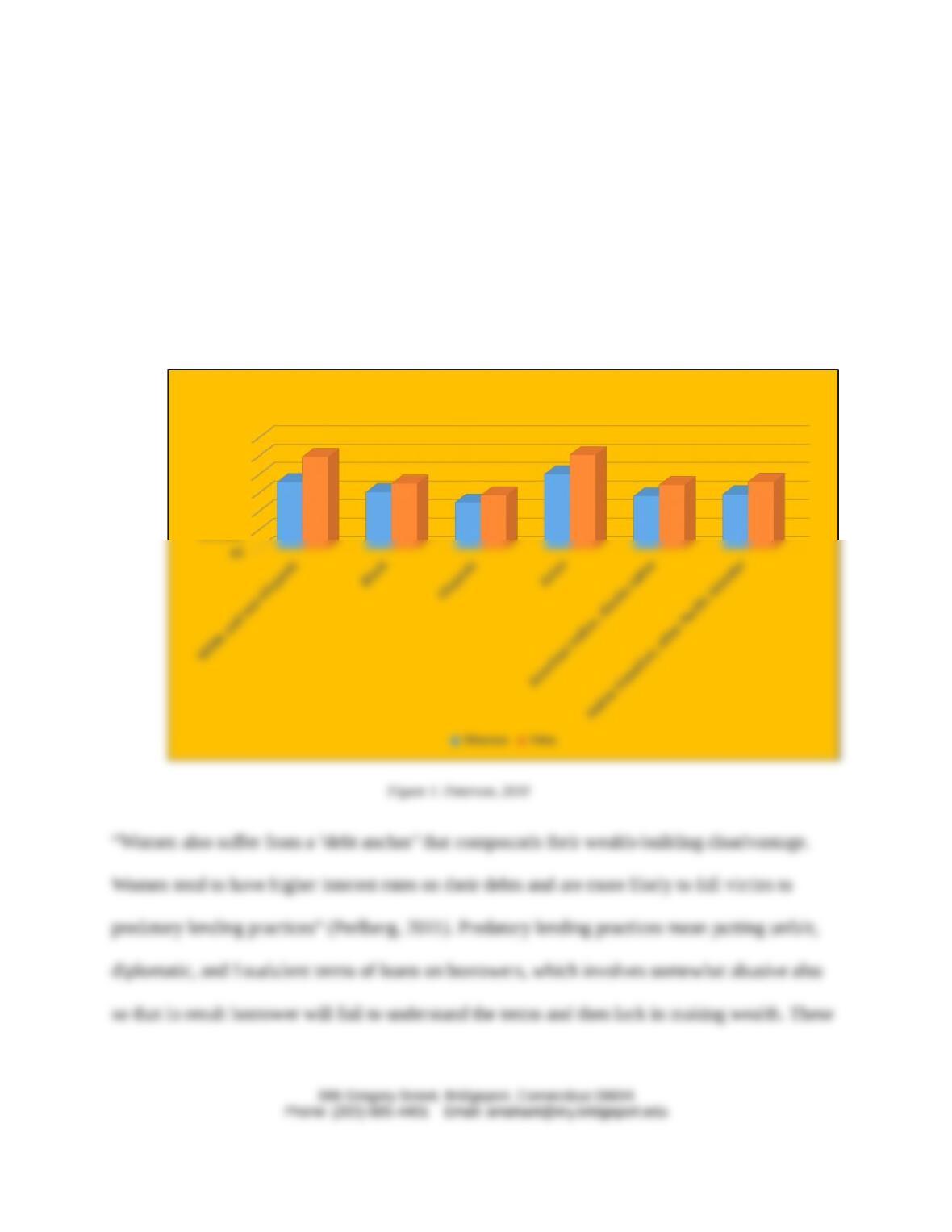
with earnings of men. Black and Hispanic races are quite near in terms of earnings of men and
women. This data shows that developed country like Unites States where men and women equal
in all terms still faces differences in privilege, prestige, and power of women.
Following a graph that clearly shows the earnings gaps of full time workers by sex and
race and how much the difference in their income.
$20,000
$30,000
$40,000
$50,000
$60,000
Earnings Gaps for Full–me workers by Sex and Race