Running head: ANALYSIS REPORT OF WALMART’S HEDGING STRATEGY 1
Analysis Report of Walmart’s Hedging Strategy
Student’s Name
Institutional Affiliation

ANALYSIS REPORT OF WALMART’S HEDGING STRATEGY 2
Analysis Report of Walmart’s Hedging Strategy
Hedging is considered a financial tool that aims to reduce the company risk exposure of
financial instruments. It intends to lower the risk of adverse price movements of an asset
(Downey, 2020). There are inherent risks involved in a business operation subjected to
fluctuation exposures; these include foreign currency exchange rates, interest rates, commodity
prices, and equity prices. Price movement in these areas can affect the net earnings of the
Company. That is why it is crucial to seek out transactions whose sensitivity to price changes
offsets the core business’s vulnerability to such movements or hedging. According to Downey
(2020), hedging is an imperfect science that limits the risk of losses from uncontrollable financial
events. Hedging also presents an opportunity to add to its bottom lines while protecting the firm
from financial prices’ adverse effects. Popular hedges also involve derivatives that track an
underlying asset. This is based on the inherent risk-reward tradeoff in hedging to reduce potential
risk and take away potential gains. Walmart, a market leader in the retail industry, applies
hedging strategies in its financial instruments.
Why Walmart Want to Hedge?
Walmart’s operation has an inherent risk because of its exposure to market risks,
including interest rates, exchange rates, and the equity investment’s fair value. The firm uses the
nature of forward-looking statements in assessing its risk factors. It expresses the reasonable
estimates and expectations of the economic performance of the Company.
Interest Rate Risk
Walmart is exposed to changes in interest rates as a result of its short-term obligation and
long-term debt. The Company uses hedging in its debt by managing the combination of fixed and
variable rate liabilities and entering into derivatives like interest rate swaps. In 2020, Walmart’s
ANALYSIS REPORT OF WALMART’S HEDGING STRATEGY 3
interest rate swaps’ net fair value increased to $175 million due to fluctuations in market interest
rates.
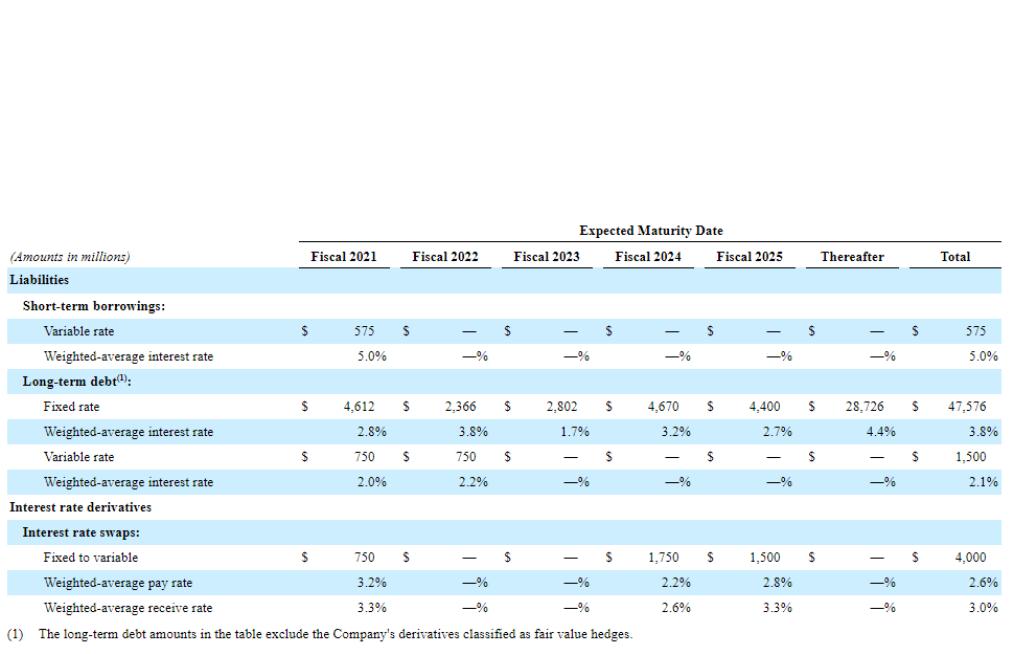
Figure 1.0 Interest Rate Risk Hedging
The figure above depicts the financial instruments that are sensitive to movement in
interest rates. It detailed the mix of fixed and variable rates of Walmart’s liabilities, which helps
manage the risk of interest fluctuation by diversification and interest rate derivatives. Knowing
that most companies finance some of its operation in debt, it is prudent to assess their sensitivity
to price changes.
Foreign Currency Risks
Walmart’s domestic and international presence exposes the Company to the fluctuation of
currency exchange rates. For the recent fiscal year, the firm has increased its currency translation
gain by $0.3 billion through its affiliates in the UK and Mexico. The company hedge portion of
its foreign currency risk using currency swap derivative. In the fiscal year of 2020, the fair value
of currency swaps’ primary movement was in the liability position. It resulted from variation in
currency exchange rates due to strengthening the U.S. dollar relative to other currencies. In
ANALYSIS REPORT OF WALMART’S HEDGING STRATEGY 4
addition to currency-related hedges, the firm also hedges a portion of its foreign currency-
denominated long-term liabilities as nonderivative. Walmart also pass in into immaterial foreign
currency forward contracts to minimize the cost of purchase payment on non-functional
denominated currencies commitments.
Investment Risks
The Company has an equity investment in JD.com that exposes Walmart to stock price
changes with its ownership of a 12% stake (Sun, 2018). The recorded $1.9 billion change in
investment’s fair value in J.D. is due to the increase of stock price in 2020. The fair value’s
movement is recorded within other improvements, and losses resulted in a increase of $1.9
billion in current year due to an upsurge in the stock price of J.D. As of 2020, the equity
investment’s fair value in J.D. was $5.4 billion. As of January 31, 2020, a hypothetical 10%