This report proposes a novel treatment for Acute myeloid leukemia (AML). It will begin with a general
overview as to why AML was chosen, and the current treatments. Then the report will elucidate upon
using Tandem Chimeric Antigen Receptor (CAR)-T cell with All-Trans-Retinoic Acid (ATRA), and
icaspase9 suicide gene as a novel treatment for AML.
Background/Rationale
AML is a rare disease that is fatal for most patients (80%)1. Treatments for AML has not
changed, and an increased survival rate observed is due to better supportive care, and bone-marrow
transplantation techniques2. Hence, the survival rate has not significantly improved since the 1970’s.
AML mortality for elders continues to increase, and there is a dire need for novel treatments for AML3.
In North America there is an estimated 61,048 people living with AML4, which qualifies any novel
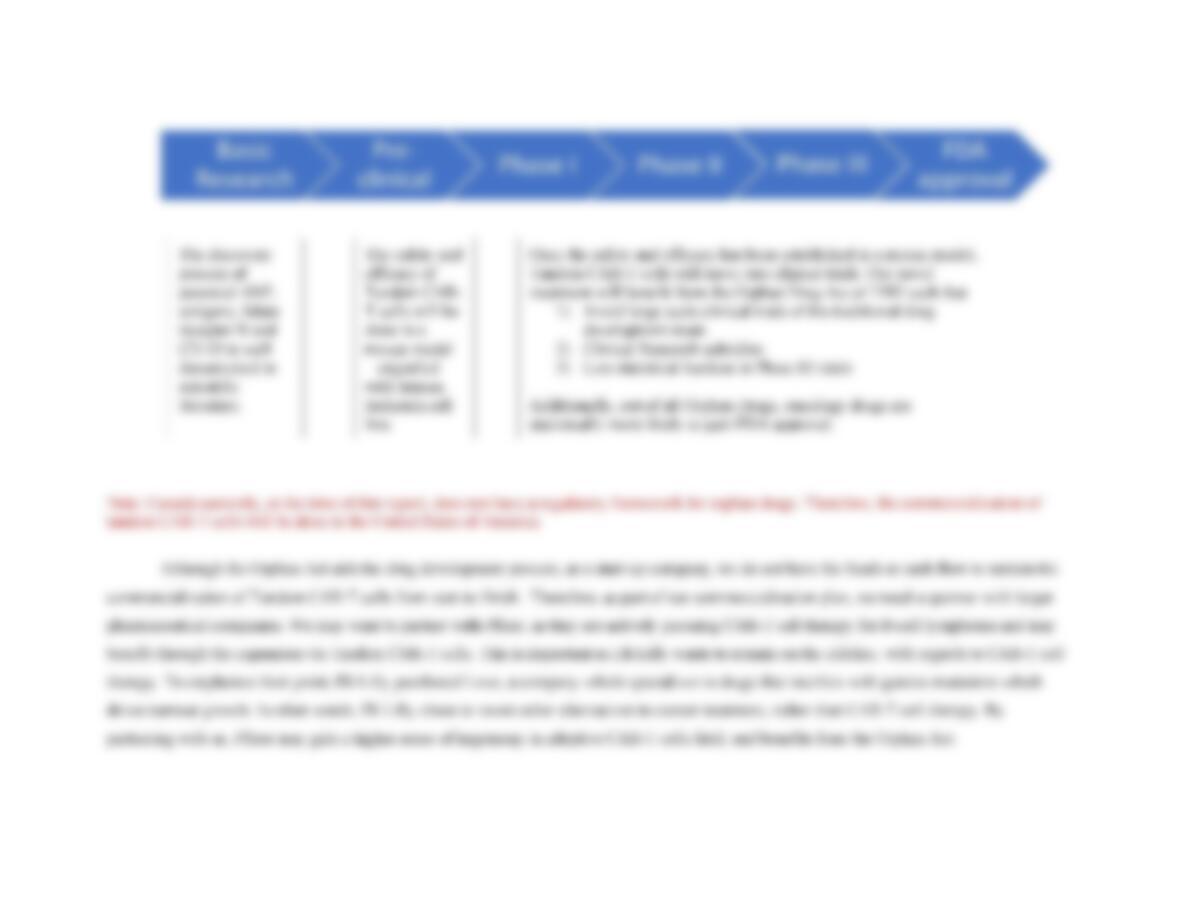
treatments to AML to the Drug Orphan Act of 1983. The Drug Orphan act provides financial incentives to
encourage the development of drugs that treat rare disease, or any diseases that affect less than 200 000
people5. Some incentives include partial tax credits for clinical trial expenditure, and eligibility for 7 years
of market exclusivity. More importantly, the three major advantages to this act includes: 1) Avoid cost of
large scale randomized clinical trial that are standard for traditional drug development (mean of 98
patients for orphan studies vs. mean of 294 patients for non-orphan studies)6 2) There is often less
competition for orphan drug relative non-orphan drugs. For example, Glycerolphenylbutyl – a treatment
for a rare urea cycle disorder – is $793 000 a year for one patient. Hence, orphan drugs often generate
similar revenues as non-orphan drugs with the added benefit of a lower cost of development. Case in
point, the top ten orphan drug therapies generated $1 billion in revenue for manufactures7. 3) Companies
that announce the development of oncology orphan drug on average increase stock by 3.86% compared to
non-oncology orphan drugs, which increase average stock by 3.36%8. Therefore, the dire need to develop
novel treatments for AML, along with the beneficial incentives of the Drug Orphan Act, makes AML a
profitable niche to explore, and hence the topic chosen.
There are two current main treatments for AML, chemotherapy and stem cell transplant.
Traditional chemotherapy uses the “3+7” format, where patients will be intravenous injected with
Daunorubicin for 3 days, followed by Cytarabine for 7 days9. Daunorubicin is an anthracycline cytotoxic
antibody produced by Streptomyces Peucetius and inter-calculates between DNA base pairs to inhibits
topoisomerase II and polymerase activity, with maximal toxicity is at S-phase. Once injected,
Daunorubicin is metabolized in the liver by cytoplasmic aldol-keto-reductase, to produce daunorubicol,
the major metabolite responsible for anti-cancer activity10. On the other hand, Cytarabine is a pyrimidine
analog that blocks the transition between G1-phase to S-phase. Upon injection, Cytarabine is metabolized
by deoxycytidine kinase to a nucleotide triphosphate. From there, the mechanism of action is not well
understood, but it appears to inhibit DNA polymerase, and cause chromosomal damage11. For
chemotherapy, remission rates are 70-80% of patients younger than 60 years old, and 50% for patients
older than 60 years old. Unfortunately, despite somewhat high remission rates, 30-40% of patients will
experience relapse after their 1st remission9.
Aside from chemotherapy, stem cell transplant is another option. There are two types of stem cell
transplant, allogenic stem cell transplant, and autologous bone-marrow transplant. Both methods, require
patients to receive high doses of radiation or chemotherapy to kill cancer cells, and prepare their body for
donor cells. Allogenic stem cell transplant are haematopoietic stem cells from compatible donors and may
originate from the donor’s blood, bone marrow, or donated umbilical cord stem cells. Allogenic stem cell
transplant may cause graft-vs-host disease, if the body rejects the donor stem cells. Also, patients are
often put on immunosuppression, which leads to susceptibility to infections12. Hence, allogenic stem cell
transplant is usually done on patients below the age of 5513. Despite this, allogenic stem cell transplant
can cure 50-60% of patients. One the other hand, autologous bone-marrow transplant takes the patient’s
own hematopoietic stem cells14. As a result, patients do not suffer from graft-vs-host disease, and
immunosuppressive are not needed. However, it is hard to separate healthy cell from leukemia cells,