American Eagle Outfitters Final Report
By: Michael Blobner, Kaitlyn Evans,
Katelyn Sovek, Joshua Wessel, Katerina Yakoumas
2015
Dear Jay L. Schottenstein,
American Eagle is battling in a highly competitive environment during an economically
challenging time period. The main issue we need to focus our attention on is how we as a
company can remain competitive. This year, looking at American Eagle’s gross margin
percentage, it is seen that they had a significant drop from 2013, losing 6% compared to our
primary competition, Urban Outfitters who has been progressing the past 2 years and is at 14%.
1 | P a g e

Currently our strategy at a high level is brand differentiation through providing quality clothing
to people between the ages of 15- 25. While this has worked in the past we believe their needs to
be revisions in order to rejuvenate the brand and put American Eagle in a superior standing
among competitors. We believe that we can obtain this level of competition by first increasing
the company’s online presence. This could be used as a source of promotion, and an outlet for the
company to convey who we are as a company. Additionally, we want to revise the Project Your
Life campaign. Project Your Life 1.0 campaign was a good start, but did not give customers the
opportunity to see the depth of the people in the campaign. With Project Your Life 2.0 we want
to create a platform that shows off personal styles and talents and drive sales and traffic. With
proper implementation and coordination, we believe that our recommendations will prove to be
the key to creating a sustainable and competitive brand for many years to come.
2 | P a g e

Executive Summary
Key Issues
Key issues facing American Eagle Outfitters include their ability to remain competitive
during tough economic times.
In the Retail Industry, other competitors have realized that they must set up larger distribution
channels, inventory management systems, and wide scale marketing plans in order to remain
competitive.
Hard vs. Soft Retail
Relies heavily on price competition
Being well-known
In the retail industry the main key success factors are: quality, fashion, service, brand loyalty,
price, efficient supply chain management, and design capabilities.
Prices either need to be lower than offered by competitors or made more attractive
because of added incentives, such as higher quality products. The success of a company
is reliant on the customer’s willingness to pay the prices of the products that they offer.
By looking at American Eagle’s gross margin percentage it is seen that they had a significant
drop from 2013, losing 6%. This significant drop reflects the current financial condition of the
company and gives an insight to their status.
It is at its lowest point in three years, at 4%. This does not reflect well for the company,
especially because their biggest competitors, Urban Outfitters have been progressing the
past 2 years and is at 14%
American Eagle has large worldwide presence.
3 | P a g e

They have strong customer/brand loyalty. Their brand name signifies a culture of fun,
variety, and individualism, realness, and honesty. The brand is about being trendy.
Customers tend to rebuy from American Eagle once they start buying clothing from the
company.
American Eagle has inconsistent growth.
Their operations are seasonal with a large portion of their total income occurring in the
third and fourth fiscal quarters. This reflects the increased demand during year–end
holiday selling seasons.
American Eagle Outfitter’s current generic strategy is a best-cost provider strategy.
They incorporate differentiating features into their product lines that cause buyers to
prefer their products over competitor’s brands. They have selected a segment of the
market and have tailored their strategy to serve them.
Increase their internet presence through more public relation campaigns and
AdWords/banner campaign. They could use online news releases to promote the
company’s activity and through this call attention to the mission and vision of the
company.
Project Your Life 2.0
The new contest/campaign will be redesigned in order to show personal style, talents, and
individuality of all the contestants involved.
4 | P a g e

Problem Statement/Key Issues
Key issues facing American Eagle Outfitters include their ability to remain competitive
during tough economic times. They are also in a highly competitive industry: the retail industry
and that compete primarily on the basis of quality, fashion, service, selection, and price. How
can American Eagle Outfitters remain competitive in the retail industry during tough economic
times?
Industry Analysis
The retail industry covers a large array of businesses that sell goods and services to
customers. However, although the industry is very large it is broken down into smaller segments
such as: department stores, specialty stores, boutiques, and discount stores. Retail has gone
through a whirlwind of changes throughout the past few decades. Customers are now interested
in ready-to-wear clothing, as opposed to what was once a strictly made-to-order market. In the
United States, billion-dollar multinational conglomerates such as Wal-Mart run the retail market.
Other competitors have realized that they must set up larger distribution channels, inventory
management systems, and wide scale marketing plans in order to remain competitive. The main
categories within the retail industry are “Hard” and “Soft”. “Hard” retail includes goods such as
appliances, electronics, and furniture. “Soft” retail includes goods such as clothing, apparel, and
other fabrics. Within these categories lie arrays of retailers who rely on different characteristics
within the economy in order to succeed. For example, discount stores have a greater success rate
when the economy is down.
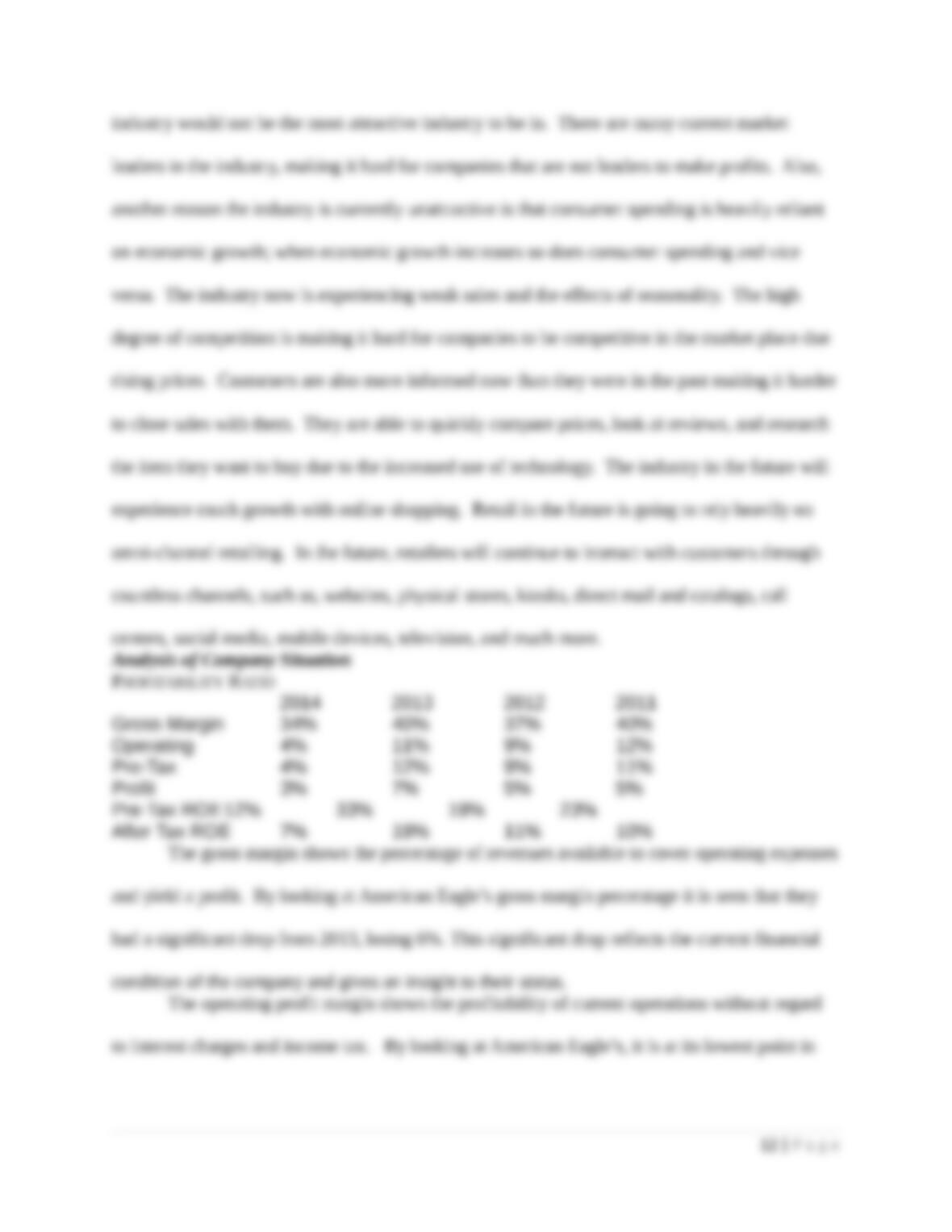
As far as financials are concerned American Eagle has seen an overall decrease in 2014
compared to 2013, with the exception of their asset turnover ratio, which has increase from 1.88
to 1.92. This increase signifies that the company’s revenue per asset has gone up. Earnings per
share (EPS) are down .73 from the prior year, which is the largest decrease the company has seen
in EPS since 2009 when it dropped 1.02. It is very possible that the cause of this decrease is due
5 | P a g e

to the overall decrease in revenues this year. Another percentage that has gone down in 2014 is
the company’s gross margin percentage. This year it is 33.7%, which is 6.3% less than last year.
Gross margin is calculated by taking the selling price of an item less the cost of goods sold.
Hence, the gross margin is directly affected by the decrease in sales throughout the year once
again.
Short-term solvency is a way to determine how quickly a company can come up with
cash. A company’s Current Ratio is calculated by dividing current assets by current liabilities.
In the case of American Eagle, their current ratio is 2.30. This signifies that they have $2.30
worth of cash or short-term investments for every dollar of debt. Long-term to Total Assets
Ratio provides a general measure of the financial position of the company. A decrease in this
ratio over the years shows that the company is becoming less dependent on debt to grow their
business. This year, American Eagle’s Long-tern to Total Assets ratio is .28, which remained
consistent with the prior year. This indicates that the company has $.28 in long-term debt for
each dollar that it has in assets.
Currently, American Eagle brought in approximately $3.28 billion in revenue this year.
Statistics show that the company is anticipating huge growth within the next year at an
astounding rate of 35.98%. However, they are only anticipating growth of 10.96% the following
year. The increase in growth for the upcoming year may be attributable to the loss in profit of
their greatest competitors, Abercrombie and Fitch and Aeropostale. These two competitors are
not doing as well as they have in previous years, and this is a great opportunity for American
Eagle to step in and take advantage of a weak spot in the industry.
DRIVING FORCES ANALYSIS
As of today, there are eight driving forces in the retail industry that can affect its growth.
However, there are four forces in particular that may have a significant effect on the industry in
the future. The first factor is e-commerce. E-commerce continues to increase as online shopping
6 | P a g e
becomes more and more popular across the world. The second force is information technology
(IT). IT is a growing force and as consumers continues to make technology a huge part of their
lives, IT is adapting and adding new methods to pay such as “on the spot” payments. The third
driving force is marketing. As technology continues to become more prominent, consumers are
relying more on their smartphones. Marketers have focused their marketing strategies to cater to
retail consumers by creating more mobile coupons and offers that are sent directly to
smartphones, while still adhering to government laws and regulations. Last but not least, the
fourth driving force is the generation of shoppers. Millennial’s, Generation Xers, and Boomers
all have different interests, wants, and needs. This makes it especially challenging in the retail
industry because they must cater to each generation of shoppers.
Although these generations have more differences than common factors, one thing
remains consistent: as economic growth increases, consumer spending also increases. It is
important for the retail industry to keep political, economic, social, and technical changes in