2
Executive Summary
The founder of the American Apparel, Dov Charney was just a college student
when he started the company. American Apparel was known as one of the greatest
businesses of multinational clothing as a distributor and also a retailer from Los
Angeles. The company was built by former CEO, Dov Charney from every process of
design, marketing, manufacturing and etc. Within seven years this company managed to
grow into one of the biggest clothing manufacturers in the U.S. They did all the
production process in house instead of outsourcing it offshore.
Aside from the greatness achieved by the company, it was also known in the
news for many other reasons related to their former CEO’s controversial personality. Its
scandalous advertising campaigns were being banned by the Advertising Standard
Authority (ASA). The coverage of this racy ad campaigns has been all over the press
and has become the rise and and fall of the company. This may be the start of the
nightmare of this favourite fashion empire along with the lawsuits against the former
CEO and delisting from the New York Stock Exchange.
The year of 2007 was where American Apparel became the biggest T-shirt
manufacturers where they managed to sell about $125 million of their clothes is also the
year where Dov Charney became controversial over his lawsuits of sexual harassment
by creating a negative hostile work environment.
In the year of 2009, they managed to increase and post a greater gross margin
even during weakened global economy situations. In a way to bust their revenue and
also create a good chain of stores globally the company opened 27 new stores in 2009.
The major trouble was when the company was told to lay off their factory workers due
to the immigration sweep that affected the production at that time. Due to the pressure,
they sold their 18% of the company to avoid bankruptcy to Lion Capital.

3
The company reported a loss of $86 million in the year of 2010 due to low sales.
Many investors fled to another company causing the plummeting stock in that year.
They then received funding from Canadian investors in order to avoid bankruptcy. They
also make a decision to not file for Chapter 11 bankruptcy but has caused them, Mark
Samson and Mark Thornton to leave the American Apparel. In 2011, this ailing
company‘s operations were at risk and they were trying to get other investors. In a way
to survive, the company kept enhancing their stores and managed to reduce their net loss
to 39 millions compared to the previous years. In the next year of 2012, the company
tried to do an upgrade to their productions and systems and by that they managed to
reduce the net loss from $39 million into $37 million. They also continued to open new
stores as part of the demand planning solution.
In 2013, the assets of the American Apparel decreased when they were
restructuring their business and turned out to be the worst financial year for them due to
the new transitioning of the distribution centre. The cost of goods sold were increasing,
the nett loss were increasing with a minimal margin growth at only 3% from $617
million in 2012 to $633 million in 2013.
Abstract
Financial performance of the past five years (2009–2013) in the fall and the recovery
of American Apparel has been part of the news. This company has gone through a
few stages of debt and loss from 2009 until 2013. There was variable borrowing
happening in the year of 2009 that caused the increase of the interest expense in the
next few years. Due to the massive debt caused by their former CEO, Dov Charney,
he was then dismissed. This report is an analysis and evaluation on the financial
performance of American Apparel. Insights from a different perspective can also be
gathered from this analysis and evaluation.

4
Introduction
This case study has been published by Harvard Business School to
understand and experience a real world case problem for financial. This will allow us
to explore options and solve it by analysing the problem statement from the case
study.
There are so many negative indicators that can be discussed and analysed
using the ratios for this case and also to be evaluated for future recommendation and
action. This American Apparel Drowning in Debt Case is part of the existing
managerial problem ready to be solved to allow development for the organization.
The analysis of this American Apparel Drowning in Debt Case focused on
the greatest influence on the problem, analysing it and translating it into action. The
solution of this financial statement can be expressed and identified through relevant
financial ratios analysis such as Liquidity measures, Efficiency measures,
Profitability measures, Leverage measures and Solvency measures. The goal is to
determine the solutions, alternative solutions and working them into action plans for
the American Apparel Drowning in Debt Case study.

5
Problem statement
American Apparel’s money situation worsened by the first quarter of 2011 and the
company stated that it might file for protection against bankruptcy.The company was
suffocating under its debt burden, an interest payment of $14 million. In addition, the
company acquired additional inventory for a large purchase, therefore it causes
change in payable turnover.
Besides that, hiring employees without proper legal identification documents
leads to a loss of 2000 employees which causes them to face supply demand issues
and acquired debt with a high interest rate which is 18% causing burden to pay back.
American Apparel was cash-crunched in 2014 when its interest payable and other
debt repayment had increased to $13.4 million. It was worse when American
Apparel had encountered a substantial increase over its net loss of $106 million in
2013 and the company was not making profit since 2009. Even though its net sales
increased marginally in 2013, the company still ended with a bigger loss as
compared to previous years. At the same time, its shares had plummeted by 95 per
cent.
The global recession in 2010 has impacted American Apparel’s sales and
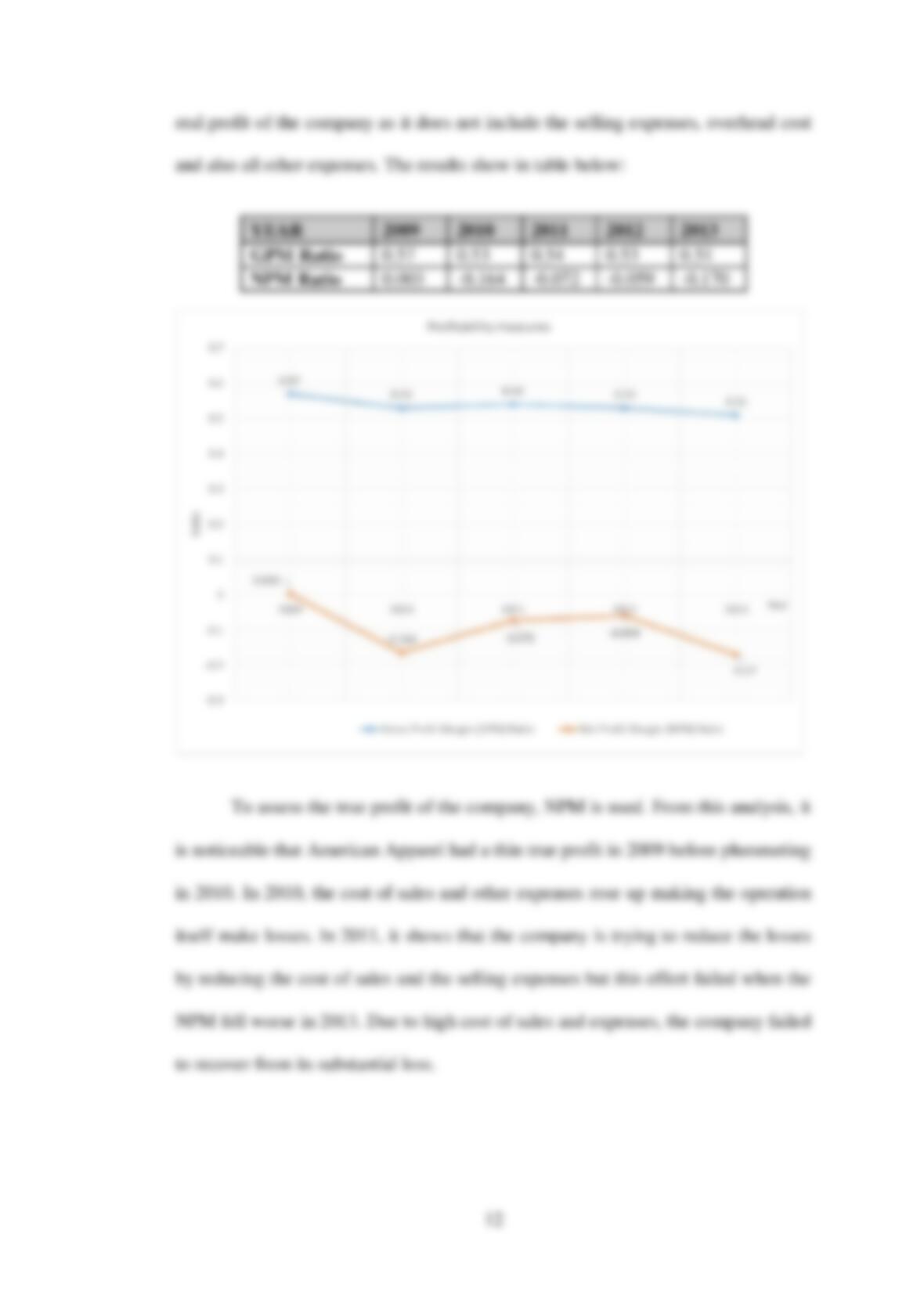
operating income. From the GPM ratio, the analysis shows the gross margin slightly
declined over the years. This indicates the cost of sales is higher from year to year.
The company failed to reduce the cost of sales making the gross margin reduces over
the year. From the NPM, the expenses such as selling and administrative also high
hence consume all the profits. From the perspective of profitability ratios, these are
the causes of why American Apparel is running at a loss.
Accounting Analysis
In this chapter, we used four (4) types of measurement to analyse American
Apparel’s financial statement. The liquidity measures are used to measure the ability
of the company to repay current liabilities. The efficiency measures are used to
estimate the ability of a company to use its assets and manage its liabilities to
generate income. The profitability measures are used to assess a company’s ability to
generate income relative to its revenue, operating expenses, balance sheet assets, or
shareholders’ equity over time. Last but not least, leverage measures are used to
measure the business entity’s ability to meet its long-term debts and financial
obligations.
I. Liquidity measures
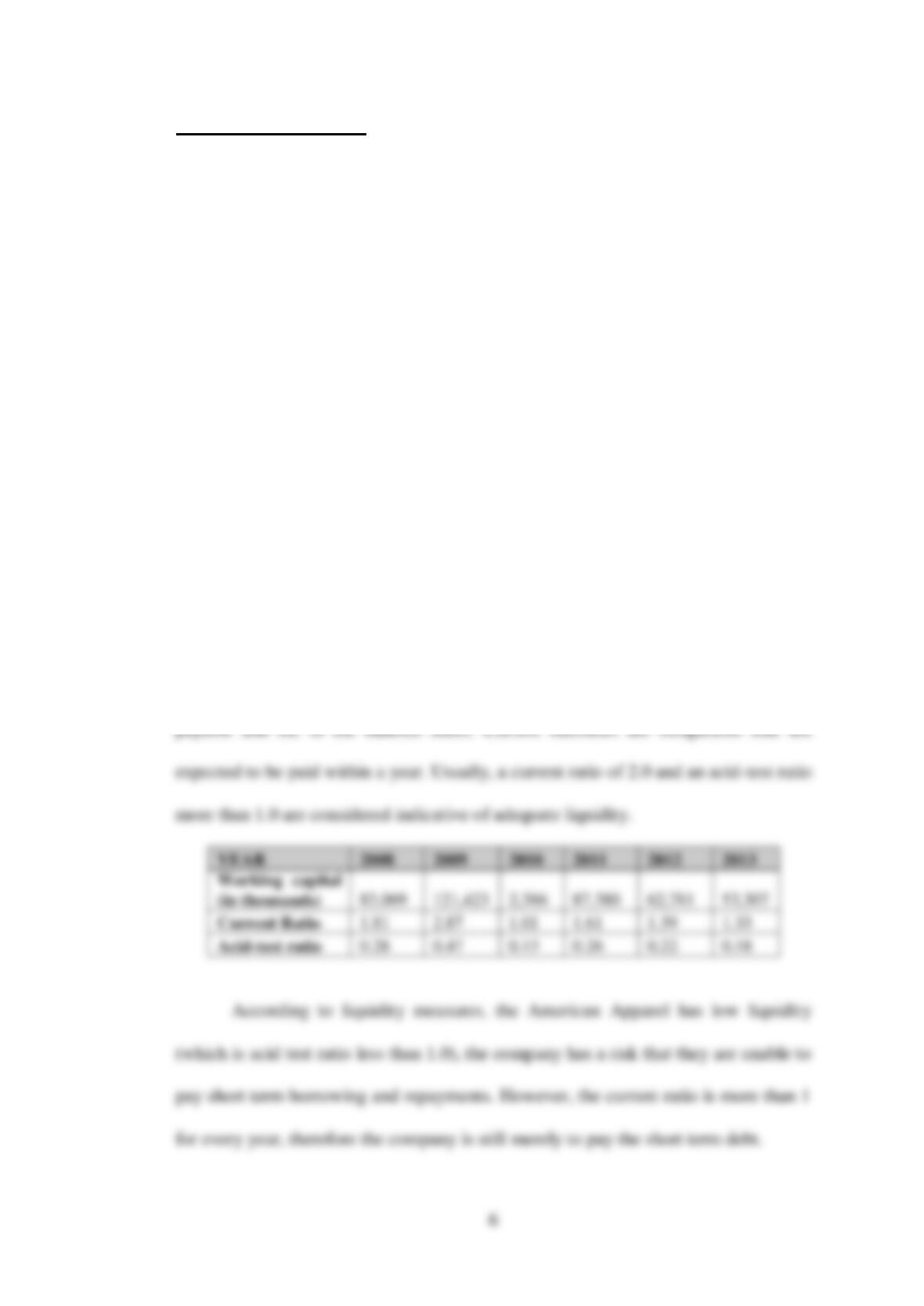
Liquidity measures are the gauge to measure the ability of the company to repay the
current liabilities such as interest, short term loan, income taxes payable, bills