12-1
Copyright © 2018 Pearson Education, Ltd.
CASE 12
Amazon.com, Inc: Retailing Giant to High Tech Player?
I. CASE ABSTRACT
Founded by Jeff Bezos, online giant Amazon.com, Inc. (Amazon) was
incorporated in the state of Washington in July 1994, and sold its first book
in July 1995. Amazon quickly grew from an online bookstore to the world’s
largest online retailer, greatly expanding its product and service offerings
through a series of acquisitions, alliances, partnerships, and exclusivity
agreements. By 2010, 43 percent of Amazon net sales were from media,
including books, music, DVDs/video products, magazine subscriptions, digital
downloads, and video games. More than half of all Amazon sales came from
computers, mobile devices including the Kindle, Kindle Fire, and Kindle
Touch, and other electronics, as well as general merchandise from home and
garden supplies to groceries, apparel, jewelry, health and beauty products,
sports and outdoor equipment, tools, and auto and industrial supplies. Amazon
faced several other challenges, including those from state governments that
wanted to collect sales taxes so that it did not adversely compete against
local businesses. Amazon was at a crossroads with regard to its push into
technology versus its general merchandise.
Decision Date: 2012 FY Sales: $48 billion
FY Net Income: $631 million
II. CASE SUBJECTS AND ISSUES
Industry Analysis
Strategy Formulation Competitive Advantage
Strategy Implementation New Product Development
Core Competencies Market Segmentation
Online Marketing Online Sales
Competitive Strategy Manufacturing/Outsourcing
Digital Media/Streaming ebooks/eReaders
Same Day Delivery Sales Tax/State Govt. Relations
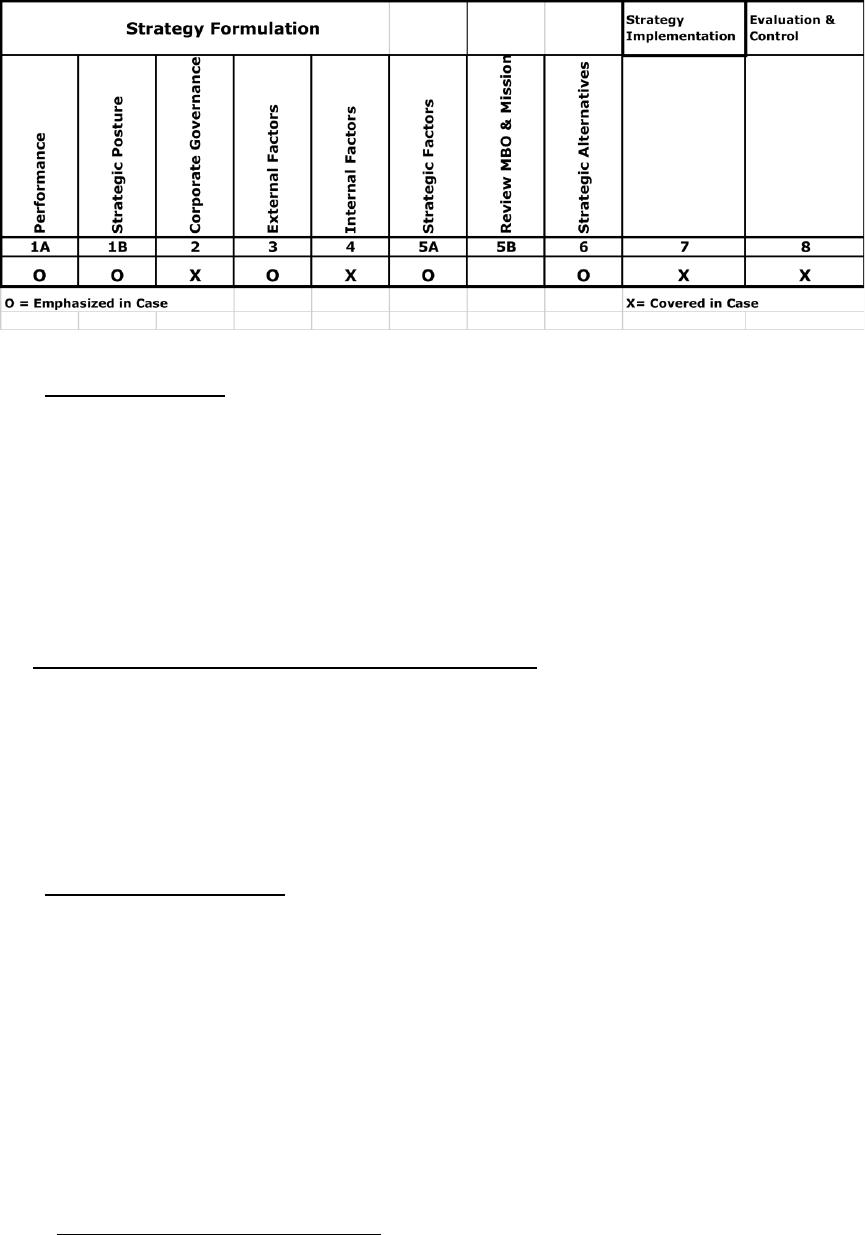
III. STEPS COVERED IN STRATEGIC DECISION-MAKING PROCESS
CASE 12
Amazon.com, Inc: Retailing Giant to High Tech Player?
12-2
Copyright © 2018 Pearson Education, Ltd.
IV. CASE OBJECTIVES
1. To discuss product innovation: eReaders and tablets.
2. To discuss online sales and streaming.
3. To discuss domestic/international online growth opportunities.
4. To discuss the merits of same day delivery.
5. To discuss sales tax collection and state government relations.
V. SUGGESTED CLASSROOM APPROACHES TO THE CASE
1. This is an excellent case for instructor-led discussion.
2. This is an excellent case for an exam or written case analysis.
3. This is an excellent case for a team presentation.
4. This is an excellent case for an individual or team strategic Audit.
VI. DISCUSSION QUESTIONS
1. Is Amazon becoming a high-technology company?
2. Does it make sense for Amazon to sell Kindle below its cost?
3. Should Amazon collect state sales tax in every state?
4. Should Amazon invest in same day delivery?
5. Should Amazon expand its streaming content?
6. Can Amazon compete with Samsung, Sony, and Apple?
VII. CASE AUTHOR’S TEACHING NOTE—Not Available

CASE 12
Amazon.com, Inc: Retailing Giant to High Tech Player?
12-3
Copyright © 2018 Pearson Education, Ltd.
VIII. STUDENT STRATEGIC AUDIT
I. Current Situation
A. Current Performance
Based on a selected statistics below, Amazon Net Income and ROI
declined, but the share price increased, which is partially due to
share repurchase program in 2011 (10K).
• Net income declined to $631 million in 2011 from $1,152 in 2010.
• Share price rose to $194.44 on 1/3/12 from $169.64 on 1/3/11, or
by 16 percent.
• Return on investment was 2.5 percent in 2011 and 6.1 percent in
2010.
B. Strategic Posture
1. The corporation’s mission, strategies, and objectives are detailed
below. The firm’s mission is aligned with Amazon’s performance and
is manifested by its operations.
2. Mission
• Company’s Mission Statement: “Earth’s most customer-centric
company…a place where people can come to find and discover
anything they might want to buy online.”
• Amazon is an e-commerce business, investing heavily in technology
to gain market share and differentiate itself. It sells a wide
variety of goods and services, including web Services, Kindle
etc.
• The company’s mission statement properly addresses the e-commerce
specialization. In addition, the investments in technology
infrastructure, and goods and services offered (web services,
acquisitions of Zappos, Quidsi, etc.) provide support to the e–
commerce business and in alignment with the firm’s mission.
3. Objectives
• To increase sales domestically and internationally.
• Gain and retain the market share in the e-commerce industry.
• Achieve long-term sustainable growth.
• Provide exceptional customer service.
• Lower costs
• Continuous improvement of web site.
• Premium brand building and differentiation.
The objectives are aimed at Amazon’s growth and profitability in an
extremely competitive environment and are in alignment with the mission
statement. They address the nature of the external environment (competition,
price, customer loyalty, and globalization) and internal environment
(technological development, finance, and marketing).
CASE 12
Amazon.com, Inc: Retailing Giant to High Tech Player?
12-4
Copyright © 2018 Pearson Education, Ltd.
4. Strategies
• To increase sales and market share through partnership,
acquisitions, and strategic alliances.
o Allow 3rd party sellers to place links on Amazon web sites.
o Provide hosting and web site maintenance services for
partners.
• Sacrifice short-term profits to gain or retain market share in
certain business lines, such as e-reader (Kindle) in the long–
term.
• Heavily invest in technology infrastructure.
• Invest in inventory management, shipping, and other business
capabilities, e.g. FBA, FWS, and Frustration Free Packaging.
• Utilize technology/web site capabilities to:
o Analyze website traffic
o Customer/non-customer data collection
o Better market products and services to customers
• Utilize technology to offer customers unique and useful tools and
services.
o Ratings engine
o Safe and convenient transaction environment
o Ease of website use
• Continuous adaptation to ever-changing environment.
• Effective online marketing techniques to attract customers and
satisfy partners.
o Pay-per-click advertisements
o Permission email marketing
o Amazon Prime Membership
• Strategic positioning of fulfillment centers (near airports) at
low-costs.
The strategies are consistent with each other as they support the
corporate and business objectives.
5. Policies
• Maintain a lean corporate culture, focused on increasing its
operating income.
• Tightly manage operating costs.
• Encourage employees to develop, to better serve customers.
• Reduce carbon footprint.
6. International Operations
Amazon’s strategic goal is to gain international market share in
e-commerce with the support of technology. The current mission,
objectives, strategies, and policies encourage expansion, including
international operations. In order to expand overseas, the company must
have customized a set of objectives, strategies, and policies for each
region, which has a unique set of geographical, economical, business,
political, and social factors.

CASE 12
Amazon.com, Inc: Retailing Giant to High Tech Player?
12-5
Copyright © 2018 Pearson Education, Ltd.
II. Corporate Governance
A. Board of Directors
1. Ten directors: one internal and nine external.
2. The Chairman, Jeffrey Bezos, holds 19 percent of the stock, and the
remaining nine directors hold 0.03 percent of stock collectively.
3. The stock is publicly traded on NASDAQ under AMZN ticker. There is
only one type of stock, the Common Stock.
4. Directors have collective expertise in capital ventures, technology,
media, and law. One of the directors, Alain Monie, is a CEO of a
Fortune 100 company, Ingram Micro Inc., which is the world’s largest
technology distributor.
5. The directors served on the board for various lengths of time. The
Chairman, Mr. Bezos, has served since 1994, a total of six directors
have served for over eight years. Two directors have served for less
than one year (See Table I below).
6. The Board is responsible for the control and direction of Amazon
Inc. The Board is very much involved in the firm’s strategy and
meets several times a year to address Amazon’s issues and
strategies. Furthermore, the Board also reviews CEO succession
planning.
Table I
Directors
Shares Owned
Served
Since
Industry
Jeffrey P. Bezos
87,963,414
1994
E-commerce
Patricia Q.
Stonesifer
39,549
1997
Art
Thomas O. Ryder
31,579
2002
Media
Tom A. Alberg
28,344
1996
Technology
John Seely Brown
17,566
2004
Academia
William B. Gordon
7,242
2003
Venture Capital
Blake G. Krikorian
6,950
2011
Technology
Alain Monié
6,550
2008
Technology/Wholesale

CASE 12
Amazon.com, Inc: Retailing Giant to High Tech Player?
12-6
Copyright © 2018 Pearson Education, Ltd.
Jonathan J.
Rubinstein
1,831
2010
Technology
Jamie S. Gorelick
4
2012
Law
B. Top Management
1. President, Chairman of the Board, and CEO is Jeffrey Bezos. There
are eleven more officers (See Table II on the following page).
2. The Officers of the company have been a part of Amazon for various
lengths of time. However, all of them have held the position for at
least five years. Management background includes holding managerial
or officer positions at Apple, GE, MS, Intel, and Deloitte Touche.
They possess expertise in technology, consulting, and accounting
(www.amazon.com).
Three officers hold international Sr. VP positions in International
Consumer Business, Worldwide Operations, and Worldwide Digital
Media. One officer has extensive experience in international
business from his prior positions in Amazon and Apple
(www.amazon.com).
None of the officers come from companies acquired by Amazon.
3. Most of the officers have been internal hires. None of the officers
have held a position for less than five years. Therefore, their
contribution is evident from Amazon’s performance in various
strategic areas: e-commerce, partnerships, technology, etc.
4. The top management has established a systematic approach to
strategic management to support the firm’s mission and objectives.
5. Top management is responsible for strategic development of their
departments, which are co-dependent and together contribute to
Amazon overall market position. Each department/subsidiary has a
strategic position and, therefore, it requires high involvement of
top managements.
6. All employees are encouraged to develop better solutions in their
areas of expertise. Thus, top management relies on lower level
managers to get new ideas for strategies, improvement, and
development. The board of directors oversee top management
performance and meet several times a year to discuss company’s
strategy and direction. The CEO is also a Chairman of the Board,
which provides the Board a better “ability to focus on key policy
and operational issues.”
CASE 12
Amazon.com, Inc: Retailing Giant to High Tech Player?
7. Ethical and Social Responsibilities
• Environmentally friendly (carbon foot print reduction initiative)
• Use of recyclable materials in packaging
• Reducing waste by determining a right size of the shipping box
8. Officers’ compensation is a combination of stocks, base salaries,
and bonuses. Stock compensation is a primary component of
compensation, which is “tied to long-term shareholder value“
(www.amazon.com).
9. Top management collectively has expertise in key areas, such as
technology, e-commerce, consumer business, and law.
Table II
Directors
Shares Owned Title Empl. since Prior experience
BEZOS JEFFREY P
87,963,414 President, Chief Executive Officer and C hairman of the Board 1994
PIACENTINI DIEGO
114,646 Sr. VP, International C onsumer Business 2000 Apple
VALENTINE H BRIAN
78,000 Sr. VP, Ecommerce Platform 2006 MS, Intel
WILKE JEFFREY A
75,954 Sr. VP, Consumer Business 1999 AlliedSignal
BLACKBURN JEFFREY M
63,350 Sr. VP, Business Development 1998 Deutsche Morgan Grenfell
SZKUTAK THOMAS J
49,000 Sr. VP and C hief Financial Officer 2002 GE
ONETTO MARC A
36,683 Sr. VP, Worldwide Operations 2006 Solectron, GE
22,501 Sr. VP, General C ounsel, Secretary 1999