1
ALMAZA BEER
MRK 321 – Final Project
PREPARED FOR:
Dr. Esther Sleilati
PREPARED BY:
Melissa Rahbani
Renata Lyann
Sarine Anserlian
Marie-Carole Maalouf

2
Outline:
I. Company’s identity
a) Current position in the market
b) Problem
c) Expectations
II. Target audience
a) Who
b) Primary and secondary targets
i. Customer/prospect segments
ii. Stakeholders
c) Think, feel, do
d) Cognitive and affective objectives
III. SWOT Analysis
IV. Promotional image or positioning
V. Buyer behavior
a) Consumer attitudes’ sequence of events
b) Roles of marketing messages in cognitive mapping
VI. Objectives
VII. Marketing Communications Elements
VIII. Alternative marketing
IX. Message strategy
X. Media selection
XI. Evaluation and control

3
I. Company’s identity
a) Current position in the market
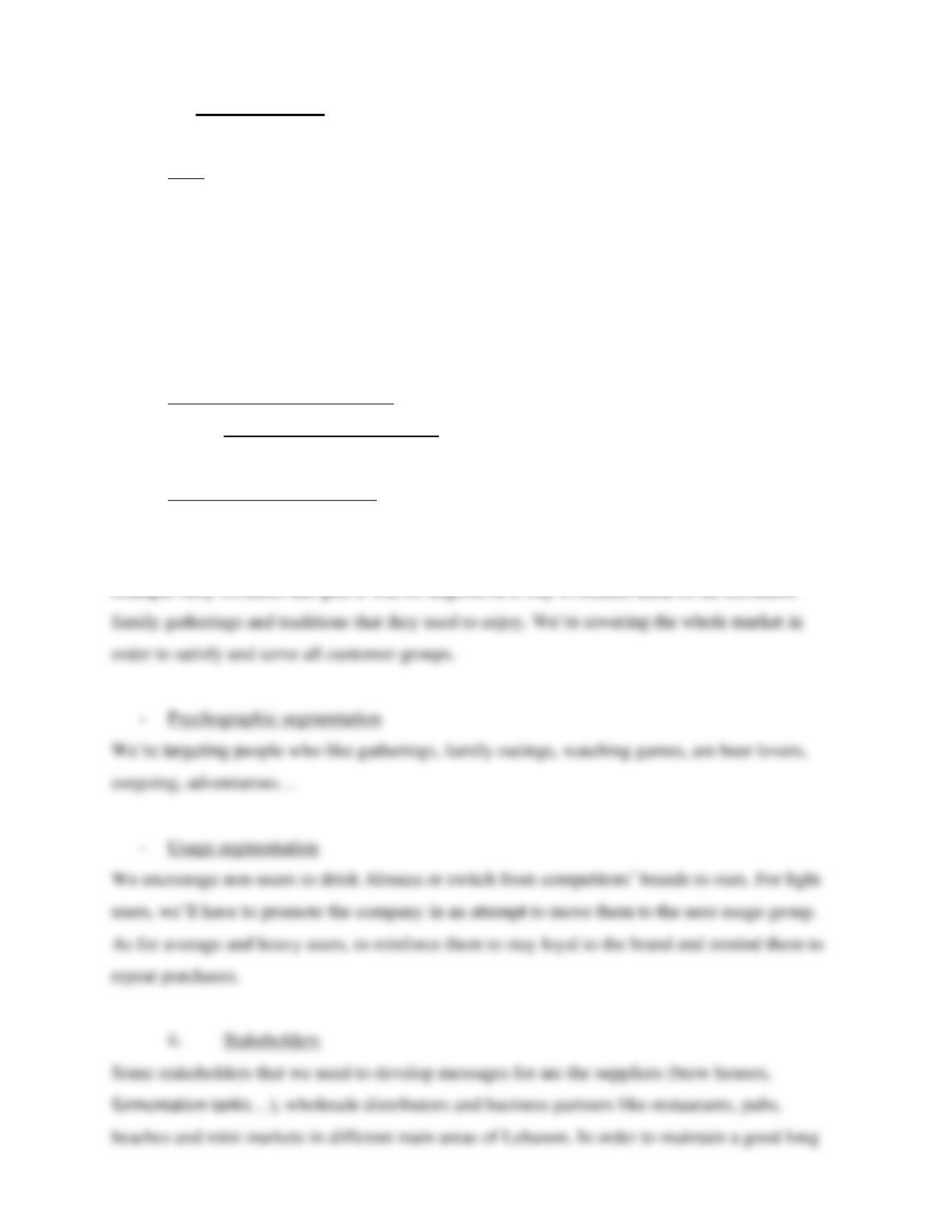
Despite their decline in sales, Almaza still has the largest market share in the Lebanese beer
industry. It is the most popular beer of the Middle East and everyone recognizes it as an icon of
Lebanon. Few of the reasons are that: they target different segments in all the Lebanese market
using mass marketing; they’ve been in the market since 1933 and were the first Lebanese
brewery. This shows that they have a lot of experience in the industry, which also backs their
known refined quality. Almaza also stands out when compared to competitors like Beirut Beer,
961, Colonel Beer…
b) Problem
Being a market leader means having a lot of competition, and as the years went by, Almaza
experienced many like 961, Colonel Beer… but all failed to come even close. It wasn’t until the
launch of Beirut Beer in 2014 that Almaza started to experience a huge decline in sales after
Beirut Beer was well established. Although Beirut Beer doesn’t have a marketing mix like
Almaza’s, they ran many successful campaigns and were on ground a lot during the recent years,
especially in pubs and beaches. Not to mention the quality you get for a very affordable price
that definitely lured a big part of Almaza’s audience. Other than having a worthy competitor,
Almaza’s cost of production is an issue compared to other beer brands which works in Beirut
Beer’s favor, because Almaza has more expensive prices.
c) Expectations
After the implementation of our plan, we expect to regain our lost sales percentage and keep the
market share margin large between us and our main competitor. We will have the customers
prefer our brand over the competitors’ by creating convictions to purchase the brand, which will
reinforce buying decisions and encourage customer retention. We will also create strategies to
keep up with the market transformation, its demands, and especially on how to operate in a
competitive digital environment.
4
II. Target audience
a) Who
We ought to influence all beer lovers in general, including our competitors’ customers. This
varies between whether they initially buy their products or switched from Almaza, and also
includes our current loyal customers, in order to reinforce purchases. Our target audience doesn’t
only represent young adults but also grown-ups and aged people who were used to drinking
Almaza and who will be reminded of the brand itself.
b) Primary and secondary targets
i. Customer/prospect segments
In order to segment our audience properly, we’re going to use three types of segmentation:
– Segmentation by generation
It will include generation Z starting from the legal age 18 till 23, millennials (24-39), generation
X (40-55) and baby boomers (56-74). Each generation will be differently targeted by the ads, for