King Fahd University of Petroleum and Minerals
KFUPM School of Business
MBA Program
MKT-510
Almarai Company – case 1
Oct 13, 2020
Table of Contents
Introduction ………………………………………………………………………………………………………….. 1
Problems Statement ………………………………………………………………………………………………… 1
Environmental Analysis ………………………………………………………………………………………….. 2
SWOT Analysis ……………………………………………………………………………………………………… 7
Strengths ……………………………………………………………………………………………………………………..8
Weaknesses …………………………………………………………………………………………………………………..9
Opportunities……………………………………………………………………………………………………………… 10
Threats ……………………………………………………………………………………………………………………… 10
Market Segmentation ……………………………………………………………………………………………. 11
Geographical Segmentation ………………………………………………………………………………………….. 11
Behavioural Segmentation ……………………………………………………………………………………………. 12
Demographic Segmentation ………………………………………………………………………………………….. 12
Customer Segmentation ……………………………………………………………………………………………….. 13
Customer Analysis ………………………………………………………………………………………………… 14
Income ………………………………………………………………………………………………………………………. 14
Age range…………………………………………………………………………………………………………………… 14
Geographical Location …………………………………………………………………………………………………. 15
Marketing Mix …………………………………………………………………………………………………….. 15
Place …………………………………………………………………………………………………………………………. 16
Product ……………………………………………………………………………………………………………………… 16
Promotion …………………………..……………………………………………………………………………………… 17
Price …………………………………………………………………………………………………………………………. 18
Alternative Solution………………………………………………………………………………………………. 19
Alternative-1: Large Scale Dairy Farms & Best Practices in New Markets ………………………….. 19
Alternative-2: Manufacturing in Other Markets ……………………………………………………………… 20
Alternative-3: New Product Segments ……………………………………………………………………………. 22
Recommendation ………………………………………………………………………………………………….. 23
Conclusion ……………………………………………………….…………………………………………………. 24
Abbreviations ………………………………………………………………………………………………………. 24
Exhibits………………………………………………………………………………………………………………. 25
1
Introduction
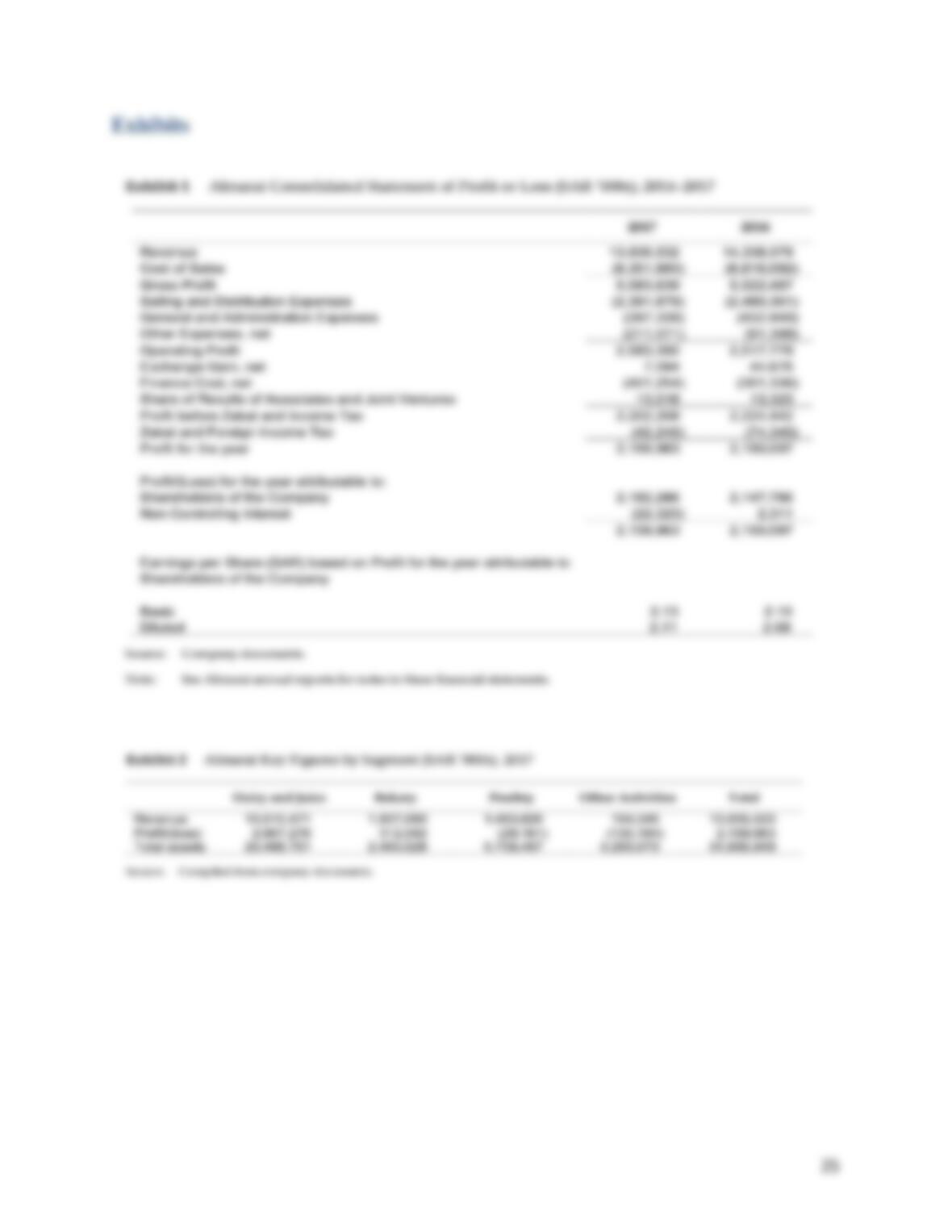
In 2017 Almarai Company had revenues of SAR 14 billion ($3.7 billion). See Exhibits 1–3 for
financial information. Almarai Company produces and distributes dairy, poultry, juice, infant
nutrition, and bakery products. The headquarter of the company is in Riyadh, Saudi Arabia.
Almarai Company is built up with upgraded technology that helped to improve the production. It
has the largest portfolio of branded dairy items, bakery products, and juices. Almarai invested
heavily in processing, always keeping capacity ahead of demand.
Problems Statement
In 2018, Mohammed bin Salman – a new crown prince of Saudi Arabia has organized new
economic program called VISION 2030. This program added taxes and has been reducing the
household budget. Also, the significant variations in the policies from the new government
program has started causing non-Saudis who have been making about third of Saudi Arabian
population to leave the kingdom in big numbers. Those people who left were considered very big
number of customers of the dairy products offered by Almarai company.
The challenges for Almarai Company was how would the company grow and defend its position
in the Saudi Arabia market and how to find the new sources for future success and growth.
2
Environmental Analysis
Growth opportunities have a direct relationship with the operations cost of any organization.
Basically, if an organization is considering an intensive growth, integrative growth, or
diversification growth, it will need to profoundly study its current operations cost, the level of the
economies of scale, and the consumers’ economy to avoid any future losses that might emerge
after implementing a growth strategy. In other words, having a clear picture of these factors of a
company will enhance the decisions of which market should the company enter? What new
product should the company produce? What geographical location should the company expand in?
and how to have the minimum operations cost in the planned growth? To help decision makers in
the marketing department of Almarai company to make the right decision, we will consider the
economic environment, the technological environment, political environment and social
environment in the following paragraphs.
It has been announced by Almarai CEO that they are seeking a further growth: “By 2025, 30% of
turnover should be coming from new categories or new geographies where we don’t currently
participate,” said Schorderet. This growth plan has been taken into consideration in Almarai due
to the current environmental challenges in the Saudi market; higher competition, lower consumer
budget and subsidy cut are the main challenges. As a result of these challenges, the growth of diary
product retail sales in Saudi Arabia, Almarai’s main market, has decreased for the first time in 10
years by more than 2% in 2017 (Exhibit 7: Annual Growth (%) of Dairy Product Retail Sales in
Saudi Arabia, 2005–2017). Surely, the business can’t survive with the current trend line, therefore,
a closer look and an immediate action should be taken in accordance to the growth opportunities.
3
The economic environment plays a major role in studying the current consumers’ behavior and the
future growth for Almarai. The purchasing power of individuals for Almarai depends heavily on
their income because these are daily products. In fact, consumers’ behavior changes after any drop
in the economy. In other words, people tend to save more money than before when they face any
economic drop. Currently, Almarai is producing in Saudi Arabia which is a raw material exporting
economy where marketers and it is seeking growth in industrializing economies like Southeast
Asia. Especially that their market could have the highest demand for milk over the next 15 years.
In 2018, Saudi consumers’ budget shrunk due to the domestic economic restructure including
subsidy cut which is a major challenge and a big shift for Almarai economy. As a result, the sector
had contracted 2.6% in 2017 and more than this in 2018. Yet, the major markets for Almarai, diary,
juice and bakery, were profitable in 2017, however, poultry and other activities were running in a
loss. These factors had affected the traditional sales channels for Almarai, Bakalas as well and
forced some nonnegligible number of them to close. More focus on the modern retailers would
take place to increase the products sales.
Throughout the history of Almarai operations, the production technologies have always been a
dilemma for the company. Particularly, the high temperatures in the regions where they produce
and distribute the highly sensitive products such as fresh-milk and poultry. First, the distribution
of Almarai refrigerators to groceries for free is indeed an excellent model for promoting the
company’s product and getting people’s attention to be more engaged with the brand. In addition,
it encourages grocery owners to open more branches due to the low cost. However, this have costed
4
Almarai more than what it should cost them. In fact, Almarai is well-known for its high-quality
products, therefore, it is perhaps not a very good idea to promote a brand that is already on the top
of its competitor. Second, the farms in desert where temperatures exceed 50°C is one of the direct
contributing causes to the high operating cost that might hurdle future growth. This solution
appeared to be very costly to Almarai especially with the high energy prices that came as a result
of the economy restructure taking place in Saudi Arabia.
The technological environment is also a crucial factor to Almarai growth. First, accelerating pace
of change is not being implemented in Almarai at its best. The same phenomena of placing their
refrigerators in the sales channels has been practiced for years without any change. Second, the
unlimited opportunities for innovation has always been a part of Almarai business model.
Political events and issues had major impact on Almarai’s growth, starting with the JV between
PepsiCo and Almarai, trying to expand by acquiring two companies in 2009 in neighboring
countries Egypt (Beyti company) and Jordan (Teeba company), which did not play out as well as
expected. The JV didn’t make profit because of the differences in market between Saudi Arabia
versus Jordan and Egypt, Beyti in Egypt suffered under the political revolution of 2011, which led
to economic instability. Also, distribution was harder in Egypt as the company didn’t have a fleet
like Almarai did in Saudi Arabia, they outsourced distribution to logistics firms and individual
truck owners. While in Jordan Teeba was facing local competition left and right with high quality
products. With pricy shelf spaces in Jordan and Teeba’s high cost structure making it hard to lower
their products prices to compete. It all led the JV to review the partnership between the two
companies back in 2012.
In 2018, Government policies for capacity-building and employment of Saudi national to localize
companies in Saudi Arabia to meet the vision of 2030 of the Kingdom. Almarai’s aim is to increase
its local staff and with time, to be fully operated by Saudi men and women. Almarai emphasized
the importance of women in their business, increasing their female work force from 21 females in
2008, to 740 in 2018. These Government policies are changing the whole structure of the company
and shaping its future in Saudi Arabia.
After gulf countries including Saudi Arabia initiated an embargo against Qatar, Almarai stopped
selling their products in Qatar which relied heavily on Almarai for their dairy needs. This embargo