ABSTRACT
ACKNOWLEDGEMENT
Behind every fruitful endeavor lie the advice, guidance and inspiration of all the
people directly or indirectly involved with the report. I wish to express my gratitude
to all the people involved in the completion of this report. I am thankful to all of them
for their help and encouragement throughout the completion of the report. They have
been a constant source of support for me.
My heartfelt gratitude and warm salutations are to Prof. Wang Fuming, the faculty
guide, for inculcating in me the principles of dedication and hard work, and proving
his guidance and support throughout the Project. I would also like to thanks her for
making the doubts clear during the presentation and also for her constructive criticism
of the approach to the problem and the result obtained during the course of this work
has helped me to a great extent in bringing work to its present shape.
CHAPTER 1
This report on Bharti Airtel is done to find out certain objective regarding the strategic
approach Adopted by Airtel to stand strongly in the competitive telecom market.
Airtel’s marketing strategies are analyses using various models like SWOT analysis, ,
porter’s five forces etc. The outcomes of these models are properly analyzed to find
out the various aspects like companies position and competitors position in the
market. This report is not just give description about the company but it also talks
about the various strategy adopted by the company. SWOT analysis of Airtel helps to
find out the weak points of the company and to find out the way to overcome this
problem. It can be finding that what are the different strategic options available to the
company under the different market condition and to find the answer that why
company is looking for overseas market like Nigeria and Seychelles.

1.1 INTRODUCTION
1.1.1 Economic Condition and Telecommunication Market
The Democratic Republic of Congo (formerly Zaire) went through several wars and
considerable social upheaval. There remain violent conflicts in the eastern part of the
country, exacerbated by considerable corruption within the government and police
which make it difficult for the government to extend its control effectively in these
regions. The economy is heavily dependent on revenue from the mining sector though
much economic activity occurs informally and is not reflected in GDP data. The
global economic crisis reduced GDP growth to around 3% in 2009, but it returned to
7% in 2010-12, increasing to 8.5% in 2013 and an anticipated 8.7% for 2014. It is
expected to remain stable at that level for the next two to three years, largely
supported by mining.
Largely due to the country’s troubled history, the national telecom system remains one
of the least developed in the region. The national operator, SCPT theoretically has
monopoly rights under 1970 legislation. However, recognizing the need for
telecommunications infrastructure, the government is only loosely regulating the
sector.
Mobile network operators have taken over as the providers of basic telecom services.
By 2001, some 16 private operators had been granted mobile telephony licenses and
the subscriber base was growing at triple digit rates annually. However, the
proliferation of networks also caused frequency spectrum shortages, interference and
compatibility problems. As a result, the mobile sector has since consolidated and now
has five major players.
Development of the DRC’s internet and broadband market has been held back by the
poorly developed national and international infrastructure. However, the country was
finally connected to low-cost, high-quality international bandwidth through the

WACS submarine fiber optic cable in 2013, and SCPT is rolling out a fiber optic
national backbone network with support from China. An alternative terrestrial
international fiber connection exists via neighboring countries. Broadband access is
provided by 3G mobile services and wireless networks using WiMAX and EV-DO
technology. The country’s first commercial LTE networks are imminent.
1.2 Background Information
1.2.1 Airtel
Bharti Airtel Limited is an Indian global telecommunications Services Company
headquartered in New Delhi, India. It operates in 20 countries across South Asia,
Africa, and the Channel Islands. Airtel provides GSM, 3G and 4G LTE mobile
services, fixed line broadband and voice services depending upon the country of
operation. It is the largest mobile network operator in India and the third largest in the
world with 325 million subscribers. Airtel was named India’s second most valuable
brand in the first ever Brandz ranking by Millward Brown and WPP plc.
Airtel is credited with pioneering the business strategy of outsourcing all of its
business operations except marketing, sales and finance and building the ‘minutes
factory’ model of low cost and high volumes. The strategy has since been adopted by
several operators. Airtel’s equipment is provided and maintained by Ericsson and
Nokia Solutions and Networks whereas IT support is provided by IBM. The
transmission towers are maintained by subsidiaries and joint venture companies of
Bharti including Bharti Infratel and Indus Towers in India.
Airtel has already ventured into providing mobile financial services, mobile money
transfers to customers in rural areas, further leveraging its existing base of cellular
subscribers.
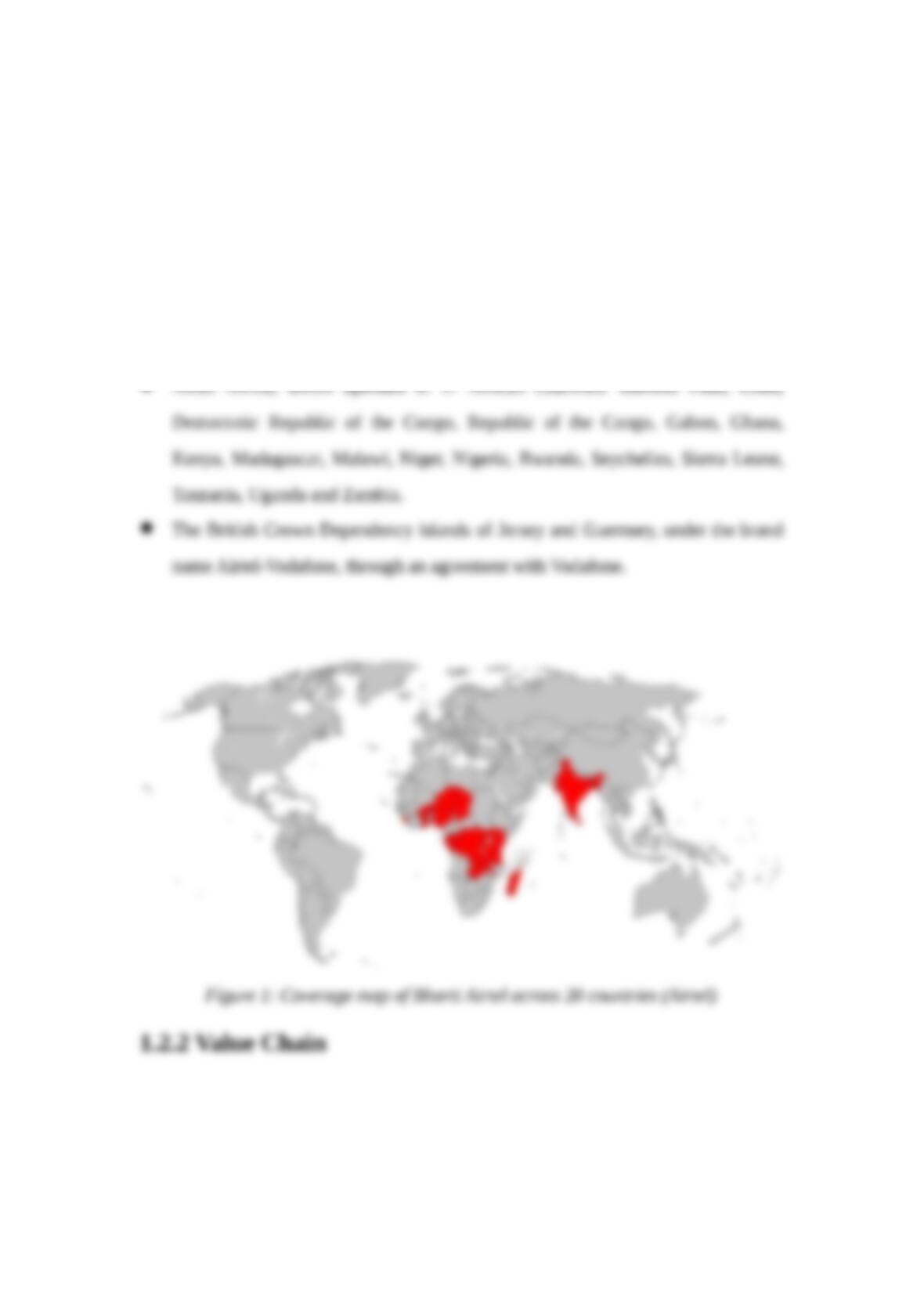
Airtel is the one of the largest mobile operator in the world in terms of subscriber base
and has a commercial presence in 20 countries and the Channel Islands; Bay square
Technology developed a Settlement and Reconciliation Tool (SRT) to reconcile from
various data streams. The system was developed to match the calls being captured by
the network elements and the calls getting rated, i.e. ensuring that operator is billing
all calls its serves and also it is paying out to other operators the correct billing
amounts.
Its area of operations includes:
The Indian Subcontinent: Airtel India, in India
Airtel Sri Lanka, in Sri Lanka
Airtel Bangladesh, in Bangladesh