Running head: ADVOCACY, LEADERSHIP, AND THE PROFESSIONAL SCHOOL 1
Advocacy, Leadership, and the Professional School Counselor
Erickah Thao
Salem College
Anne Sourbeer Morris, Ed.D.
March 07, 2018
ADVOCACY, LEADERSHIP, AND THE PROFESSIONAL SCHOOL 2
Advocacy, Leadership, and the Professional School Counselor
What are the aspects which can help create the professional school counselor? There is no
clear concrete response for creating the professional school counselor because every person or
individual are different from one another. Advocating for the academic achievement of every
student is a key role of school counselors and places them at the forefront of efforts to promote
school reform” (American School Counselor Association [ASCA], 2012, p. 4). However, when
promoting student achievement, the school counselors are the ones to “believe, support, and
promote every student’s opportunity to achieve success in school” (ASCA, 2012, p. 4). As a
school counselor, advocacy is necessary because it demonstrates how students are different
because of what school counselors do for the students. When trying to promote student
achievement and being there to guide the students along the way, it portrays school counselors
being advocates but also being leaders within the school or the school system. The school
counselor’s advocacy efforts involve a) eliminating the barriers impeding students’
developments, b) creating opportunities to learn for all students, c) ensuring the access to a
quality school curriculum, d) collaborating with others within and outside the school to help
students meet their needs, and e) promoting positive, systemic change in schools. The moment a
school counselor begins to advocate for these efforts, they step into their leadership role.
School counselors are leaders in a variety of ways. Their leadership involves: a)
supporting academic achievement and student development, b) advances effective delivery of the
comprehensive school counseling program, c) promotes professional identity, and d) overcomes
challenges of role inconsistency (ASCA, 2012). Since school counselors spend time being
leaders within the school system, it is up to them to decide how to work on trying to improve
their leadership within the administration. As a school counselor, leadership should not be to
ADVOCACY, LEADERSHIP, AND THE PROFESSIONAL SCHOOL 3
command but to teach. “School counselors should try to open people’s eyes and minds because
when you are teaching them, they should learn new ways to see the world and guide them to new
goals. To achieve these goals, it gives those being taught motivation and discipline while at the
same time teaching them to share their own knowledge and try to teach others” (ASCA, 2012, p.
2).
However, not everyone can be a leader but some are still able to become a professional
school counselor. Being an advocate involves holding some form of leadership towards the
administration, faculty, staff, and students. Which are two aspects at becoming a professional
school counselor. There are a variety of people who are professional school counselors and each
one of those professional school counselors are alike. As a professional school counselor, there
needs to be an understanding of what you should be doing and how that involves with who you
are as an individual. Then there are the moments where the school counselor would have to pay
attention to who they are as a professional and how they create their professional outlook
towards students and their colleagues. Many of these can help create and improve upon the
transformed school counselor. Especially at knowing how to become advocates for the students,
school, teachers, and administrators.
Discussion
Advocacy
“When advocacy is conceptualized and described in terms of school counselor
competencies, the structure, purposes, and processes of advocacy are illuminated” (Trusty &
Brown, 2005, p. 260). As a school counselor, when you are trying to advocate for the students,
there is a consultation process the school counselor can utilize when they are consulting with a
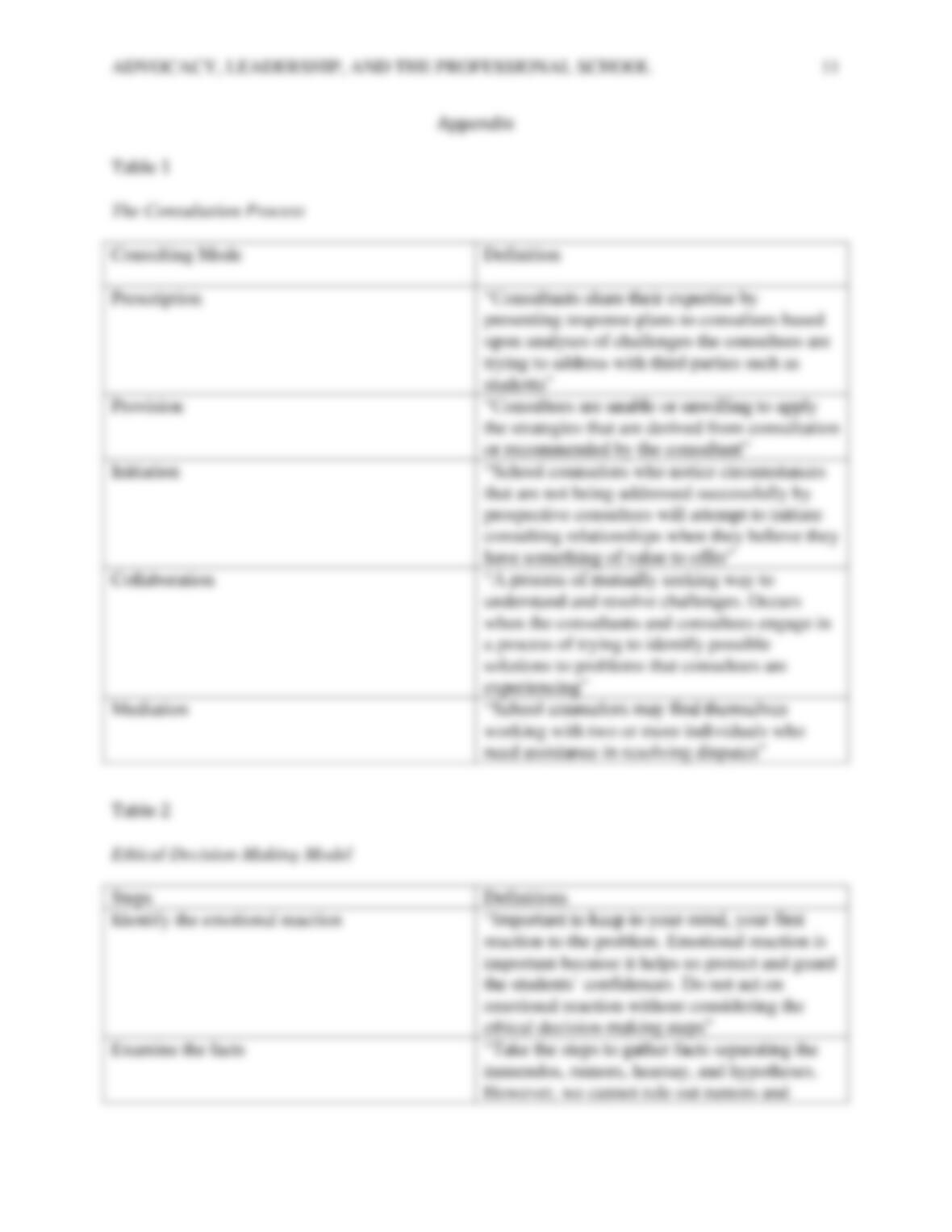
student. The consultation process is categorized into five different consulting modes which
ADVOCACY, LEADERSHIP, AND THE PROFESSIONAL SCHOOL 4
happen between the school counselor and the student or client. These modes are prescription,
provision, initiation, collaboration, and mediation which are described in Appendix A (Baker,
Robichaurd, Westforth Dietrich, Wells, & Schrek, 2009). As school counselors, there is a need
for many to become advocates because they can be there for educational opportunities for the
students, especially those who are the least successful.
The Council for Accreditation of Counseling and Related Educational Programs
(CACREP) 2009 standards defined advocacy as the “action taken on behalf of clients or the
counseling profession to support appropriate policies and standards for the profession; promote
individual human worth, dignity, and potential; and oppose or work to change policies and
procedures, systemic barriers, long-standing traditions, and preconceived notions that stifle