a) Discuss how an operations manager perform the transformation to achieve the
required output? (10 marks).
Production function is that part of an organization, which is concerned with the transformation of a
range of inputs into the required outputs (products) having the requisite quality level.
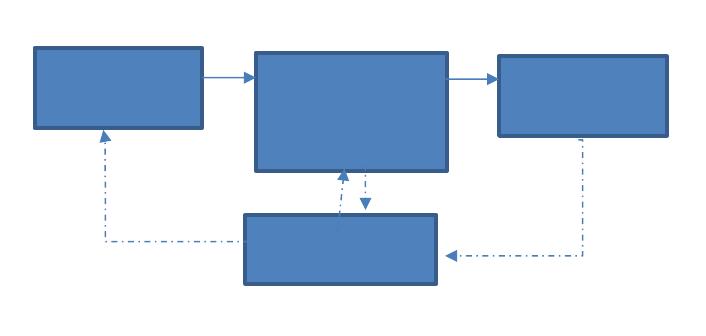
Input is transformed to output via a transformation/conversion process. There are many inputs involved
in a process including labor, capital, technology, information, raw material and so forth. These resources
are transformed into goods or services that are able to satisfy customer wants and needs. This is done
by the transformation processes such as storing, packing, transporting and so forth. Value is added
during the transformation process to convert input into output. Measurement and feedback are
constantly taken throughout the process to evaluate and compare against previously established
standards to decide if a correction is needed.
To ensure desired outputs are achieved, measurements are taken at various points in the
transformation process (known as feedbacks) and compared with previously established standards to
decide if correction is needed. The process flow is given as:
b) Discuss the OM challenges faced by OM managers with example (10 marks)
The challenges faced by OM Managers are as follows:
1) Economic conditions
Measurement
& Feedback
Measurement
& Feedback
Measurement
& Feedback
Input
Transformation/
Conversion
Process
Output
Control
Value Added
In the current economic conditions, it is important for OM managers to ensure that economical
resources are properly segregated to ensure that the company continues to sustain. For
instance, a tradeoff between inventory cost and expenses for R&D will need to be carried out,
hence requiring a detailed study.
2) Innovating
It is important to continuously innovate to ensure that the product does not become stale and
always remain appealing to customers. The first innovated product out in the market will usually
dominate the market such as Apple Iphones, Ipods and so forth.
3) Quality problems
It is always important to ensure the quality of the product is maintained. The OM manager must
decide whether to introduce a new product early and face backlash due to bugs or to spend
more time ironing out issues before releasing them (Windows program for example). This is a
tradeoff that must be made.
4) Risk management
The OM manager must ensure that all risks are properly mitigated internal risks such as safety
of equipment to workers may lead to downtime and loss of reputation if any accidents happen.
External risks such as disasters and changes in government policy must be considered and
contingency plans must be available.
5) Competing in a global economy
When moving into a global environment, many issues must be considered such as whether the
product will suit the new customers. For example, Japanese customers do not like cheap
products as they associate it with low quality (hence Walmart had to change their strategy).
There are also risks such as foreign exchange rates, government policy, taxes and so forth to
take into account.
c) Choose a company, either a manufacturing firm or service firm. Explain their competitive priorities
companies, operations management strategies, performance measurement criteria? (20 marks)
Tenaga Nasional Berhad is a power utility company. One of the businesses under TNB is TNB
Generation where they possess many power plants. TNB power plants main service output is
providing electricity supply to all customers in the nation, with the objective being to keep the lights
always on.
Competitive priorities
There are many competitive priorities such as cost reduction, maximise quality, innovation, time
(being fast) and flexibility.
The main competitive priority employed by TNB power plants is to compete on costs. Hence, much
focus is given in reducing the costs of the electricity generated. As the plants purchase fuel gas from
Petronas and burn the fuel gas to generate electricity, it is important the efficiency of the plant is
maximised to ensure reduction in fuel costs and ensure that maximum power is generated. Other
efforts are also taken to reduce costs such as optimising number of manpower, implementing
Preventive Maintenance strategies and so forth in order to reduce cost.
Time is the secondary competitive priority where by the plant must make sure to startup as fast as
possible to meet the electricity demand. Plant that can startup fast will be given competitive priority
by the Grid System Operator.
According to the Malaysian Grid Code, all power plants must comply with the power quality
requirement. Hence, this has become a bread and butter (order qualifier) for all plants and no longer
a competitive priority.
With an efficient plant, maximum power is generated with minimum fuel consumption, hence
reducing operational cost and increasing profit.
Operation management strategies
There are many operational strategies used by companies. They are given as competing on
differentiation, competing on cost, and competing on response. Here, the OM strategy used by TNB
power plant is competing on cost. The aim of the plant is to reduce fuel costs and maximise power
generated. Other costs involved include fixed cost and labor costs.
The number of manpower is optimised to ensure that the labor costs are kept to a minimum. The
plant is maintained at a good efficiency to ensure that fuel cost remains low and maximum
electricity power is sold to customers to maximise revenue and profit.
Here, the maintenance activities are also thoroughly scrutinised to ensure that maintenance is done
only if needed. Focus on Preventive Maintenance to ensure reliability and cost-savings. The plant
try to avoid breakdowns as this causes downtime and hence loss in revenue and increase in cost.
The secondary strategy used is competing on response time, whereby the plant must be able to
dispatch power immediately when instructed by Grid System Operator. Any delays will cause a
penalty and lead to other plants being given the preference. Hence, the strategy is to ensure plant
starts as fast as possible.
The power plant does not compete on differentiation as the quality and specification of the
electricity being supplied to customer has been clearly stipulated by Suruhanjaya Tenaga in the
Malaysia Grid Code, hence no deviations allowed.
Performance measurement criteria
The performance measurement criteria used is the efficiency of the plant:
Efficiency = Output (Energy Sold)/ Input (Fuel Energy) x 100%
Trending is carried out on the plant efficiency to monitor if there is any drop in efficiency. Corrective
action will be needed if there is any drop in efficiency,
Apart from that, profit is also calculated using Profit = Total Revenue – Total Cost
Trending is also carried out monthly on the revenue, cost and profit, The profit is compared against
a target and intervention will be needed if unable to achieve target.
Time is also measured from the time Despatch Instruction is given by the Grid System Operator until
the time the plant is able to deliver electricity to the grid. The time difference must be minimised to
ensure that the plant gains a competitive edge.
Unplanned outage rate (UOR) is also measures as follows:
UOR = Total Energy Loss during downtime/Total energy possibly sold in a year x 100%
The plant want to minimise the UOR value (minimise downtime) to prevent financial losses, hence
important to carry out Preventive Maintenance activities.
For Preventive Maintenance activities, the measure of effectiveness is:
Total number of breakdowns/Total number of Preventive maintenance activities.
The goal is to minimise the ratio to ensure that total number of breakdowns is minimised and
number of preventive maintenance activities are maximised
(i) Manufacturing and services are often different in terms of what is done but quite similar in
terms of how it is done. Please explain the difference between good versus providing services.
(10marks)
Goods and services are different in terms of what is done but similar in terms of how it is done.
The differences are given as
1) Production and delivery – Production of goods result in tangible outputs that can be seen
or touched while service delivery implies that an act is taken (may combine time, location,
form or psychological value)