Chapter 01 – Cost Accounting: Information for Decision Making
Chapter 1
Cost Accounting: Information for Decision Making
Solutions to Review Questions
•
Financial accounting is designed to provide information about the firm to external
users. External users include investors, creditors, government authorities,
regulators, customers, competitors, suppliers, labor unions, and so on. Cost
accounting systems are designed to provide information to internal users
(managers).
This difference is important, because it affects the design of the systems. Financial
accounting systems are based on standards or rules. This allows the user to
compare the results of different firms. Managerial accounting systems do not
require rules. Each firm is free to develop managerial accounting systems that best
serve the needs of the decision makers (managers).
•
B Providing cost information for financial reporting
A Identifying the best store in a chain
C Determining which plant to use for production
•
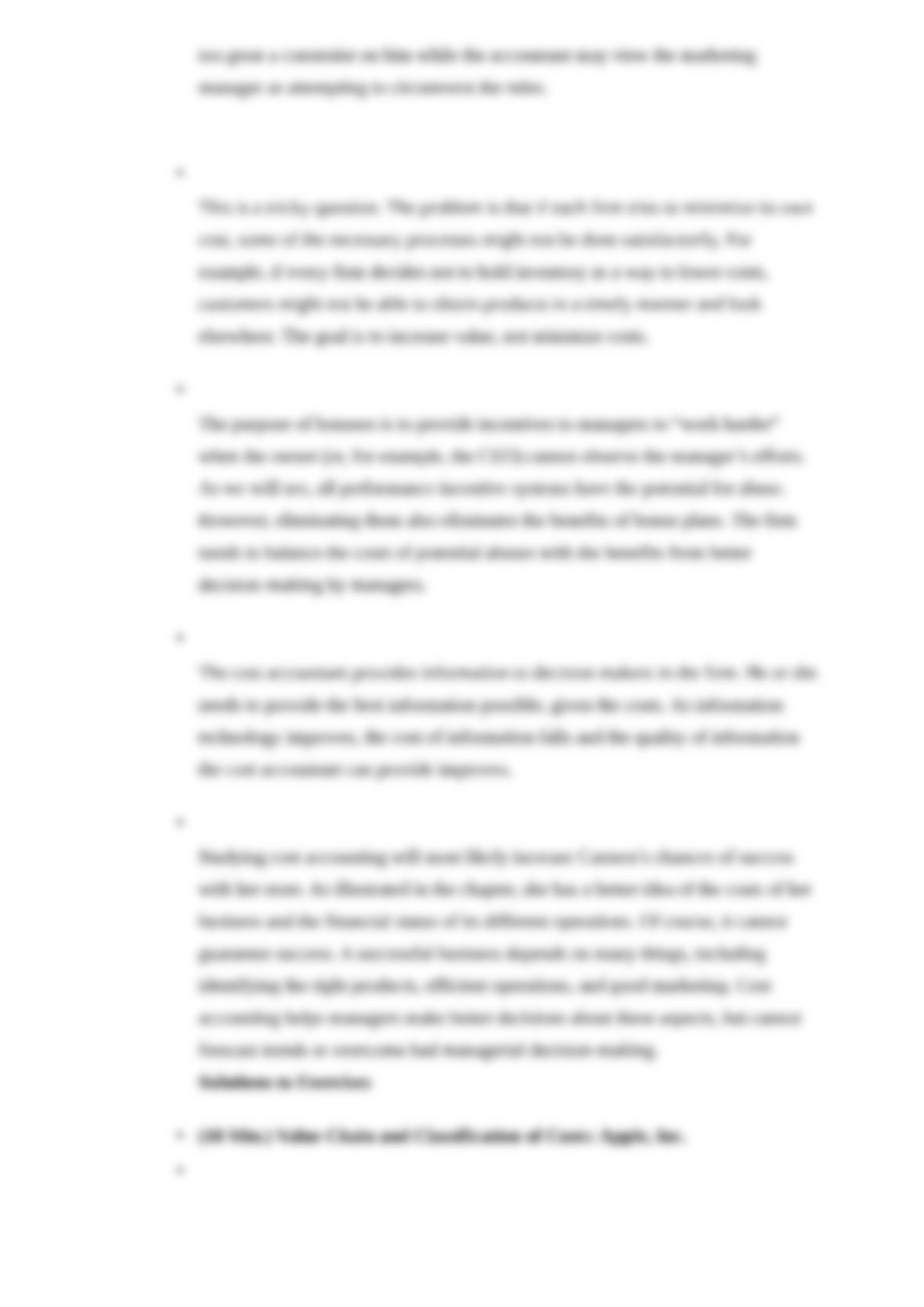
The value chain is the set of activities that transforms raw resources into the goods
and services end users purchase and consume. The supply chain includes the set of
firms and individuals that sells goods and services to the firm. The distribution
chain is the set of firms and individuals that buys and distributes goods and services
from the firm.
•
The customers of cost accounting are managers, from plant managers to the CEO.
•
Value-added activities are activities that customers perceive as adding utility to the
goods or services they purchase. Nonvalue-added activities do not add value to the
goods or services. By classifying costs this way, the cost accounting system can
help the manager identify areas (processes) that can be improved, lowering costs
and adding value to the organization.
•
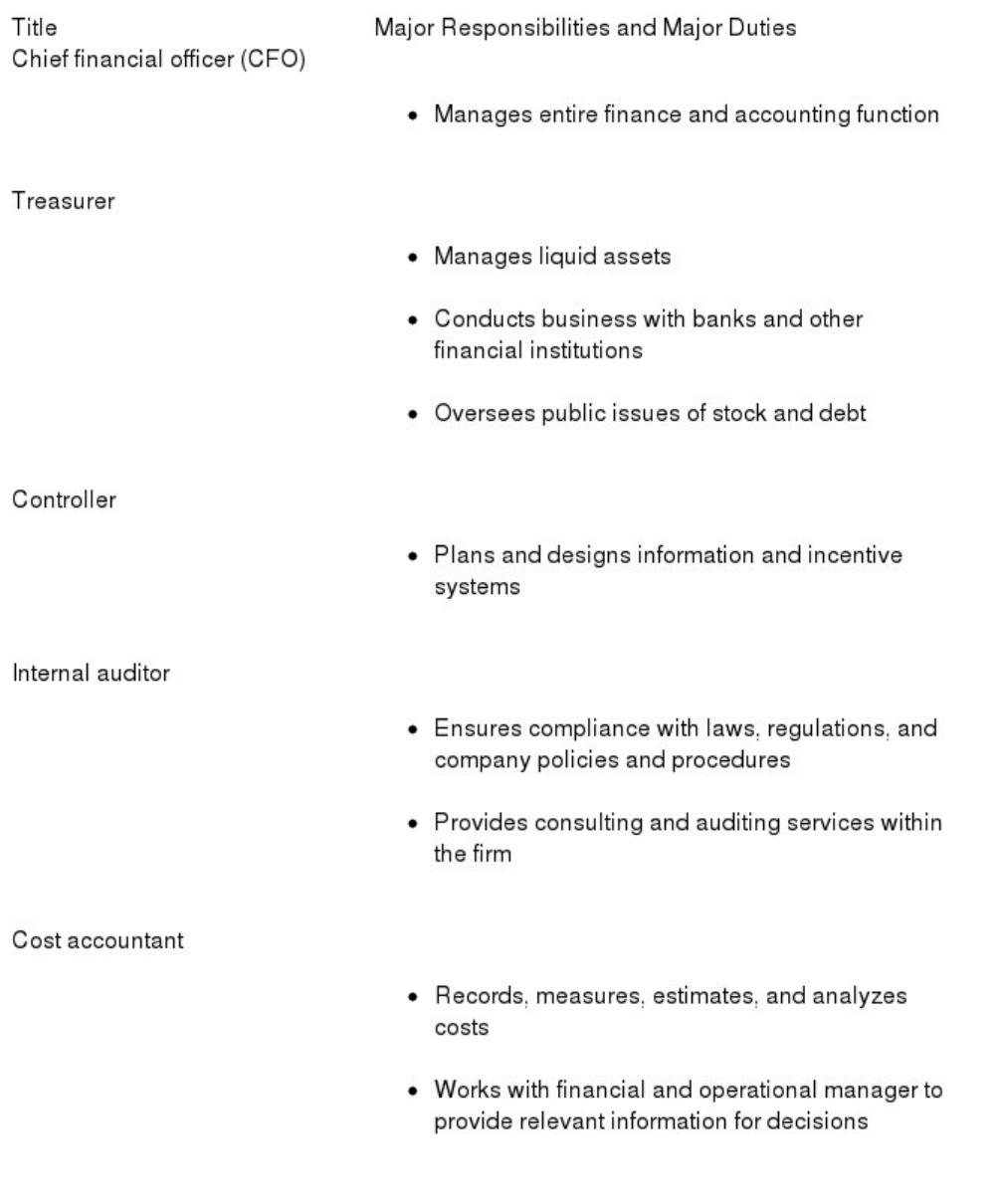
Answers will vary, but should include some of the following:
•
No. Sarbanes-Oxley is a law and violations of it are legal issues. Codes of ethics
are necessary to help accountants and managers identify situations that might
develop into ethical conflicts, understand what they could do in these situations,
and to learn what to do when they believe that an ethical violation has occurred.
Solutions to Critical Analysis and Discussion Questions
•
The calculation of cost depends on the decision being made. Therefore, the first
question to ask is, “What decision (or decisions) are you trying to make?”
•
Costs that you could ask to be reimbursed might include the fuel, a share of the
maintenance costs, “wear and tear,” or depreciation, and insurance. To avoid
disagreements, it would be necessary to negotiate an agreement (even if only
informally) between you and your friend considering all factors. For example, you
might agree that she should pay for the gas and any other supplies (e.g., oil) needed
on the trip.
If you are going along, you might change the agreement so that you split these
costs. Alternatively, you might say that because you are going anyway, she can ride
along for nothing.
•
Although it is not the “job” of accounting to determine strategy, accounting
provides important information to those who do determine strategy. If the cost
accounting system provides inaccurate information, the firm may end up with an
unintended strategy, because managers are making decisions based on faulty
information.
•
Executive performance evaluation systems are designed for a specific company’s
needs. The systems should be flexible to adapt to the circumstances that exist in
that company. A common set of accounting principles would tend to reduce
flexibility and usefulness of these systems. As long as all parties know the
accounting basis used by the system, the exact rules can be designed in whatever
manner the parties deem appropriate.
•
Airlines are characterized by the need to own a substantial amount of capacity
costs. Managers at airlines require very sophisticated load management information
that predicts the number of passengers flying on a particular route on a particular
day. If they set a single price that would cover their costs given a certain number of

passengers, they risk flying with empty seats. Once the plane takes off, they cannot
sell the seat. Therefore, they need a flexible pricing system. Such a system requires
detailed cost information about passengers and aircraft.
The costs are unlikely to be much different among passengers. The variable costs
are relatively low (per passenger) and may include food and beverage, some
baggage handling cost, some ticket processing costs, and, depending on the plane, a
(very) small amount of fuel.
•
The cost accounting issues for Nabisco are the same as for Carmen’s Cookies in the
sense that managers at Nabisco want the same kind of information as Carmen: what
are the costs of cookies, who is performing the best, and so on.
The cost accounting issues are different in the size and complexity of the operations
at Nabisco compared to Carmen’s Cookies.
•
In decision-making, managers or supervisors may wish to take actions that they
believe will increase the firm’s value that are difficult to justify given available
information. Often, these situations arise when managers are using their intuition
and their experience to identify new business opportunities and cannot point to data
that support their views. For example, a marketing manager might view investment
in a new advertising campaign as necessary for remaining competitive even though
it appears to increase costs. Because the accountant does not have expertise in this
area, she cannot verify the information the marketing manager is using.
In a few cases, however, a marketing manager may wish to pursue a project
because of personal reasons (for example, because he was the champion of the
product), and hopes to have an economic analysis to justify additional advertising
support. In these situations, care must be taken to ascertain the economic merits of
the plan, and, if the plan cannot be justified on economic grounds, the manager