Cheat Sheet
Chapter 1:
ASSETS=OWNERS EQUITY + LIABILITIES
ASSETS
EQUITY
LIABILITIES
Cash
Owners Equity
Creditors
+ Accruals
Plant & Equipment
– Administrative Wages
Loans
Raw Material
+Profit
Deferred Revenue
Processed Inventory
-Depreciation
Labor for creation of product
-Cost of doing business
Finished Goods inventory
– Depreciation to Plant & Equip
– Expenses like maintenance
Prepayments
Debtors
– Bad Debts
In P&L: Inventory & Labor that include in Cost of Sales is only that which applies to goods actually sold
Balance Sheet: Inventory means the value of all inventory (raw & finished)
Cash: Increase in inventory is total inventory
Provision for bad debt:
Year One Debtors
100,000
Year Two Debtors
122,000
Policy: bad debts
provision set at 5%
Same policy
Specific bad debt
arising in Year 2 to be
written off
2,000
Entry in P&L
Entry in P&L
Charge for bad debts
provision
5000
Bad debt written off
2,000
Top Up provision to 5%
(5% of 120K – 5000, its
120K because 122k
minus 2k bad debts)
1000
Entry in balance sheet
Entry in Balance Sheet
Debtors less provision
95,000
Debtors
$120,000
Less Provision ($6000)
$114,000
Chapter 2:
Cost of goods sold = cost of opening stock + cost of purchases – cost of closing stock
If using average cost method to calculate cost of closing stock, don’t forget to include the opening
balance value in your calculations
Reducing Balance Depreciation = 1 – nth Sq Root (Scrap cost/Cost), n = life of asset – but most of the
time you are given a precentage which you apply to an ever diminishing book value.
Bad debts are taken off debtors in the Balance Sheet
Rent is a general expense in the P&L.
The P&L only contains expenses that are for the time period in questions, prepayments are instead
included in the Current Assets section of the Balance Sheet
Accruals appear in the Current Liabilities section of the balance sheet, they are taken added to the
Creditors figure.
Cash Statement : ortcaelf
O= Cash Flow from Operations (Profits after tax & interest (+depreciation + increase in bad debts
provision), increase in inventory/creditors (+),decrease in creditors )
R = Returns on Investments & servicing finance (e.g. interest paid)
T = Taxation (Taken from last year’s balance sheet)
C = Capital Expenditure (cash from selling assets
A = Acquisitions
E= Equity Dividend (including increase in shares & Drawings on Cash)
L = Management of liquid resources (govt securities etc.)
F = Financing (increase or decrease in loans)
Gearing = (Long term Debts/Owners Equity)
Return on Owners Equity = (Profit after interest on loan/Equity) x 1000
Note: Equity includes any long term debts
Chapter 3:
Deferred Income:
Example: One year subscription = $75, Three year = $ 210. In 1996 there were 3000 one year and 2000
three year subscriptions:
Balance Sheets
1996
1997
1998
Cash
645000
–
–
Owners Equity
$X
$X
$X
Deferred Revenue
280,000
140,000
–
Profit and Loss
Account
Subscription Revenue:
One Year
225,000
–
–
Three Years
140,000
140,000
140,000
Total
365,000
140,000
140,000
Only this years rightful income appears in the P&L, Deferred Revenue is used to offset the artificially high
Cash figure
The result of the cash flow statement should equal the increase (or decrease) of ‘Cash’ in the Current
Assets part of the balance sheet from one year to the next.
Note: When calculating cash flow its important to include any fixed assets disposed of. Look at the book
value in the previous years balance sheet and the value at the end of this year’s. If they differ then there
was a fixed asset disposal, you must calculate the actual value of the disposal (rather than the profit) and
include that in the cash flow statement.
Note: Do not include bank overdrafts in the cash flow statement – instead add their delta to the cash delta
and compare to the cash flow statement result
Chapter 6:
Ratios are only good when comparing companies of a similar size and in the same type of business.
Liquidity:
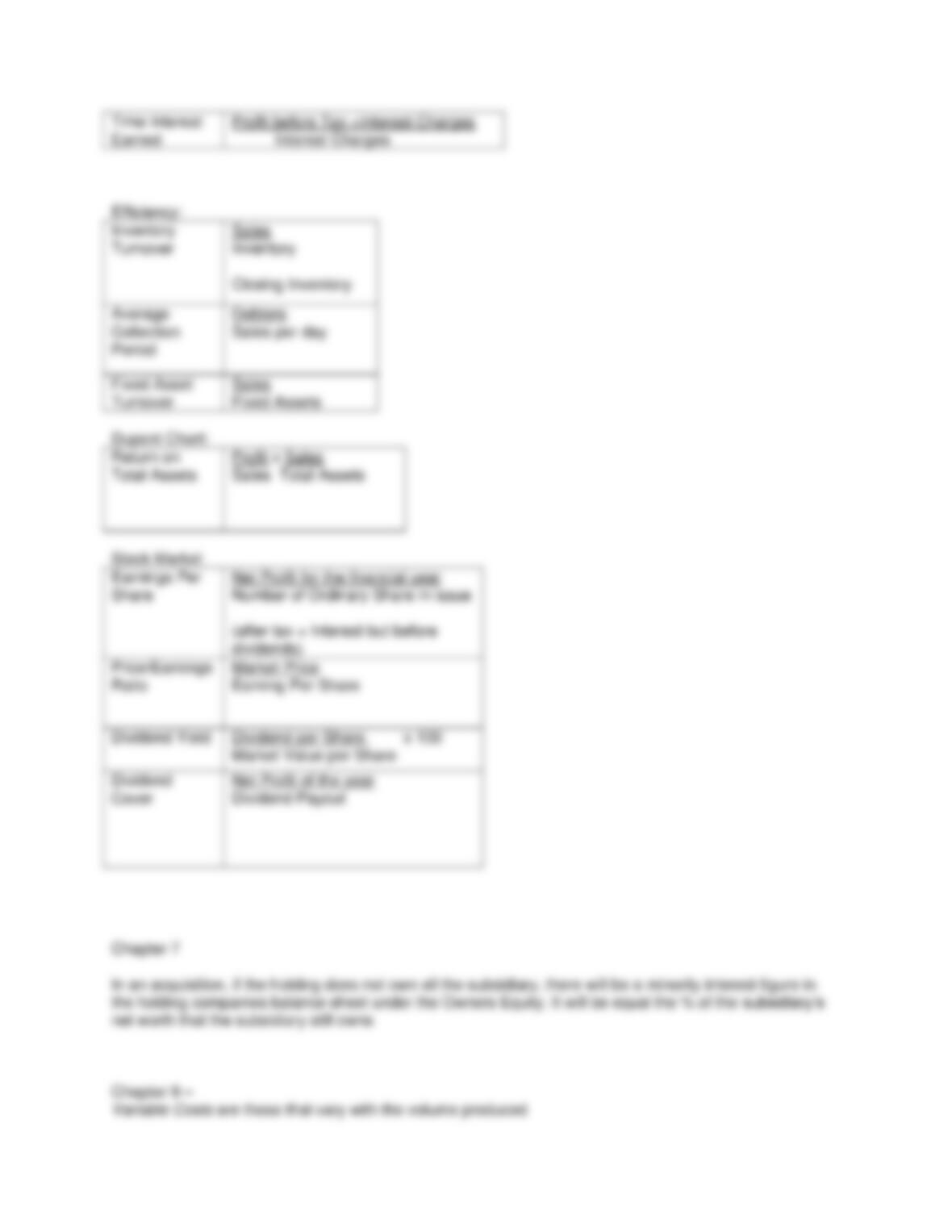
Current Ratio
Current Assets
Current Liabilities
Quick Ratio
(Acid Test)
Current Assets – Inventory
Current Liabilities
Profit:
Gross Profit
Margin
Gross Profit x 100%
Sales
Profit Margin
Profit before Interest and Taxes x 100%
Sales
(Profit includes that from associated
companies)
Return on
Total Assets
Profit before Interest and Taxes x 100%
Total Assets
Specific
Assets
Return on
Capital
Employed
Profit before Interest and Taxes x 100%
(Owners Equity = share capital + retained
earnings + share premium)
Fixed to
Current Asset
Fixed Assets
Current Assets