King Fahd University of Petroleum & Minerals
KFUPM Business School, Department of Accounting and Finance
Advanced Accounting
TAKE-HOME EXAM (192)
Thursday, 26 March, 2020, 12:00 P.M
Due: 12:00 PM, 27 March, 2020, Friday
Reading time: 5 minutes
Student Name: _______________________________________
ID No. _______________________________________
Part
Questions/Topic
Points
Score
Est. Time
2
Problems and Quantitative
80
150 min.
80
150 min.
Instructions:
• Write your NAME and your ID number on answer sheet.
• Answer all 3 questions
• Read each question carefully and write your answers clearly.
• Allocate your time wisely between exam parts.
• Show all work and computations to receive full credit.
• Submit your answer sheet via blackboard link for this exam
GOOD LUCK!
ACCT 403
(

Question 1
(a) The ownership of majority voting rights in itself may not be a decisive factor of control in
IFRS 10 Consolidated Financial Statements. Discuss two situations where ownership of
majority voting rights is not a conclusive determinant (decisive factor) of control. (8
marks)
Answer:
IFRS 10 adopts a principles-based approach towards determining control. The three essential
attributes of control require the investor to have the ability to use power to affect returns of
another entity. Power may arise from voting rights and other sources such as contracts and
special relationships. All three elements must be present for control to exist. IFRS 10 emphasizes
de facto control that may arise from the holding of relative voting power.
Examples where ownership of majority voting rights do not necessarily lead to control include
the following:
• Competing sources of power. IFRS 10 requires a consideration of all facts and circumstances to
determine if control exists. Other sources of power must be considered. These sources include
potential voting rights, contracts and special relationships. The strength of power of a majority
shareholder is weakened if other shareholders have power from other sources besides voting
rights. For example, a minority shareholder may have control through contractual arrangements
or special relationships that allow the minority shareholder to make decisions about the most
relevant activities that impact returns. An example is the buying out of founder shares of an
entrepreneurial company. The founder may hold minority shares but may have informal power
through specialized knowledge of the business and the power over the employees through the
long-term relationships that the founder has built up over the years. Through contracts, the
founder may also be retained to serve as the chief executive of the company. The combined
power of the minority voting rights, decision-making power and power through special
relationships may enlarge the power base of the minority shareholder relative to those of the
majority shareholder.
• Absence of ability. A majority shareholder may have substantial barriers to exercise control. In
such a situation, the shareholder does not have the ability to affect returns. Examples of barriers
include regulatory barriers. For example, the investment may be in a foreign country that requires
the majority of the board of directors to be made up of local directors. In the absence of contractual
arrangements between the board of directors and the investor, the investor would not have the
practical ability to make decisions about the relevant activities that affect the investee’s returns.

(b) In March 20×5, P Co performed due diligence tests on W Co. On 1 May 20×5, P Co completed
the purchase of 75% of W Co from D Co, the existing owner of W Co. The following
expenditures by P Co occurred during the period 1 March 20×5 to 1 May 20×5. Transaction
costs are paid in cash.
Payment to consultants to conduct due diligence checks
$150,000
Shares issued by P Co to D Co
1,500,000
Fair value per share of P Co at date of share issue
$2.40
Salary of Business Development Manager of P Co for Mar-Apr
20×5
$50,000
Travelling and hotel expenses incurred by the Business Development Manager
directly related to the acquisition of W Co
$10,000
Undiscounted cash payment payable to D Co at the end of 1 year
$750,000
Interest payable to D Co for deferred payment
5%
Assumption of the liabilities of the D Co (P assumes legal
obligation to pay off the short-term liabilities of D Co)
$120,000
Legal fees to execute sales agreement with D Co
$18,000
Stamp duties and other incidentals of share issue to D Co
$17,000
Details relating to W Co as at 1 May 20×5:
$
Share capital
1,200,000
Retained earnings
4,000,000
Other reserves
180,000
5,380,000
Fair value of unrecognized intangible asset
300,000
Estimated useful life of intangible asset from 1 May 20×5
5 years
Fair value of non-controlling interests
1,400,000
Tax rate is 20%. Recognize tax effects on fair value adjustments.
Required
i. Determine the consideration transferred in accordance with IFRS 3 Business
Combinations. (3 marks)
ii. Show the journal entry or entries in P’s books to record the expenditures incurred by P Co
in 20×5. (5 marks)
iii. Show partial consolidation entries for the year ended 31 December 20×5 (8 marks)
Answer:
(a) Determine the consideration transferred in accordance with IFRS 3 Business Combinations.
Fair value of shares issued
1,500,000*2.40
3,600,000
Deferred payment to D Co (Loan
payable)
(750,000@5% end of 1 years)
714,286
Assumption of short-term liabilities
120,000
Consideration transferred
4,434,286
(b) Show the journal entry or entries in P’s books to record the expenditures incurred by P Co in
20×5.
Dr Investment in W
4,434,286
Dr Unamortized discount on loan
35,714
Cr Share capital (equity)
3,600,000
Cr Loan payable to D Co
750,000
Cr Short-term liabilities
120,000
Consideration transferred
4,470,000
4,470,000
Dr Acquisition-related expenses
168,000
Dr Business development expenses
60,000
Dr Equity
17,000
Cr Cash
245,000
Transaction costs expensed
off
Dr Share capital
Dr Retained earnings
Dr Other reserves
Dr Goodwill
(Note 1)
Dr Intangible asset
Cr Investment in W
Cr Deferred tax liability
Cr Non-controlling interests
Elimination of investment in
S
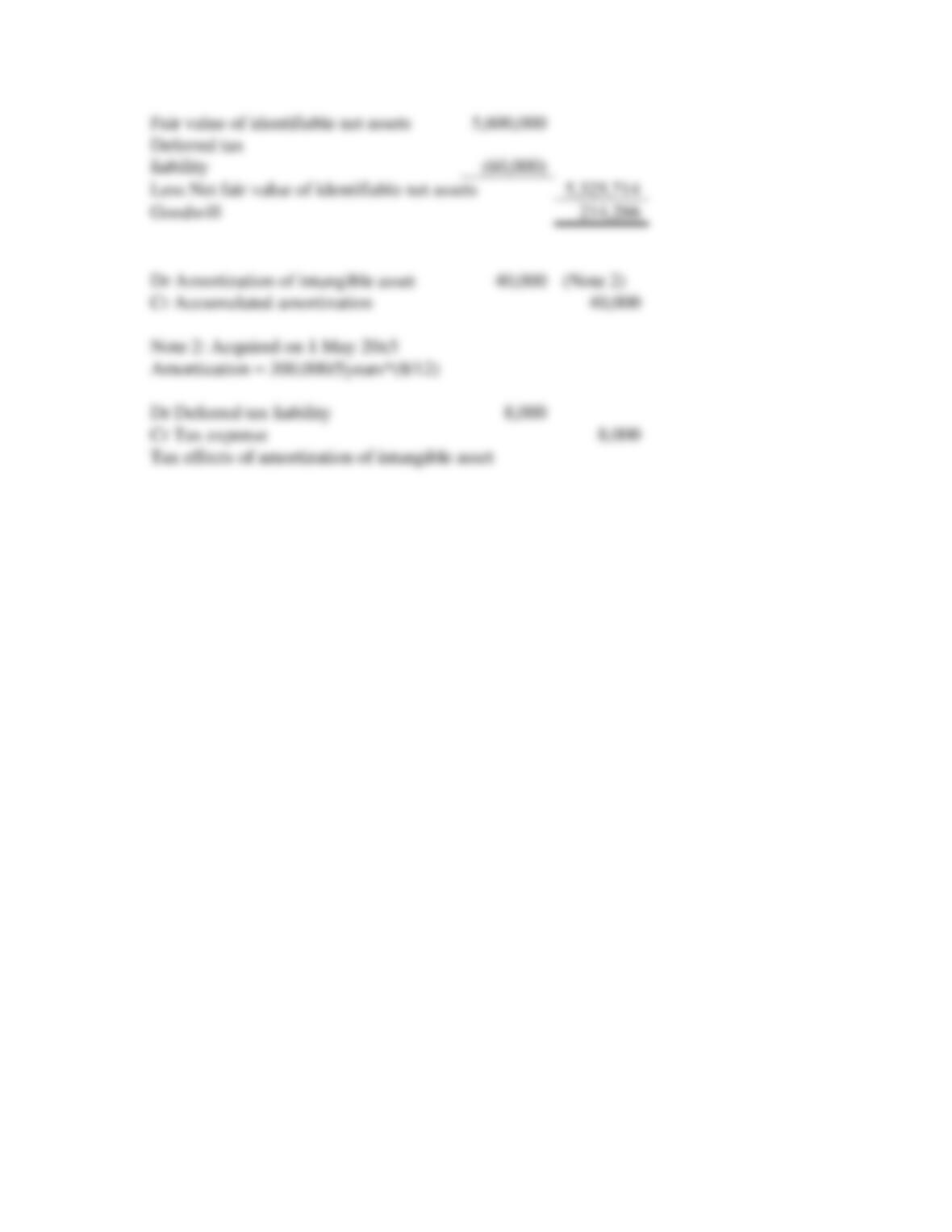
Note 1: Goodwill
Consideration transferred
Fair value of non-controlling interests