Chapter 2 Homework
E2-2. (Usefulness, Objective of Financial Reporting, Qualitative Characteristics) (LO 1, 2, 3)
Indicate whether the following statements about the conceptual framework are true or false. If false, provide a
brief explanation supporting your position.
a) The fundamental qualitative characteristics that make accounting information useful are relevance and
verifiability.
b) Relevant information only has predictive value, confirmatory value, or both.
c) Information that is a faithful representation is characterized as having predictive or confirmatory value.
d) Comparability pertains only to the reporting of information in a similar manner for different companies.
e) Verifiability is solely an enhancing characteristic for faithful representation.
f) In preparing financial reports, it is assumed that users of the reports have reasonable knowledge of
business and economic activities.
E2–3. (Qualitative Characteristics) (LO 3, 7)
SFAC No. 8 identifies the qualitative characteristics that make accounting information useful. Presented below are a
number of questions related to these qualitative characteristics and underlying constraint.
a) What is the quality of information that enables users to confirm or correct prior expectations?
b) Identify the pervasive constraint developed in the conceptual framework.
c) The chairman of the SEC at one time noted, “If it becomes accepted or expected that accounting principles
are determined or modified in order to secure purposes other than economic measurement, we assume a
grave risk that confidence in the credibility of our financial information system will be undermined.” Which
qualitative characteristic of accounting information should ensure that such a situation will not occur? (Do
not use faithful representation.)
d) Muruyama Corp. switches from FIFO to average-cost to FIFO over a 2-year period. Which qualitative
characteristic of accounting information is not followed?
e) Assume that the profession permits the savings and loan industry to defer losses on investments it sells
because immediate recognition of the loss may have adverse economic consequences on the industry.
Which qualitative characteristic of accounting information is not followed? (Do not use relevance or faithful
representation.)
f) What are the two fundamental qualities that make accounting information useful for decision-making?
g) Watteau Inc. does not issue its first-quarter report until after the second quarter’s results are reported.
Which qualitative characteristic of accounting is not followed? (Do not use relevance.)
h) Predictive value is an ingredient of which of the two fundamental qualities that make accounting
information useful for decision-making purposes?
i) Duggan, Inc. is the only company in its industry to depreciate its plant assets on a straight-line basis. Which
qualitative characteristic of accounting information may not be followed?
j) Roddick Company has attempted to determine the replacement cost of its inventory. Three different
appraisers arrive at substantially different amounts for this value. The president, nevertheless, decides to
report the middle value for external reporting purposes. Which qualitative characteristic of information is
lacking in these data? (Do not use relevance or faithful representation.)

E2–5. (Elements of Financial Statements) (LO 4)
Ten interrelated elements that are most directly related to measuring the performance and financial status of an
enterprise are provided below.
Assets
Distributions to owners
Expenses
Liabilities
Comprehensive income
Gains
Equity
Revenues
Losses
Investments by owners
Instructions: Identify the element or elements associated with the 12 items below.
a) Arises from peripheral or incidental transactions.
b) Obligation to transfer resources arising from a past transaction.
c) Increases ownership interest.
d) Declares and pays cash dividends to owners.
e) Increases in net assets in a period from non-owner sources.
f) Items characterized by service potential or future economic benefit.
g) Equals increase in assets less liabilities during the year, after adding distributions to owners and
subtracting investments by owners.
h) Arises from income statement activities that constitute the entity’s ongoing major or central operations.
i) Residual interest in the assets of the enterprise after deducting its liabilities.
j) Increases assets during a period through sale of product.
k) Decreases assets during the period by purchasing the company’s own stock.
l) Includes all changes in equity during the period, except those resulting from investments by owners and
distributions to owners.
E2–6. (Assumptions, Principles, and Constraint) (LO 5, 6)
Presented below are the assumptions, principles, and constraint used in this chapter.
1) Economic entity assumption
2) Going concern assumption
3) Monetary unit assumption
4) Periodicity assumption
5) Measurement principle (historical cost)
6) Measurement principle (fair value)
7) Expense recognition principle
8) Full disclosure principle
9) Cost constraint
10) Revenue recognition principle
Instructions: Identify by number the accounting assumption, principle, or constraint that describes each
situation below. Do not use a number more than once.
(a) Allocates expenses to revenues in the proper period.
(b) Indicates that fair value changes subsequent to purchase are not recorded in the accounts. (Do not use revenue
recognition principle.)
(c) Ensures that all relevant financial information is reported.
(d) Rationale why plant assets are not reported at liquidation value. (Do not use historical cost principle.)
(e) Indicates that personal and business record keeping should be separately maintained.
(f) Separates financial information into time periods for reporting purposes.
(g) Assumes that the dollar is the “measuring stick” used to report on financial performance.

E2–7. (Assumptions, Principles, and Constraint) (LO 5, 6)
Presented below are a number of operational guidelines and practices that have developed over time.
Instructions: Select the assumption, principle, or constraint that most appropriately justifies these procedures
and practices. (Do not use qualitative characteristics.)
(a) Fair value changes are not recognized in the accounting records.
(b) Financial information is presented so that investors will not be misled.
(c) Intangible assets are amortized over periods benefited.
(d) Agricultural companies use fair value for purposes of valuing crops.
(e) Each enterprise is kept as a unit distinct from its owner or owners.
(f) All significant post-balance-sheet events are disclosed.
(g) Revenue is recorded when the product is delivered.
(h) All important aspects of bond indentures are presented in financial statements.
(i) Rationale for accrual accounting.
(j) The use of consolidated statements is justified.
(k) Reporting must be done at defined time intervals.
(l) An allowance for doubtful accounts is established.
(m) Goodwill is recorded only at time of purchase.
(n) A company charges its sales commission costs to expense.
E2–9. (Accounting Principles and Assumptions—Comprehensive) (LO 6)
Presented below are a number of business transactions that occurred during the current year for Gonzales, Inc.
Instructions
In each of the situations, discuss the appropriateness of the journal entries in terms of generally accepted
accounting principles.
(a) The president of Gonzales, Inc. used his expense account to purchase a new Suburban solely for personal use.
The following journal entry was made.
Miscellaneous Expense
29,000
Cash
29,000
(b) Merchandise inventory that cost $620,000 is reported on the balance sheet at $690,000, the expected selling
price less estimated selling costs. The following entry was made to record this increase in value.
Inventory
70,000
Sales Revenue
70,000
(c) The company is being sued for $500,000 by a customer who claims damages for personal injury apparently
caused by a defective product. Company attorneys feel extremely confident that the company will have no liability
for damages resulting from the situation. Nevertheless, the company decides to make the following entry.
Loss from Lawsuit
500,000
Liability for Lawsuit
500,000
(d) Because the general level of prices increased during the current year, Gonzales, Inc. determined that there was
a $16,000 understatement of depreciation expense on its equipment and decided to record it in its accounts. The
following entry was made.
Depreciation Expense
16,000
Accumulated Depreciation—Equipment
16,000
(e) Gonzales, Inc. has been concerned about whether intangible assets could generate cash in case of liquidation.
As a consequence, goodwill arising from a purchase transaction during the current year and recorded at $800,000
was written off as follows.
Retained Earnings
800,000
Goodwill
800,000
(f) Because of a “fire sale,” equipment obviously worth $200,000 was acquired at a cost of $155,000. The following
entry was made.
Equipment
200,000
Cash
155,000
Sales Revenue
45,000
Question 4: Describe the two fundamental qualities of useful accounting information (Discuss the
characteristics of each quality and their meanings).
Chapter 3 Homework
E3–1. (Transaction Analysis—Service Company) (LO 2)
Beverly Crusher is a licensed CPA. During the first month of operations of her business (a corporation), the
following events and transactions occurred.
April 2
2
Invested $32,000 cash and equipment valued at $14,000 in the business.
Hired an administrative assistant at a salary of $290 per week payable monthly.
3
Purchased supplies on account $700. (Debit an asset account.)
7
Paid office rent of $600 for the month.
11
Completed a tax assignment and billed client $1,100 for services rendered. (Use Service Revenue
account.)
12
Received $3,200 advance on a management consulting engagement.
17
Received cash of $2,300 for services completed for Ferengi Co.
21
Paid insurance expense $110.
30
Paid administrative assistant $1,160 for the month.
30
A count of supplies indicated that $120 of supplies had been used.
30
Purchased a new computer for $6,100.
Instructions: Journalize the transactions in the general journal. (Omit explanations.)
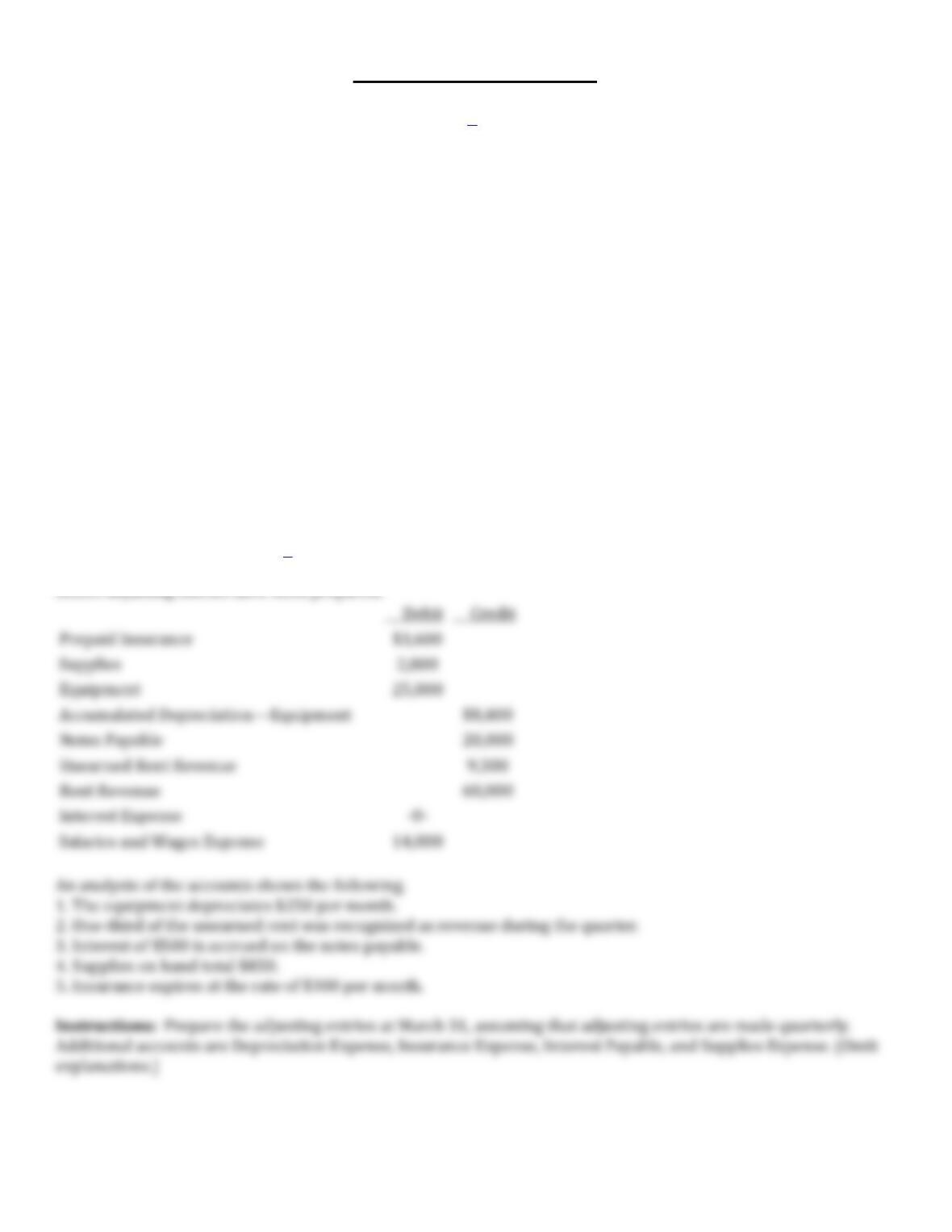
E3-5. (Adjusting Entries) (LO 3)
The ledger of Duggan Rental Agency on March 31 of the current year includes the following selected accounts
Debit
Credit
Equipment
Accumulated Depreciation—Equipment
Unearned Rent Revenue