Chapter 1: Introduction to Accounting Information Systems
1. Enterprise Systems — integrates business process functionality and information from all
of an organization’s functional areas (marketing and sales, cash receipts, purchasing, cash
disbursements, human resources, production and logistics, and business and financial
reporting).
2. E-business — use of electronic networks (including the Internet) to undertake business
processes between individuals and organizations.
3. Internal Control — a process to provide reasonable assurance that organizational
objectives will be achieved.
Implications for both public and private accountants:
Management must identify, document, and evaluate significant internal controls.
Auditors must report on the effectiveness of the organization’s system of internal
controls.
Requires disclosure to the public on a “rapid and current” basis of material changes in
an organization’s financial condition.
CICA’s 2009 Top Ten IT Issues
1. Maintaining adequate controls during the recession
2. Maintaining security over moving data
3. Lack of effective IT governance
4. 4. Coping with information overload
5. Impact of IFRS on Information Systems
6. Green computing
7. Security requirements of the Payment Card Industry (PCI)
8. Malicious activity by laid-off employees
9. Role of Web 2.0 applications in organizational information systems
10.Shortage of IT skills
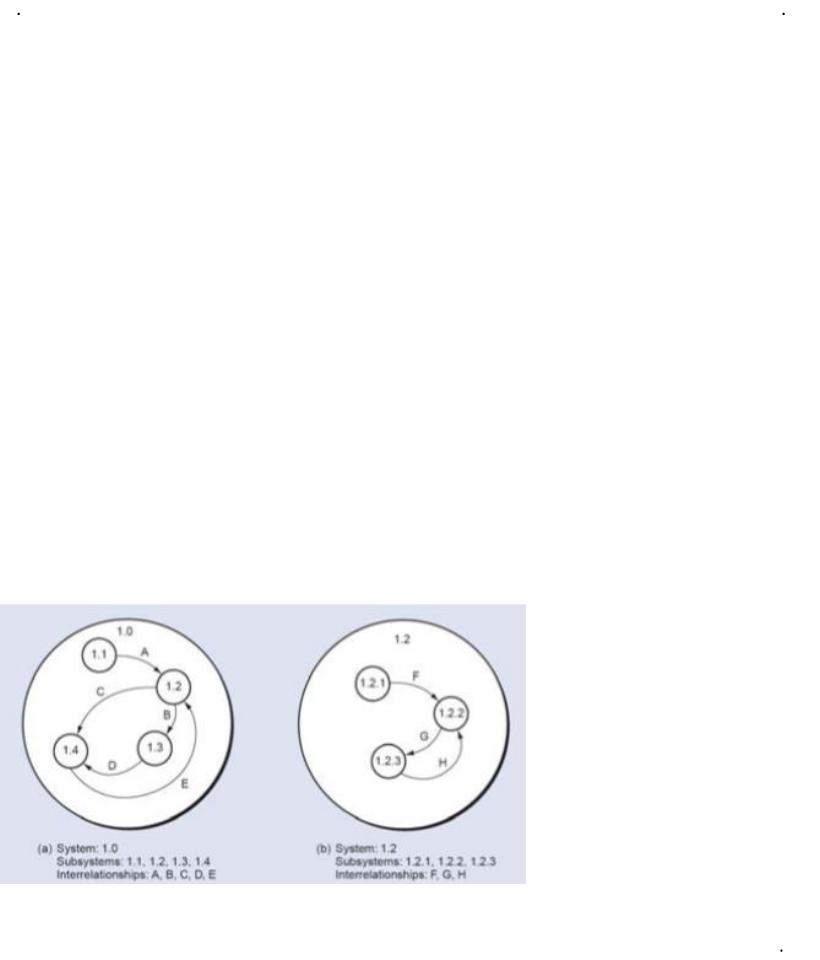
Systems and Subsystems
System: a set of interdependent elements that together accomplish specific objectives. A
system must have organization, interrelationships, integration, and central objectives.
Subsystem: a part of a system. Within limits, any system or subsystem can be divided into its
component parts.

The Information System (IS)
An information system (IS) or management information system (MIS) is a manmade system
that consists of an integrated set of computer based and manual components established to
collect, store, and manage data and to provide output information to users.
The Accounting Information System (AIS)
Accounting information system (AIS) is a specialized subsystem of the IS.
Collect, process and report information related to the financial aspects of business events.
Often integrated and indistinguishable from the overall information system.
Like the IS, the AIS may be divided into components based on the operational functions
supported.
Components are called business processes or AIS subsystems.
Three Business Process Components
Information process: portion of the overall IS related to a particular business process.
Operations process: man-made system consisting of the people, equipment, organization,
policies, and procedures whose objective is to accomplish the work of the organization
Management process: man-made system consisting of the people, authority, organization,
policies, and procedures whose objective is to plan and control the operations of the
organization.
Key Information Qualities
Validity: information about actual authorized events and objects.
Accuracy: correspondence or agreement between the information and the actual events or
objects that the information represents.
Completeness: degree to which information includes data about every relevant object or
event necessary to make a decision and includes that information only once.
Management Decision Making
1. Intelligence: Searching the environment for conditions calling for a decision.
2. Design: Inventing, developing, and analyzing possible courses of action.
3. Choice: Selecting a course of action.
Horizontal and Vertical Information Flows
Horizontal information flows relate to specific business events, such as one shipment, or to
individual inventory items. The information moves through operational units such as sales,
the warehouse, and accounting.
Vertical information flows service a multi-level management function from operations and
transaction processing through tactical, operations, and strategic management.

Accountant’s Role in Current Business Environment
Designer — application of accounting principles, auditing principles, IS techniques, and
systems development methods to design an AIS.
User — participate in the AIS design process.
Auditor — provide audit and assurance services.
Chapter 2: Enterprise Systems
Enterprise Systems and ERPs
Enterprise systems:
Integrate business processes and information from all of an organization’s functional areas.
Helps coordinate the operation of business functions and provide a central information
resource for the organization.
Enterprise Resource Planning (ERP) Systems:
Software packages that can be used for the core systems necessary to support enterprise
systems.
Integrate Business Process Functionality
When purchasing office equipment an enterprise system might:
Provide an electronic order form.
Apply business rules.
Route the order for approvals.
Send the order to a buyer.
Connect to the vendor.
Use data to receive goods, project funding requirements, compare to budget, and analyze
vendor performance.
Third‐Party Modules
Customer relationship management (CRM) software: builds and maintains customerrelated
database.
Customer self-service (CSS) software: allows customers to complete tasks without aid of
organization’s employees.
Sales force automation (SFA) software: automates sales tasks such as order processing and
tracking.
Supply Chain Management (SCM) software: plans and executes demand planning, inventory
acquisition, manufacturing, distributing and selling.
Product Lifecycle Management (PLM) software: manages product data from design through
disposal of product.
Supplier Relationship Management (SRM) software: manages the interactions with
organizations that supply the goods and services to an enterprise; includes procurement and
contract management.

Connecting Third‐Party Modules
Third-party modules are connected to ERP systems using middleware (software for
connecting applications or modules):
Application programming interface (API), provided by the application developer.
Enterprise application integration (EAI), processes, software, standards, and hardware to link
systems, allowing them to act as one.
Other Methods for Systems Integration
Event-driven architecture (EDA), business events trigger messages sent by middleware
between independent software modules.
Enterprise systems bus (ESB), communications-broker software that uses standardized
protocols to let EDA applications communicate.
Business process management, comprehensive method for integrating manual and
automated processes, applications, and systems.
Enterprise Systems Value Chain
The value chain is the system of activities that transform inputs into outputs valued by the
customer.
Enterprise systems facilitate value chain management.
The goal of an organization is to add the greatest value at the lowest cost thus increasing
competitive advantage.
The Value of Systems Integration
Coordinate activities in the value chain.
Perform this coordination by sharing data across business processes.
The following slides describe what life would be like without integrated systems and how
enterprise systems solve some of the problems.
Customer Service Questions
Do you think that Sophia, the customer service representative, wants to keep the customer
on the phone throughout this process?
Would you consider this to be good customer service?
Solution to Inefficient Customer Service
Enterprise system establishes ATP (available to promise) by checking warehouses and
scheduled manufacturing.
Enterprise systems uses the central database to automatically determine price and
creditworthiness.

Major ERP Modules
Sales and Distribution (SD)
Record customer orders
Shipping
Billing
Connections to:
Materials management module (MM)
Financial accounting module (FI)
Controlling module (CO)
Materials Management (MM)
Acquisition and management of goods from vendors
Purchase order preparation
Receiving
Recording invoice
Interacts with
Sales and distribution module (SD)
Financial accounting module (FI)
Controlling module (C0)
Financial Accounting (FI)
Plays a central role in the SAP system.
Incorporates data from other modules into general ledger accounts and financial
statements. Business events from other modules are incorporated into the general
ledger accounts and included in the external financial statements.
The FI module also includes accounts receivable and accounts payable functions to
record and manage that data directly and to complete events begun in the SD and MM
modules.
Controlling (CO)
Often called Controlling and Profitability Analysis (CO/PA)
Handles internal accounting including:
Cost center accounting
Profitability analysis for sales
Activity-based accounting
Budgeting
Human Resources (HR)
Recruiting, management and administration of personnel
Payroll processing
Training and travel
Benefits
Reports
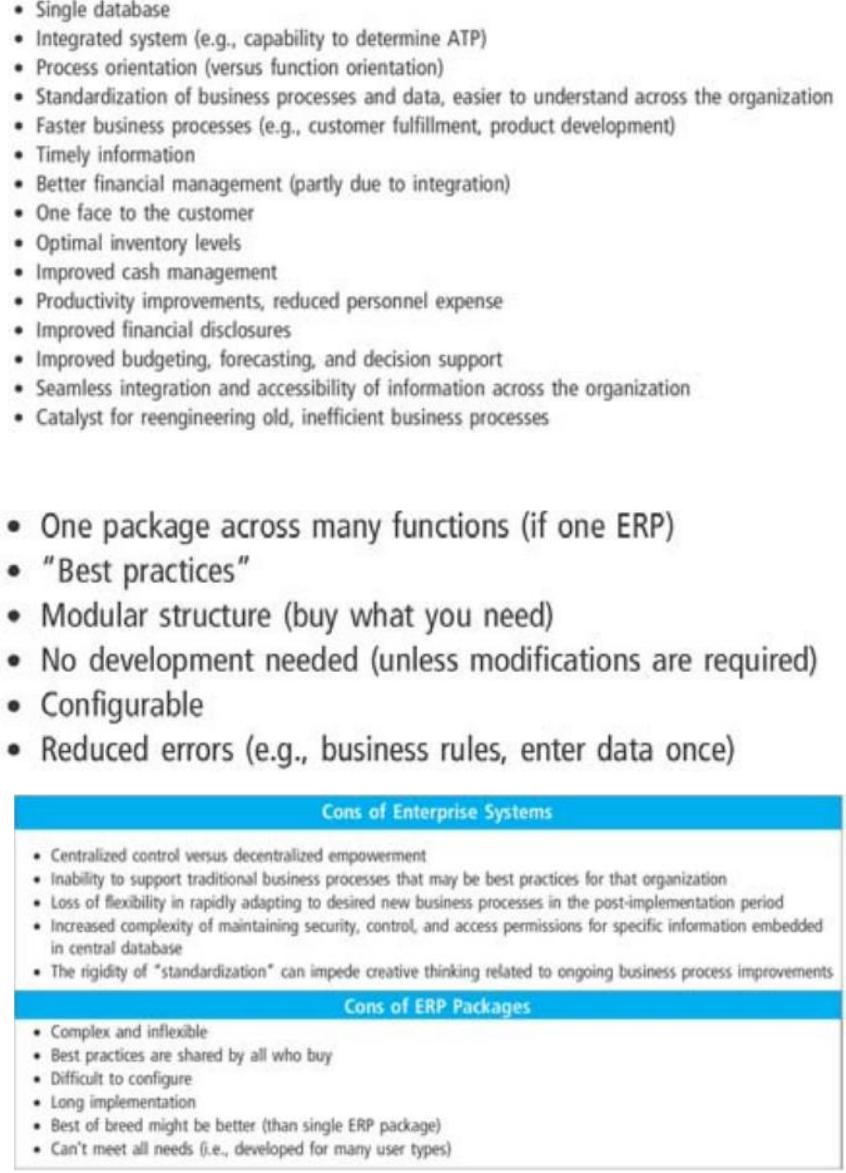
Pros of Enterprise Systems
Pros of ERP Packages
Chapter 3: Electronic Business (E‐Business) Systems
Electronic Business (e‐Business)
Electronic business (e-Business): application of electronic networks (including the Internet) to
exchange information and link business processes among organizations and individuals.
Processes include interaction between backoffice (i.e., internal) processes, such as distribution,
manufacturing, and accounting, and front-office (i.e., external) processes, such as those that
connect an organization to its customers and suppliers
Batch Processing and Periodic Mode
Batch processing: the aggregation of several business events over some period of time with the
subsequent processing of these data as a group by the information system.
Periodic mode: processing mode with delay between the various data processing steps.
Business event occurs
Record business event data
Update master data
Generate outputs
Online Transaction Entry (OLTE)
Enter business events directly, using computer input device or PC, into the information system at