INTRODUCTION
When the invitation arrived, Joe Thompson and Cathy (Cat)
Obertowitch were not sure what to do. The event looked
promising, but the last time they agreed to attend a similar
special event, they had barely broke even. They had left the
event reminding themselves, “We don’t need to say ‘yes’ to
every opportunity.”
Joe and Cat were an engaged couple who had been
running their food truck, Cat & Joe’s Pig Rig, for several
months. Their truck specialized in pulled pork and southern-
style barbecue. “Slow and low1” was the cooking philosophy
of the food truck, which was based in Kamloops, British
Columbia, Canada, a city of 100,000. Business had been
brisk, the truck was outperforming projections, and their
customer base was growing. They had also supplemented
their day-to-day business by attending local events and doing
catering jobs.
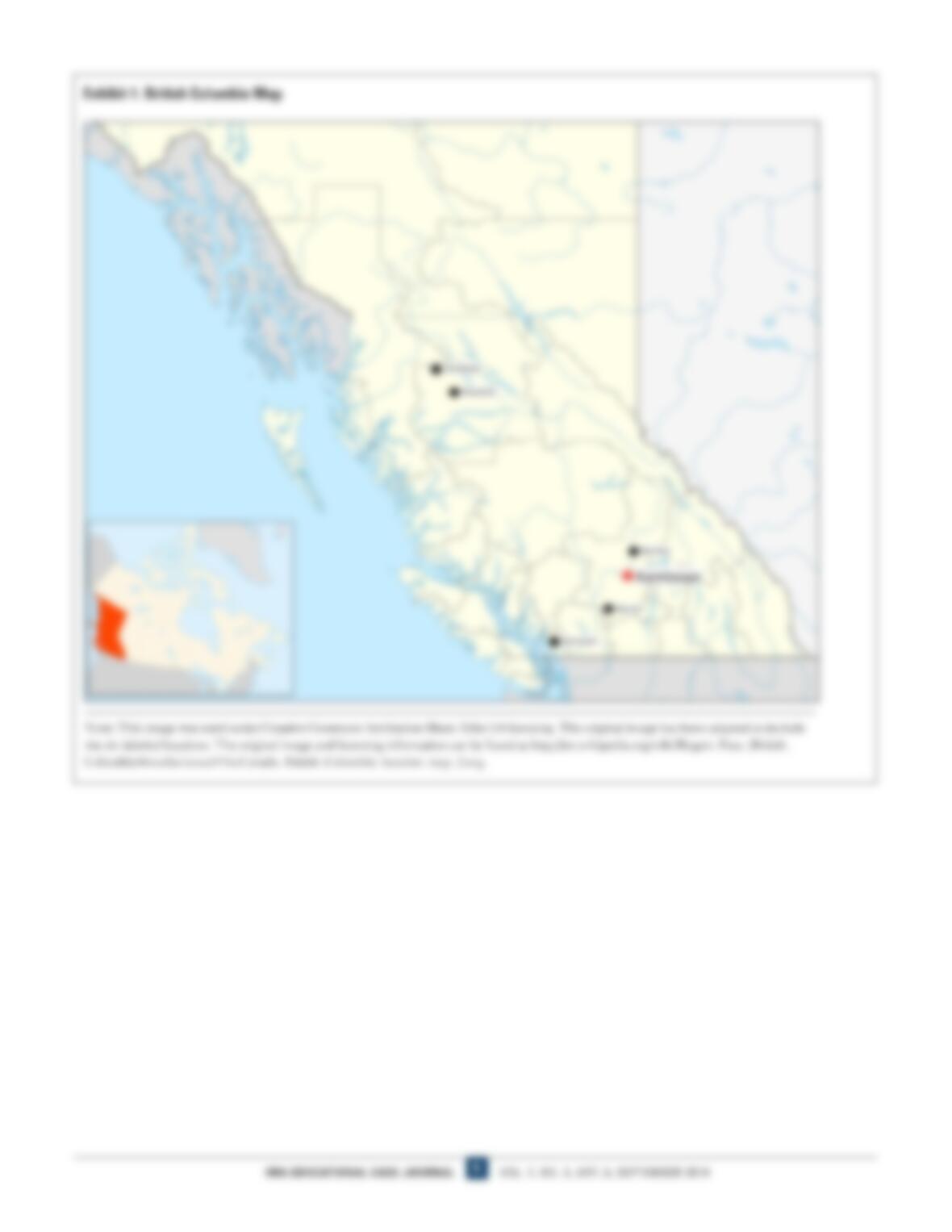
The couple had just received a request to bring their
truck to an event called “Bullarama”—a rodeo held in the
nearby town of Barriere, located 70 kilometers north of
Kamloops (Exhibit 1). Bullarama looked great on paper:
the promoters noted that 700 attendees were expected, Cat
& Joe’s Pig Rig would be the only food option, and rodeo
fans would be a great market for the company’s southern-
style barbecue. Tempering their enthusiasm for the event
were a few mitigating factors: (1) event promoters tended
to be optimistic with promises and projections, (2) the
70-kilometer drive to Barriere added a number of costs
that may be significant, and (3) perhaps most importantly,
business was good in Kamloops, and if they did the
Bullarama event, they would forgo one day’s revenues in
their home market. The couple couldn’t be sure of what to
do until they fully analyzed the opportunity.
CAT AND JOE
Cat and Joe came from the neighbouring towns of Smithers
and Houston in northern British Columbia. They knew each
other growing up but never connected beyond the level of
acquaintances. Cat recalled their relationship as teens: “I was
interested in Joe, and Joe was interested in hockey.” The
two lost touch, married other people, and started their own
families. Cat had one daughter and two sons, while Joe had
two sons of his own.
Cat went to school for nursing and referred to her career
as that of a “gypsy nurse” working for a wide variety of
organizations. Her most recent jobs included a role at a
pregnancy outreach center and an instructional post in the
nursing program at the local university in Kamloops. Joe’s
career had been more stable. After a short time as a cook in a
restaurant, he found a permanent career behind the wheel of a
logging truck, first in northern British Columbia then moving
to the city of Merritt, 100 kilometers south of Kamloops.
Cat and Joe’s marriages dissolved. Eventually, the newly
single acquaintances reconnected on Facebook when the
social media site suggested that they might know each other.
The two began dating, and on one of their earliest dates, Joe
cooked for Cat. On that night, Joe’s pulled pork sandwich
proved to be his way into Cat’s heart. She was surprised to
IMA EDUCATIONAL CASE JOURNAL VOL. 7, NO. 3, ART. 3, SEPTEMBER 2014
1
ISSN 1940-204X
Cat & Joe’s Pig Rig: Should We Stay or Should We Go?
Tony Bell
Thompson Rivers University
Andrew Fergus
Thompson Rivers University
learn that one of Joe’s hobbies was smoking meat. After high
school, as soon as Joe could afford a smoker, he bought one,
and in the two decades since, he had become an expert in
the art of smoking and slow-cooking beef and pork. He also
enjoyed making his own rubs and sauces.
As their relationship became more serious, Joe moved
from Merritt to Kamloops to live with Cat. Joe’s workplace
was still based an hour away in Merritt, leaving him little
time for family after the commute and his long days driving
the logging truck. Neither Joe nor Cat was happy with this
arrangement, with Joe spending a lot more time on the road
than at home. Something had to give, so Joe began to look
for new opportunities closer to Kamloops.
It was at a potluck dinner that Cat and Joe got the
inspiration for their business. Joe brought a dish from his
smoker, and it was a hit. Two of their friends who attended
the party, Cye Delaney and Denise Leigh, were owner–
operators of a popular local tattoo parlour. These experienced
entrepreneurs suggested that Joe’s pork was so good that he
and Cat had a legitimate business opportunity. They agreed
to give Cat and Joe advice if needed and put the couple in
touch with an angel investor.
When it came time to meet the potential investor, both
Cat and Joe were nervous. They wanted the opportunity
badly, but it was one thing to impress friends at a potluck
As of 2014, Vancouver, British Columbia, had more than
100 active food trucks selling all types of dishes, including
Indian, Korean, Japanese, seafood, Mexican, barbecue,
crepes, Ukrainian, and more.2
Cat and Joe’s pulled pork concept would be the first food
truck attempted in the city of Kamloops. After meeting with
local politicians and agreeing to some limitations3, Cat &
Joe’s Pig Rig was given the city’s blessing to begin operating.
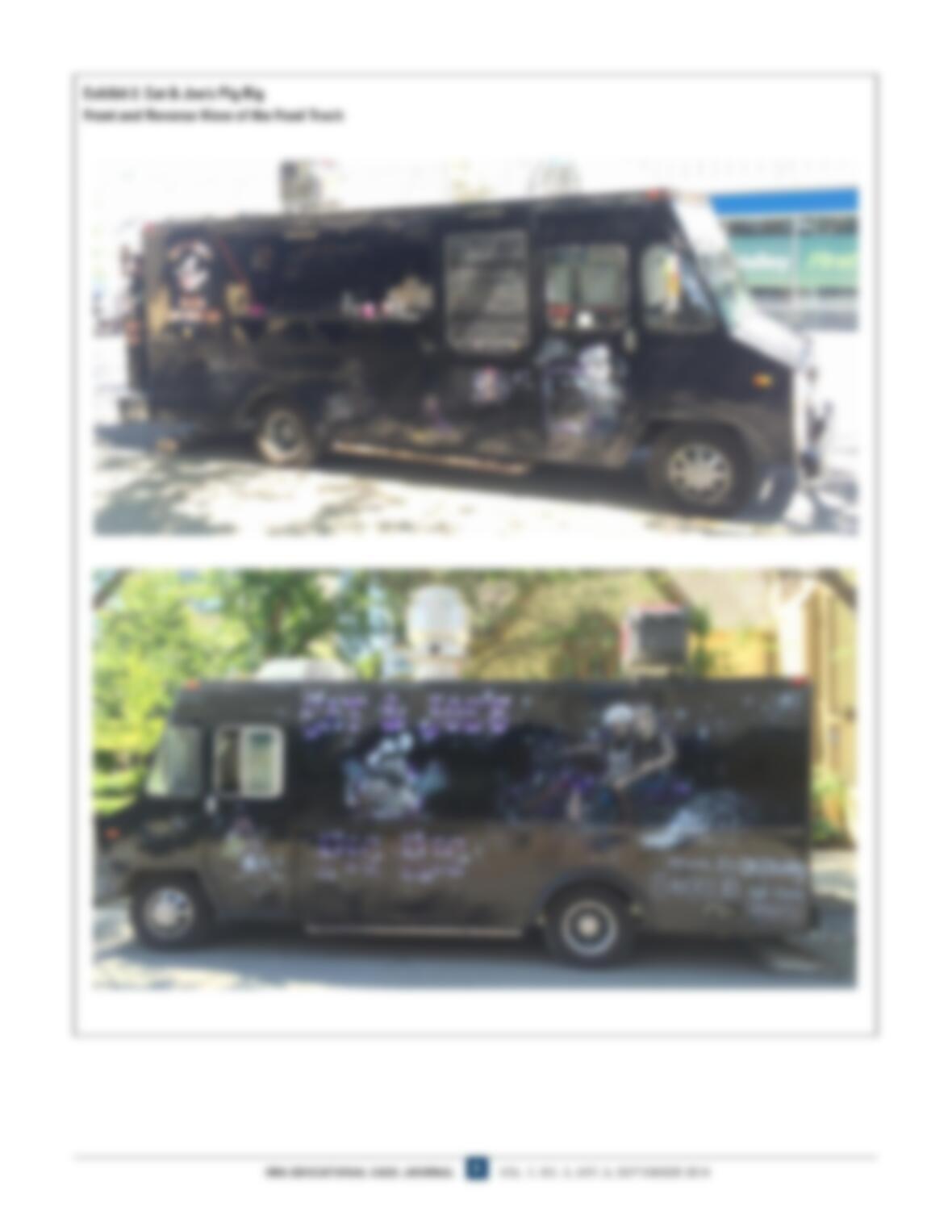
They purchased and outfitted their truck and opened for
business (Exhibit 2).
THE BUSINESS
Cat & Joe’s Pig Rig saw immediate success. In the early
months, the business outperformed its revenue and profit
projections. But Cat and Joe did not wish to rest on their
laurels. They knew that they were enjoying early success not
only because they offered a good product but also because
the food truck was a novelty in Kamloops. They were
pleased to have a first-mover advantage, but they knew it
would not last forever. They needed to continue to develop
a loyal customer base and were also working hard to expand
the event and private catering side of their business.
The food truck’s signature dish was its “Ripped Pig”
pulled pork sandwich.4 The sandwich came in a combo with