Yiran Wang
Acct 5102W Research Paper I
Subject: Troubled debt restructuring, debt modification and extinguishment
10/01/2015
Evaluations of debt restructuring for Resort Co.
Resort Co., a private company that operates luxury hotel properties which had $432
million in uncollateralized term loans (the “Original Debt”) outstanding with two lenders,
Bank A ($129.6 million) and Bank B ($302.4 million) as of December 31, 2010.
However, due to the lower revenue in holiday season, the Resort Co. projected a short-
term cash flow shortage and would not be able to meet the short-term requirements of the
Original Debt. In addition, the Company defaulted on a separate debt instrument with
Bank C, which resulted in a cross default on the Original Debt held by Bank A and Bank
B. On January 1, 2011, Resort Co. restructured and amended the Original Debt with Bank
A and Bank B by involving in the complex debt restructuring activities.
In this research paper, I will analyze three questions below:
I. Does the Restructuring of Resort Co.’s Original Debt represent a troubled debt
Restructuring?
From the background introduction of the Resort Co, we know that it would not be
able to meet the short-term requirements of the original debt. “The two key features of a
troubled debt restructuring are that the debtor is experiencing financial difficulties and the
creditor has provided concessions associated with the economic situation of the debtor”
(FASB, 470-60-15).
Based on the statements in the FASB, a debt restructuring is considered troubled if
the creditor for economic or legal reasons related to the debtor’s financial difficulties
grants a concession to the debtor that it would not otherwise consider (FASB, 310-40-15-
5). The troubled debt restructuring is that changing the amount of interest expense
recognized in the statement of operations prospectively or recognizing a gain in the
statement of operations using the basic extinguishment model. Although the company
experienced financial difficulty during the holiday season, their condition of the effective
borrowing rate of the restructured debt greater than the effective borrowing rate of the old
debt immediately before the restructuring, the creditor didn’t need to grant a concession,
so that the restructuring Original Debt doesn’t represent a troubled debt restructuring.
II. Should Resort Co. apply extinguishment accounting to the Restructuring of the
Original Debt with Bank A? With Bank B?
If the company concludes the change to the terms of its debt is not a troubled debt
restructuring, then the changes (e.g., due date, interest rate, collateral, amount) should be
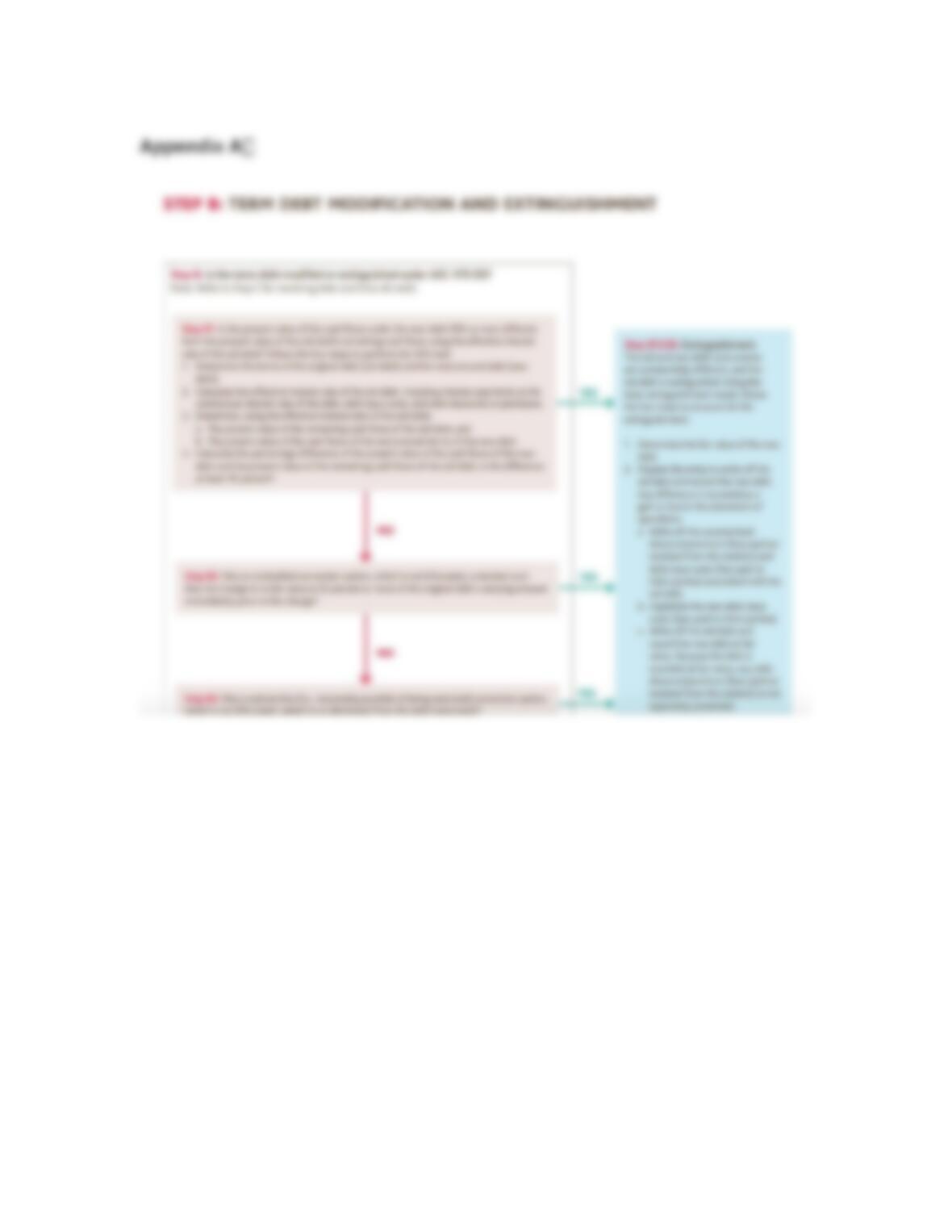
analyzed under Step B (see Appendix A). In FASB, 470-50-40-10, it establishes three
tests for determining if the debt is “substantially different” and therefore extinguished.
Thus the key of the extinguishment accounting is to decide whether the restructuring
of the original Debt with Bank A and Bank B is substantially different or not. The old and