e focus of banking is varied, the needs diverse and methods different. Thus, we need
distinctive kinds of banks to cater to the above-mentioned complexities. Deposit-taking
institutions take the form of commercial banks, which accept deposits and make commercial,
real estate, and other loans. There are also mutual savings banks, which accept deposits
and make mortgage and other types of loans. Another type is credit unions, which are
cooperative organizations that issue share certificates and make member (consumer) and
other loans.
The banking industry can be divided into following sectors, based on the clientele served and
products and services offered:
1. Retail Banks
2. Commercial banks
3. Cooperative banks
4. Investment Banks
5. Specialized banks
6. Central banks
Retail Banks:
Retail banks provide basic banking services to individual consumers. Examples include
savings banks, savings and loan associations, and recurring and fixed deposits. Products
and services include safe deposit boxes, checking and savings accounting, certificates of
deposit (CDs), mortgages, personal, consumer and car loans.
Commercial Banks:
Banking means accepting deposits of money from the public for the purpose of lending or
investment. Commercial Banks provide financial services to businesses, including credit and
debit cards, bank accounts, deposits and loans, and secured and unsecured loans. Due to
deregulation, commercial banks are also competing more with investment banks in money
market operations, bond underwriting, and financial advisory work. Commercial banks in
modern capitalist societies act as financial intermediaries, raising funds from depositors and
lending the same funds to borrowers. The depositors’ claims against the bank, their deposits,
are liquid, meaning banks are expected to redeem deposits on demand, instantly.
Banks’ claims against their borrowers are much less liquid, giving borrowers a much longer
span of time to repay money owed banks. Because a bank cannot immediately reclaim
money lent to borrowers, it may face bankruptcy if all its depositors show up on a given day
to withdraw all their money.
There are two types of commercial banks, public sector and private sector banks.
Public Sector Banks:

Public sectors banks are those in which the government has a major stake and they usually
need to emphasize on social objectives than on profitability.
Private sector banks:
Private sector banks are owned, managed and controlled by private promoters and they are
free to operate as per market forces.
Investment Banks:
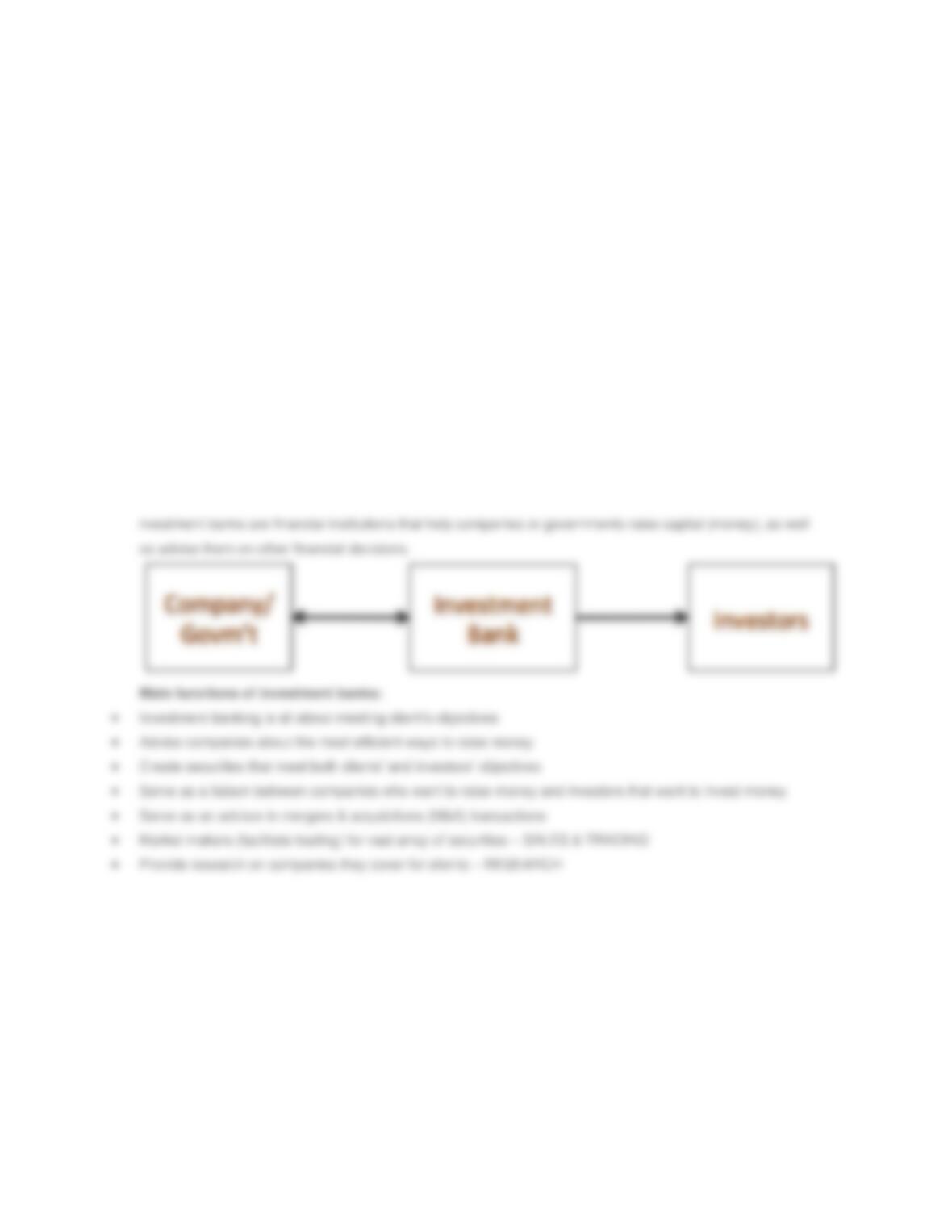
An investment bank is a financial institution that assists individuals, corporations and
governments in raising capital by underwriting and/or acting as the client’s agent in the
issuance of securities. An investment bank may also assist companies involved in mergers
and acquisitions, and provide ancillary services such as market making, trading of
derivatives, fixed income instruments, foreign exchange, commodities, and equity securities.
Investment banks aid companies in acquiring funds and they provide advice for a wide range
of transactions. These banks also offer financial consulting services to companies and give
advice on mergers and acquisitions and management of public assets.
Cooperative Banks:
Cooperative Banks are governed by the provisions of State Cooperative Societies Act and
meant essentially for providing cheap credit to their members. It is an important source of
rural credit i.e., agricultural financing in India.
Specialized Banks:
Specialized banks are foreign exchange banks, industrial banks, development banks, export-
import banks catering to specific needs of these unique activities. These banks provide
financial aid to industries, heavy turnkey projects and foreign trade.
Central Banks:
Central banks are bankers’ banks, and these banks trace their history from the Bank of
England. They guarantee stable monetary and financial policy from country to country and
play an important role in the economy of the country. Typical functions include implementing
monetary policy, managing foreign exchange and gold reserves, making decisions regarding
official interest rates, acting as banker to the government and other banks, and regulating
and supervising the banking industry.
These banks buy government debt, have a monopoly on the issuance of paper money, and
often act as a lender of last resort to commercial banks. The term bank nowadays refers to
these commercial banks. The Central bank of any country supervises controls and regulates
the activities of all the commercial banks of that country. It also acts as a government
banker. It controls and coordinates currency and credit policies of any country. The Reserve

Bank of India is the central bank of India.- Learn more at www.technofunc.com. Your online
source for free professional tutorials.

o what does an investment bank actually do? Several things, actually. Below we
break down each of the major functions of the investment bank, and provide a
brief review of the changes that have shaped the investment banking industry
through the aftermath of the 2008 financial crisis. Click on each section to
learn more.
The JP Morgan building
• Raising Capital & Security Underwriting. Banks are middlemen between a
company that wants to issue new securities and the buying public.
• Mergers & Acquisitions. Banks advise buyers and sellers on business valuation,
negotiation, pricing and structuring of transactions, as well as procedure and
implementation.
• Sales & Trading and Equity Research. Banks match up buyers and sellers as well
as buy and sell securities out of their own account to facilitate the trading of
securities
• Retail and Commercial Banking. After the repeal of Glass-Steagall in 1999,
investment banks now offer traditionally off-limits services like commercial
banking.

• Front office vs back office. While the sexier functions like M&A advisory are
“front office,” other functions like risk management, financial control, corporate
treasury, corporate strategy, compliance, operations and technology are critical
back office functions.
• History of the industry. The industry has changed dramatically since John
Pierpont Morgan had to personally bail out the United States from the Panic of
1907. We survey the important evolution in this section.
• After the 2008 financial crisis. The industry has not fully recovered from the
financial crisis that gripped the world in 2008. How has the industry changed and
where is it going?
https://www.wallstreetprep.com/knowledge/about-investment-banking/

Concept Of Investment Bankers And Their Functions
Concept Of Investment Bankers
Investment bankers are financial middlemen in security offering process. They purchase
securities from companies and governments and resell them to the general public.
Thus,investment bankers bring together suppliers and users of long-term funds in a capital
market and there by play a key role in security offering process. It is to be noted thatinvestment
bankers are neither investors nor bankers. They do not invest their own funds permanently nor
accept and guard the savings of others, as commercial banks do.
Functions Of Investment Bankers
The traditional function of the investment bankers has been to act as middlemen in channeling
individual’s savings and funds into the purchase of business securities. But now a days, they

also provide advice and help in distribution of securities. Thus, investment bankers perform
four basic functions as follows:
• Lower Price
• Human resource managements
• Capital Market
• Experts
1. Underwriting
When underwriting a security issue, an investment banker guarantees the issuer that it will
receive a specific amount from the issue. In this process, investment banker buys the security
at a lower price and then sells them at a higher price i.e. offer price to public. In this sense,
underwriting is the insurance function of bearing the risks of adverse price fluctuation during
the period of distribution. Investment bankers take this risk for a specific amount of
underwriting spread or commission. If investment banker cannot sell securities at specified
price, the underwriter, not the company, suffers the loss. Underwriter’s gain or loss is computed
using the following equation.