36
An Introduction to Consolidated Financial Statements
36
CHAPTER 3
AN INTRODUCTION TO CONSOLIDATED FINANCIAL STATEMENTS
Answers to Questions
1 A corporation becomes a subsidiary when another corporation either directly or indirectly acquires a
majority (over 50 percent) of its outstanding voting stock.
2 Amounts allocated to identifiable assets and liabilities in excess of their recorded amounts on the books of
the subsidiary are not recorded separately by the parent. Instead, the parent company records the purchase
price of the interest acquired in an investment account. The allocation to identifiable asset and liability
accounts is made through working paper entries when the parent and subsidiary financial statements are
consolidated.
3 The land would be shown in the consolidated balance sheet at $100,000, its fair value, assuming that the
purchase price is equal to or greater than the fair value of the interest acquired. If the parent had acquired an
80 percent interest and the purchase price was equal to or greater than the fair value of the interest acquired,
the land would appear in the consolidated balance sheet at $98,000. This amount consists of the $90,000
book value plus 80 percent of the $10,000 excess of fair value over book value of the land.
4 Parent company—a corporation that owns a majority of the outstanding voting stock of another corporation
(its subsidiary).
Subsidiary company—a corporation that is controlled by a parent company that owns a majority of
its outstanding voting stock, either directly or indirectly.
Affiliated companies—companies that are controlled by a single management team through
parent-subsidiary relationships. (Although the term affiliate is a synonym for subsidiary, the parent
company is included in the total affiliation structure.)
Associated companies—companies that are controlled through parent-subsidiary relationships or
whose operations can be significantly influenced through equity investments of 20 percent to 50 percent.
5 A noncontrolling interest is the equity interest in a subsidiary company that is owned by stockholders
outside of the affiliation structure. In other words, it is the equity interest in a subsidiary that is not held by
the parent company or subsidiaries of the parent company.
6 Under the provisions of FASB Statement No. 94, “Consolidation of All Majority-owned Subsidiaries,” a
subsidiary will not be consolidated if control is temporary or if control does not rest with the majority
owner, such as in the case of a subsidiary in reorganization or bankruptcy, or when the subsidiary operates
under severe foreign exchange restrictions or other governmentally imposed restrictions.
7 Consolidated financial statements are intended primarily for the stockholders and creditors of the parent
company, according to ARB No. 51.
8 The amount of capital stock that appears in a consolidated balance sheet is the total par or stated value of
the outstanding capital stock of the parent company.
9 Goodwill from consolidation may appear in the general ledger of the surviving entity in a merger or
consolidation accounted for as a purchase. But goodwill from consolidation would not appear in the general
ledger of a parent company or its subsidiary. Goodwill is entered in consolidation working papers when the
reciprocal investment and equity amounts are eliminated. Working paper entries affect consolidated
financial statements, but they are not entered in any general ledger.

Chapter 3
37
37
10 The parent company’s investment in subsidiary does not appear in a consolidated balance sheet if the
subsidiary is consolidated. It would appear in the parent company’s separate balance sheet under the
heading “investments” or “other assets.” Investments in unconsolidated subsidiaries are shown in
consolidated balance sheets as investments or other assets. They are accounted for under the equity method
if the parent can exercise significant influence over the subsidiary; otherwise, they are accounted for by the
cost method.
11
Parent’s books:
Reciprocal accounts on subsidiary’s books:
Investment in subsidiary
Capital stock and retained earnings
Sales
Purchases
Accounts receivable
Accounts payable
Interest income
Interest expense
Dividends receivable
Dividends payable
Advance to subsidiary
Advance from parent
12 Reciprocal accounts are eliminated in the process of preparing consolidated financial statements in order to
show the financial position and results of operations of the total economic entity that is under the control of
a single management team. Sales by a parent to a subsidiary are internal transactions from the viewpoint of
the economic entity and the same is true of interest income and interest expense and rent income and rent
expense arising from intercompany transactions. Similarly, receivables from and payables to affiliated
companies do not represent assets and liabilities of the economic entity for which consolidated financial
statements are prepared.
13 The stockholders’ equity of a parent company under the equity method is the same as the consolidated
stockholders’ equity of a parent company and its subsidiaries provided that the noncontrolling interest, if
any, is reported outside of the consolidated stockholders’ equity. If noncontrolling interest is included in
consolidated stockholders’ equity, it represents the sole difference between the parent company’s
stockholders’ equity under the equity method and consolidated stockholders’ equity.
14 No. The amounts that appear in the parent company’s statement of retained earnings under the equity
method and the amounts that appear in the consolidated statement of retained earnings are identical.
15 Noncontrolling interest income is not an expense, but rather it is an allocation of the total income to the
consolidated entity between majority and noncontrolling stockholders. From the viewpoint of the majority
interest (the stockholders of the parent company), noncontrolling interest income has the same effect on
consolidated net income as any other expense. This is because consolidated net income is income to the
parent company stockholders.
16 The computation of noncontrolling interest is comparable to the computation of retained earnings. It is
computed:
Noncontrolling interest beginning of the period
XX
Add: Noncontrolling interest income
XX
Deduct: Noncontrolling interest dividends
–XX
Noncontrolling interest end of the period
XX
17 It is acceptable to consolidated the annual financial statements of a parent company and a subsidiary with
different fiscal periods, provided that the dates of closing are not more than three months apart. Any
significant developments that occur in the intervening three-month period should be disclosed in notes to
the financial statements. In the situation described, it is acceptable to consolidate the financial statements of
the subsidiary with an October 31 closing date with the financial statements of the parent with a December
31 closing date.
18 The acquisition of shares held by noncontrolling stockholders does not constitute a business combination. It
is not possible, by definition, to acquire a controlling interest from noncontrolling stockholders.

38
An Introduction to Consolidated Financial Statements
38
SOLUTIONS TO EXERCISES
Solution E3-1
Solution E3-2
1
b
1
d
2
c
2
b
3
d
3
d
4
d
4
d
5
b
5
a
6
a
6
d
7
c
Solution E3-3 [AICPA adapted]
1
c
Consolidated current assets
$146,000
Less: Apex’s current assets
(106,000)
Add: Receivable from Apex
2,000
Nadir’s current assets
$ 42,000
2 d
Noncontrolling interest of $35,100/30% = $117,000
3 c
Advance to Hill $75,000 + receivable from Ward $200,000 = $275,000
4 a
5 a
Owen accounts for Sharp using the equity method, therefore,
consolidated retained earnings is equal to Owen’s retained earnings, or
$1,240,000.
6 d
All intercompany receivables and payables are eliminated.
Solution E3-4
1
Goodwill at December 31, 2003 = Goodwill from consolidation
$ 18,000
2
Consolidated net income
Pinto’s reported net income
$490,000
Less: Correction for depreciation on excess allocated
to equipment ($12,000/3 years)
(4,000)
Consolidated net income
$486,000
Solution E3-5
1 $600,000, the dividends of Panderman
2 $330,000, equal to $300,000 dividends payable of Panderman plus $30,000
dividends payable to noncontrolling interests of Sadisman.
Chapter 3
39
39

40
An Introduction to Consolidated Financial Statements
40
Solution E3-6
Preliminary computation
Cost of Slider stock
$1,250,000
Fair value acquired ($1,000,000 100%)
1,000,000
Goodwill
$ 250,000
1
Journal entry to record push down values
Inventories
20,000
Land
50,000
Buildings — net
150,000
Equipment — net
80,000
Goodwill
250,000
Retained earnings
210,000
Note payable
10,000
Push-down capital
750,000
2
Slider Corporation
Balance Sheet
January 1, 2007
Assets
Cash
$ 70,000
Accounts receivable
80,000
Inventories
100,000
Land
200,000
Buildings — net
500,000
Equipment — net
300,000
Goodwill
250,000
Total assets
$1,500,000
Liabilities
Accounts payable
$ 100,000
Note payable
150,000
Total liabilities
250,000
Stockholders’ equity
Capital stock
$ 500,000
Push-down capital
750,000
Total stockholders’ equity
1,250,000
Total liabilities and stockholders’ equity
$1,500,000
Chapter 3
41
41
Solution E3-7
1
Pasture Corporation and Subsidiary
Consolidated Income Statement
for the year 2007
Sales ($1,000,000 + $400,000)
$1,400,000
Less: Cost of sales ($600,000 + $200,000)
(800,000)
Gross profit
600,000
Less: Depreciation expense ($50,000 + $40,000)
(90,000)
Other expenses ($199,000 + $90,000)
(289,000)
Total consolidated income
221,000
Less: Noncontrolling interest income ($70,000 30%)
(21,000)
Consolidated net income
$ 200,000
2
Pasture Corporation and Subsidiary
Consolidated Income Statement
for the year 2007
Sales ($1,000,000 + $400,000)
$1,400,000
Less: Cost of sales ($600,000 + $200,000)
(800,000)
Gross profit
600,000
Less: Depreciation expense ($50,000 + $40,000 – $2,000)
(88,000)
Other expenses ($199,000 + $90,000)
(289,000)
Total consolidated income
223,000
Less: Noncontrolling interest income ($70,000 30%)
(21,000)
Consolidated net income
$ 202,000
Supporting computations
Depreciation of excess allocated to overvalued equipment:
$10,000/5 years = $2,000
42
An Introduction to Consolidated Financial Statements
Solution E3-8
1 Capital stock
The capital stock appearing in the consolidated balance sheet at
December 31, 2006 is $1,800,000, the capital stock of Poball,
the parent company.
2 Goodwill at December 31, 2006
Investment cost at January 2, 2006
$700,000
Book value acquired ($600,000 80%)
(480,000)
Excess (considered goodwill since no fair value information
is given)
$220,000
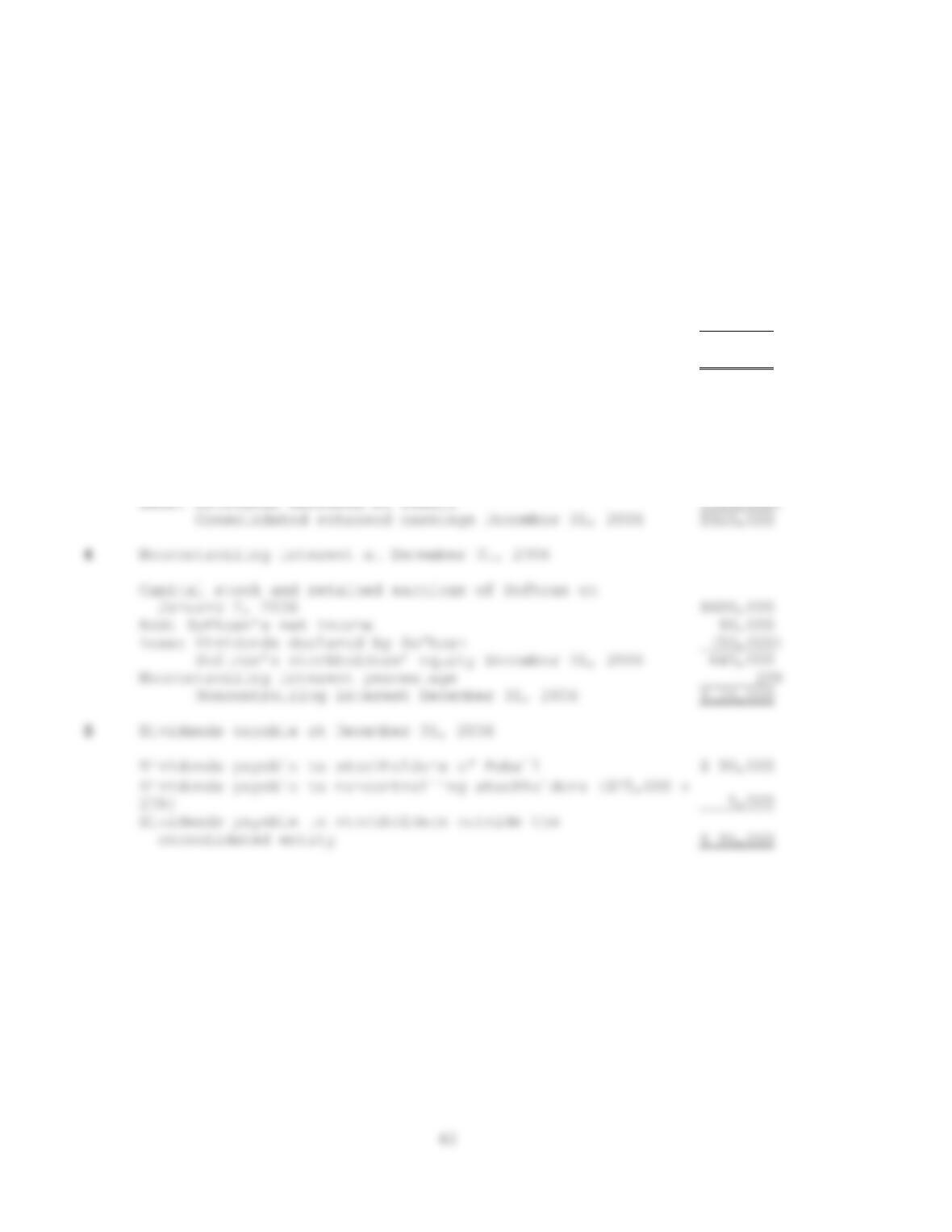
3 Consolidated retained earnings at December 31, 2006
Poball’s retained earnings January 2, 2006 (equal to
beginning consolidated retained earnings
$800,000
Add: Net income of Poball (equal to consolidated net
income)
300,000
42
Less: Dividends declared by Poball
(180,000)
$920,000
Capital stock and retained earnings of Softcan on
January 2, 2006
$600,000
90,000
Less: Dividends declared by Softcan
(50,000)
640,000
Noncontrolling interest percentage
20%
$128,000
Dividends payable to stockholders of Poball
$ 90,000
20%)
Dividends payable to stockholders outside the
consolidated entity
$ 95,000