Profitability
Analysis of
Strategic
Business
Segments
Objectives

13-2
•After studying these slides, you should be able to:
1. Understand responsibility centers
2. Discuss centralized and decentralized
organization structures.
3. Evaluate transfer pricing alternatives.
4. Understand the concept of performance
measurement when financial and nonfinancial
concepts are integrated (BSC).
Profitability Analysis of Strategic Business Segments Objectives
3
Responsibility accounting
•measures the results of each responsibility center
•compares those results with some measure of
expected or budgeted outcome.
Types of Responsibility Centers
•Cost center: only responsible for costs
•Revenue center: only responsible for revenues
•Profit center: responsible for both revenues and costs
•Investment center: responsible for revenues, costs,
and investments

Decentralization
4
The lower in the
organization that authority
is delegated, the greater
the decentralization.
The delegation of decision–making authority to successively lower management
levels in an organization
Centralization exists when top management has a wide span of control, including
direct control over all major functions of an organization.
Decentralization
5
The advantages of decentralization include:
1. Firsthand decision making (training)
2. More timely response
3. Specialization –Better access to local information
4. Motivation of segment managers
5. Focusing of central management
6. Frees up higher level management’s time
The disadvantages of decentralization include:
1. Compatible performance measurements
2. Suboptimization
3. Duplication
4. Lack of competent personnel

•Learning Objective: Explain transfer pricing
and assess alternative transfer–pricing
methods
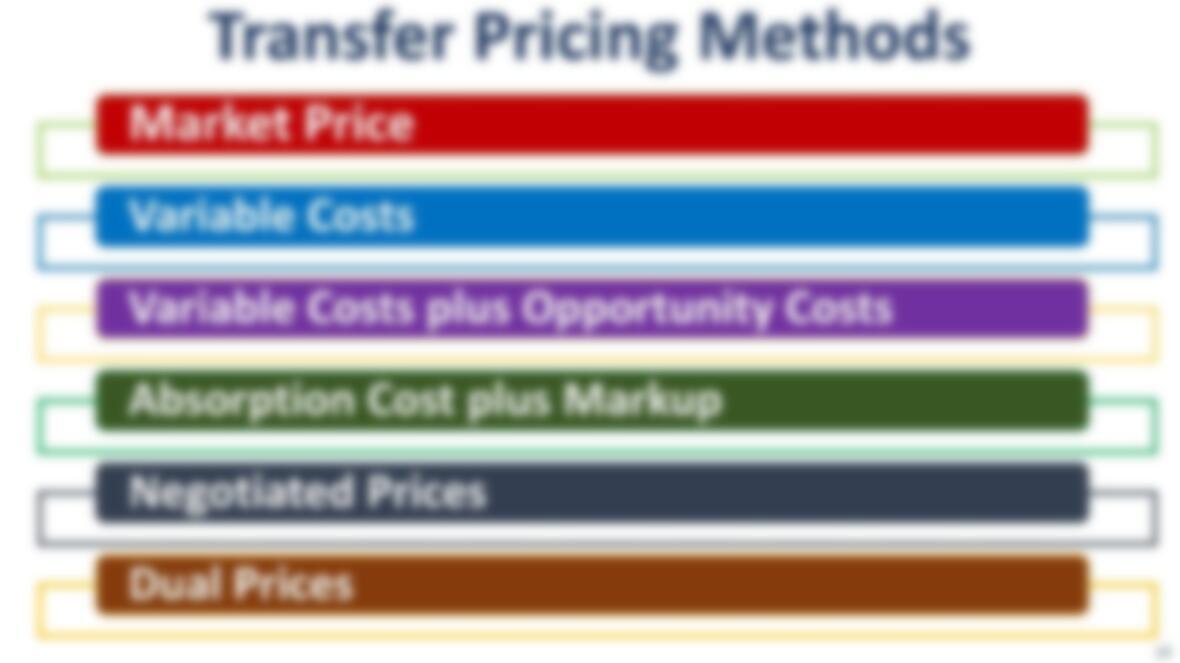
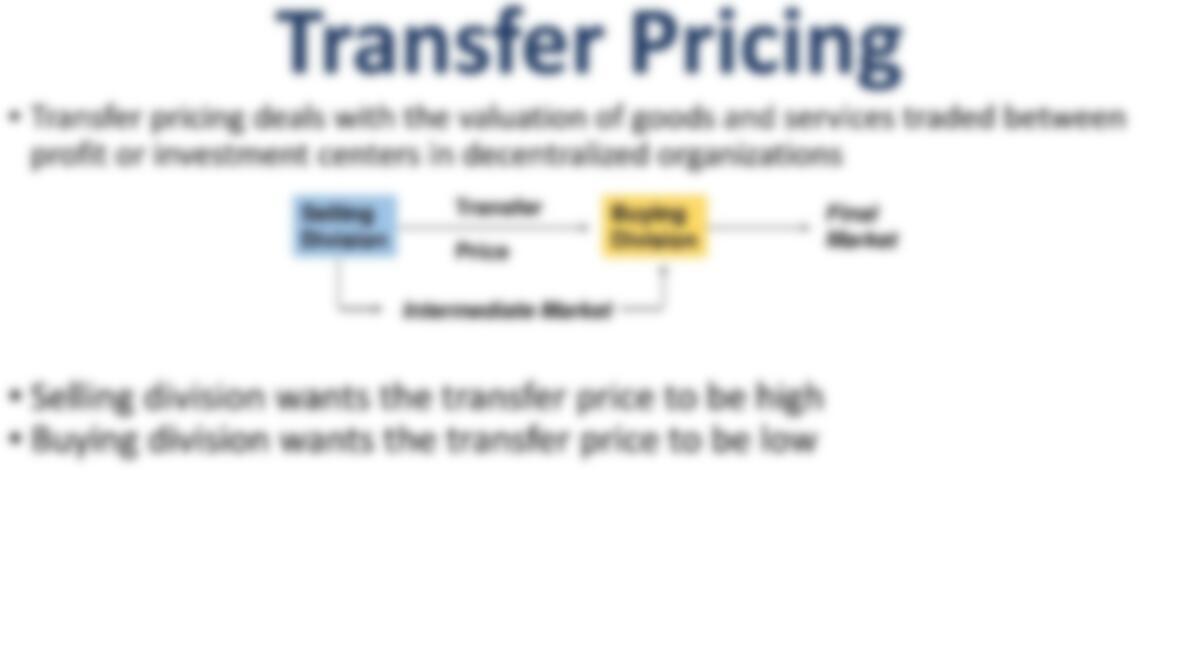
•A transfer price is the internal value
assigned a product or service that one
division provides to another.
•Transfer pricing transactions normally
occur between profit or investment
centers.
•The objective of transfer pricing is to
transmit financial data between
departments or divisions of a company.
Transfer Pricing
Transfer Pricing
•Transfer pricing systems are normally used in decentralized operations
to determine whether organizational objectives are being achieved in
each division.
•A transfer price is the internal value assigned a product or service that
one division provides to another.

C ti d