30-pt Solution – Acct 2220 Zeigler – GQ #3 (Chp 10) – Review for Exam #2
____ 1. A capital investment project may provide “cash inflows” (i.e. benefits) from:
A. incremental (new) revenues received as a result of the investment made.
B. cost savings realized due to the investment made.
C. the salvage value of the investment at the end of its useful life.
D. all of the above represent potential cash inflows (i.e. benefits).
____ 2. Which of the following statements best describes a firm’s “cost of capital”?
A. The return that a company must pay to attract investors and satisfy creditors. (Pg 302/303)
B. The maximum acceptable rate of return on investments.
C. The calculated internal rate of return on investments.
D. The interest rate the bank charges its best customers. (No, typically called the “Prime Rate”)
____ 3. The cost of capital is frequently referred to (i.e. called) all of the following except:
A. discount rate.
B. hurdle rate.
C. cutoff rate.
D. maximum rate. (See pg 303 for terminology discussion)
____ 4. For a capital investment project to be acceptable on a quantitative basis, it must generate a rate of return:
A. Less than the required rate of return.
B. Equal to or greater than the firm’s cost of capital.
C. Equal to or less than the initial investment.
D. Greater than the required rate of return, but less than the cost of capital.
____ 5. Vince & Palker, Inc. projects they can generate $300,000 of net cash benefits per year, for 7 years, on a
real estate investment project (i.e. after all expenses are deducted). If the company desires a pre-tax rate of
return of 7%, what is the maximum they should pay (rounded to the nearest dollar) for this real estate
investment? In essence, what is the present value of all expected benefits given the required rate of return?
A. $321,001
B. $642,653
C. $1,472,017
D. $1,616,787 (P.V of an annuity 7%, 7 yrs (Table 2) 5.389289 * $300,000 annual net cash inflow)
E. $2,100,000
____6. Two products from Wentling & Gaertner, Inc., X and Y, are alike in every way except that the sales of X
will start low and rise throughout its life, while those of Y will be the same each year. Total sales volume
over their five-year lives will be the same, as will selling prices, unit variable costs, cash fixed costs, and
initial investment. The Net Present Value (NPV) of product X:
A. will be less than that of product Y. (This will always be the case – make up numbers to confirm)
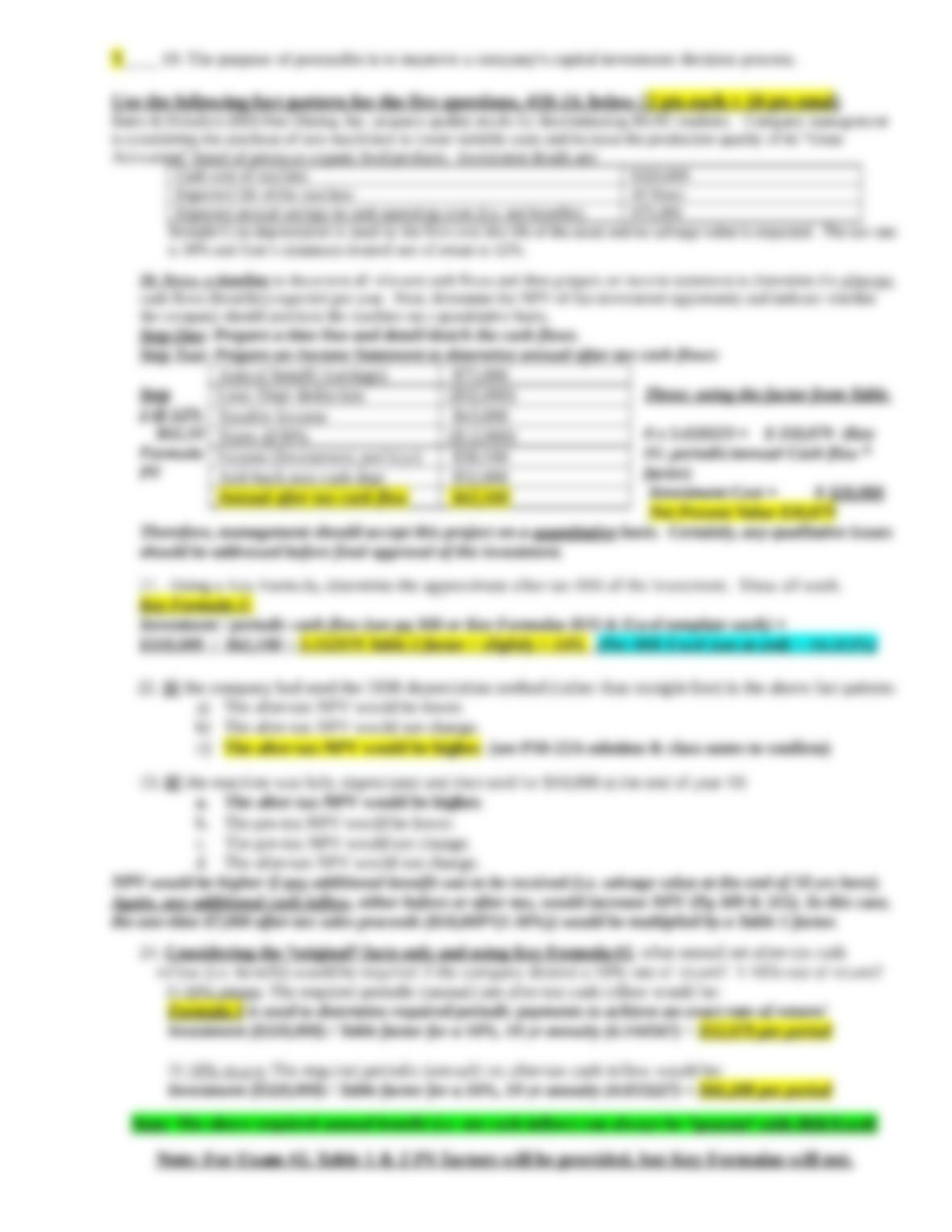
Net Present Value $30,879
Therefore, management should accept this project on a quantitative basis. Certainly, any qualitative issues
should be addressed before final approval of the investment.
21. Using a Key Formula, determine the approximate after-tax IRR of the investment. Show all work.
Key Formula 2:
Investment / periodic cash flow (see pg 308 or Key Formulas H/O & Excel template work) =
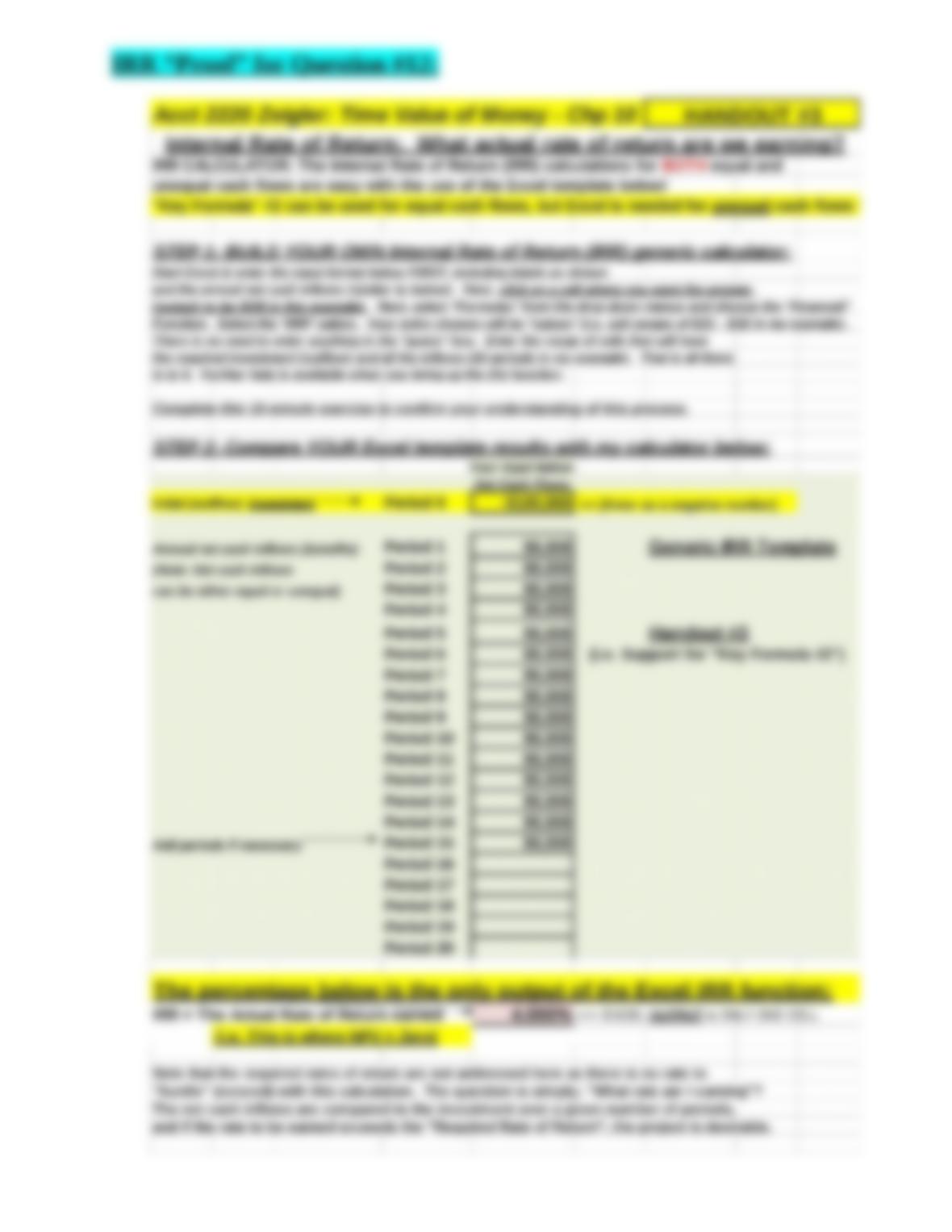
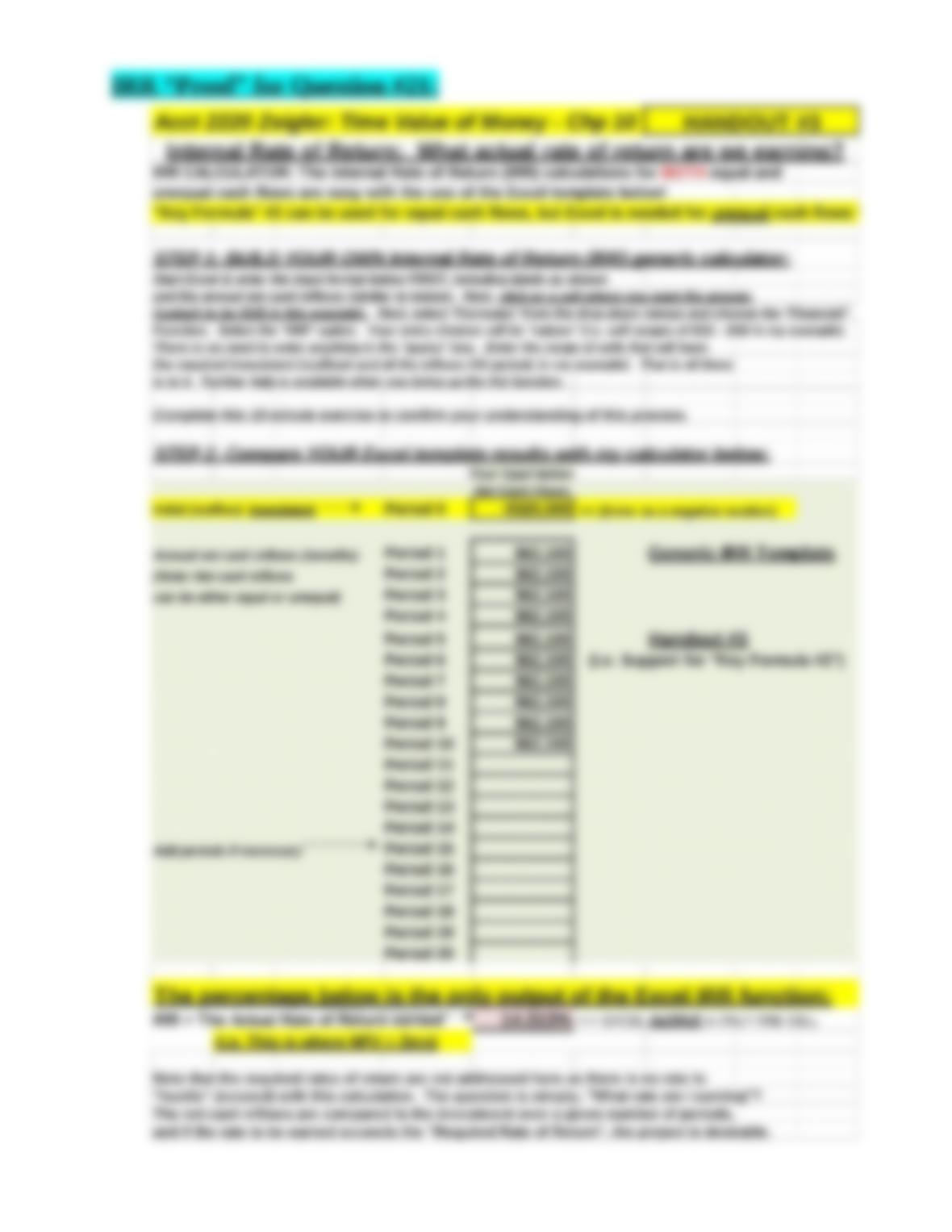
$320,000 / $62,100 = 5.152979 Table 2 factor = slightly > 14% (Per IRR Excel (see at end) = 14.313%)
22. IF the company had used the DDB depreciation method (rather than straight-line) in the above fact pattern:
a) The after-tax NPV would be lower.
b) The after-tax NPV would not change.
c) The after-tax NPV would be higher. (see P10-22A solution & class notes to confirm)
23. IF the machine was fully depreciated and then sold for $10,000 at the end of year 10:
a. The after-tax NPV would be higher.
b. The pre-tax NPV would be lower.
c. The pre-tax NPV would not change.
d. The after-tax NPV would not change.
NPV would be higher if any additional benefit was to be received (i.e. salvage value at the end of 10 yrs here).
Again, any additional cash inflow, either before or after-tax, would increase NPV (Pg 309 & 315). In this case,
the one-time $7,000 after-tax sales proceeds ($10,000*(1-30%)) would be multiplied by a Table 1 factor.
24. Considering the *original* facts only and using Key Formula #3, what annual net after-tax cash
inflow (i.e. benefit) would be required if the company desired a 10% rate of return? A 16% rate of return?
1) 10% return: The required periodic (annual) net after-tax cash inflow would be:
Formula 3 is used to determine required periodic payments to achieve an exact rate of return!
Investment ($320,000) / Table factor for a 10%, 10-yr annuity (6.144567) = $52,079 per period
2) 16% return: The required periodic (annual) net after-tax cash inflow would be:
Investment ($320,000) / Table factor for a 16%, 10-yr annuity (4.833227) = $66,208 per period
Note: The above required annual benefit (i.e. net cash inflow) can always be *proven* with IRR/Excel!
Note: For Exam #2, Table 1 & 2 PV factors will be provided, but Key Formulas will not.