Prepared by Marivic Valenzuela-Manalo
De La Salle University, Manila
1
Learning(Module(1(
Review&of&the&Accounting&Cycle&of&a&Sole&
Proprietorship&Form&of&Business&
Overview
The work for each accounting period follows a cycle, which is called the accounting cycle. This refers
to a series of sequential steps or procedures performed to accomplish the accounting process.
Accounting performs important tasks of recording daily transactions, classifying recorded data,
summarizing recorded and classified data in order to prepare financial reports and providing
interpretation of the summarized facts in informing interested people about business operation and
financial condition. Accounting information is summarized in at least four basic financial reports,
namely, (1) Statement of Comprehensive Income (SCI) or simply Income Statement; (2) Statement
of Changes in Equity (SCE); (3) Statement of Financial Position (SFP); and (4) Cash Flows Statement
(CFS) together with its accompanying notes to the financial statements.
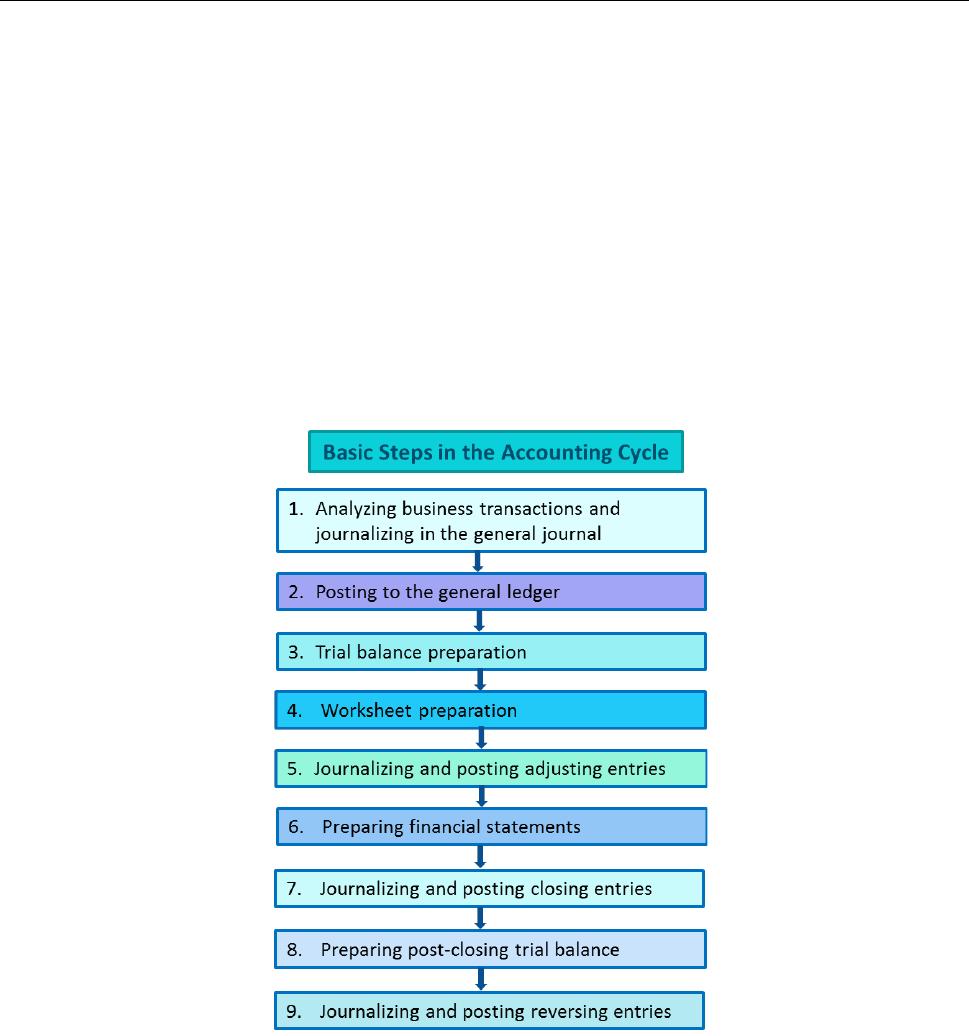
The following are the basic steps in the accounting cycle. Worksheet preparation and journalizing
and posting reversing entries are optional steps.

Prepared by Marivic Valenzuela-Manalo
De La Salle University, Manila
2
Learning Objectives
After studying this chapter, the student should be able to acquire the following competencies:
1. Practice recording business transactions and applying the rules of debits and credits.
2. Do the step posting in the general ledger using T-accounts.
3. Prepare and understand the importance of different trial balance.
4. Prepare the natural form of Income Statement for a single proprietorship
5. Prepare the Statement of Financial Position of a single proprietorship.
6. Prepare Cash Flows Statement using the direct method.
7. Perform the rest of the steps in completing the accounting cycle.
Business Case to Review the Accounting Cycle of a Sole Proprietorship Form of Business
Charito Couturier Shop
How time flies so fast! It seems just like yesterday when Charito started a small couturier shop out
of her dress making and designing hobby. Look where her favorite pastime brought her! She is now
considered by many to be a successful entrepreneur after putting Charito Couturier Shop two years
ago!
Charito more than ever is really so concerned with the progress of her business operations on its
third year of operation. She never forgets that the business to operate successfully must embody
the principles of earning profits with outmost concern for the welfare of people and planet!
She reviewed the lessons on the different steps of the accounting cycle which she tried to learn
when she was starting her small business. She started with the chart of accounts of the business as
follows and proceeds with the journalizing of the various transactions for the month of December
which is the end of the shop’s reporting period for its third year of operation.

Prepared by Marivic Valenzuela-Manalo
De La Salle University, Manila
3
CHART OF ACCOUNTS
Account Number
Account Title
ASSETS
101
Cash in Bank
102
Petty Cash Fund
103
Accounts Receivable
103-A
Allowance for Bad Debts
104
Notes Receivable
105
Advances to Employees
106
Interest Receivable
107
Sewing Supplies on Hand
201
Land
202
Buildings
202-A
Accumulated Depreciation–Building
203
Shop Equipment
203-A
Accumulated Depreciation–Shop Equipment
204
Furniture and Fixture
204-A
Accumulated Depreciation – Furniture and Fixture
LIABILITIES
301
Accounts Payable
302
Notes Payable
303
Withholding Taxes Payable
304
Utilities Payable
305
Interest Payable
306
Unearned Service Income
310
Mortgage Payable
OWNER’S EQUITY
401
Charito, Capital
401-A
Charito, Drawing
REVENUES
501
Service Income
502
Interest Income
EXPENSES
611
Salaries and Wages Expense
612
Depreciation Expense
613
Utilities Expense
614
Insurance Expense
615
Sewing Supplies Expense
616
Repairs and Maintenance Expense
617
SSS, Philhealth, and Pag–ibig Expense
618
Bad Debts Expense
619
Miscellaneous Expense
630
Interest Expense

Prepared by Marivic Valenzuela-Manalo
De La Salle University, Manila
4
The following is the trial balance prepared for Charito Couturier Shop as of November 30, 2020.
Charito Couturier Shop
Trial Balance
November 30, 2020
Account Title
Debit
Credit
Cash in Bank
P
182,000
Petty Cash Fund
10,000
Accounts Receivable
123,000
Allowance for Bad Debts
P
9,500
Sewing Supplies on Hand
72,500
Land
700,000
Buildings
800,000
Accumulated Depreciation-Building
100,000
Shop Equipment
480,000
Accumulated Depreciation-Shop Equipment
112,500
Furniture and Fixture
150,000
Accumulated Depreciation – Furniture and Fixture
52,000
Accounts Payable
18,000
Notes Payable
20,000
Withholding Taxes Payable
7,200
Mortgage Payable
100,000
Charito, Capital
1,284,300
Charito, Drawing
70,000
Service Income
2,250,000
Salaries and Wages Expense
1,121,250
Insurance Expense
68,450
Utilities Expense
85,200
Repairs and Maintenance Expense
18,500
Transportation Expense
8,250
SSS, Philhealth, and Pag-ibig Expense
41,550
Miscellaneous Expense
18,400
Interest Expense
4,400
Total
P
3,953,500
P
3,953,500
Prepared by Marivic Valenzuela-Manalo
De La Salle University, Manila
5
Step 1: Analyzing Business Transactions and Journalizing in the General Journal
Charito reviews the first step which is journalizing business transaction, now that all the business
documents of his business for the month of December were properly sorted and filed. She recalled
the definition that journalizing is the chronological recording of the business transactions in the
book called the general journal. A journal is a daily record of business transactions that shows in
one place the complete debit and credit effect of each transaction on the accounts of the business
in chronological order.
She also remembered that in journalizing transactions it is not only important to know the form of
business organization according to ownership (i.e., sole proprietorship, partnership, corporation, or
cooperative) but to also know the form of business organization according to activity (i.e., service,
merchandising, or manufacturing). Service business activity is rendering service, for example,
designing and sewing clothing apparels similar to her own shop. Merchandising or trading business
activity means the company is engaged in the buying and selling of finished goods or merchandise,
for example drug store. Manufacturing business activity on the other hand is a business engaged in
the processing of products or the conversion of raw materials into finished goods that are then sold
like the furniture factory.
To understand what journalizing is all about, one must fully appreciate that debits and credits are
fundamental in the bookkeeping procedure; that this is connected to the accounting equation.
ASSETS = LIABILITIES + OWNER’S EQUITY
Debit and Credit can be literally translated as LEFT for debit (i.e., LEFT hand column of an account)
and as RIGHT for credit (i.e., RIGHT hand side of an account).
Assets
Liabilities
Owner’s Equity
Normal balance
Debit
Credit
Credit
Increased by
Debit
Credit
Credit
Decreased by
Credit
Debit
Debit

Prepared by Marivic Valenzuela-Manalo
De La Salle University, Manila
6
Activity 1.1 to DEMONSTRATE student’s learning in step 1: Journalizing
The following is the list summarizing the various transactions of CCS for the month of
December, 2020 which you are asked to record.
Dec. 1
Received 5%, 3-month, P30,000 note from Maffy for the party gown that CCS
designed and delivered for the former today.
2
CCS purchased buttons, threads, and ribbons from Luz Sewing Supplies Store
amounting to P 14,800 paying 50% down and the balance on account.
3
Romy, the master cutter in the shop made salary advances amounting to P3,000.
4
Michelle, a frequent customer of CCS paid P52,000 for the balance of the gown she
requested Charito to specially design for her two months ago.
5
Charito withdrew buttons, ribbons, and threads amounting to P500 for her personal
use at home.
6
Paid Efren Repair Service Center P1,500 for the repair of one of the sewing machines.
7
Delivered the debut gown of Rose and collected P25,000.
8
Paid the transportation fare of Rene, the liaison officer of CCS amounting to P750.
9
Paid the P18,000 accounts payable to Jose Building Maintenance Company.
10
Charito withdrew P20,000 cash permanently from the business fund.
18
CCS entered into a P350,000 contract of designing all the gowns for the wedding
entourage of Joy and Rafael on June, 2021. The couple paid 20% down payment.
20
Paid the internet and telephone December bill received from GlobeSmart Telecom
amounting to P1,200.
27
Billed Mary Renee Dance Company for P75,000 for the costumes designed and sewed
for their theater actors and actresses.
31
CCS paid December salaries of its employees amounting to P89,700.
Note: SSS, Philhealth, Pag–ibig, and withholding tax deductions were not included in this transaction to simplify reviewing
Step 1 – Journalizing of the accounting cycle.
Required:
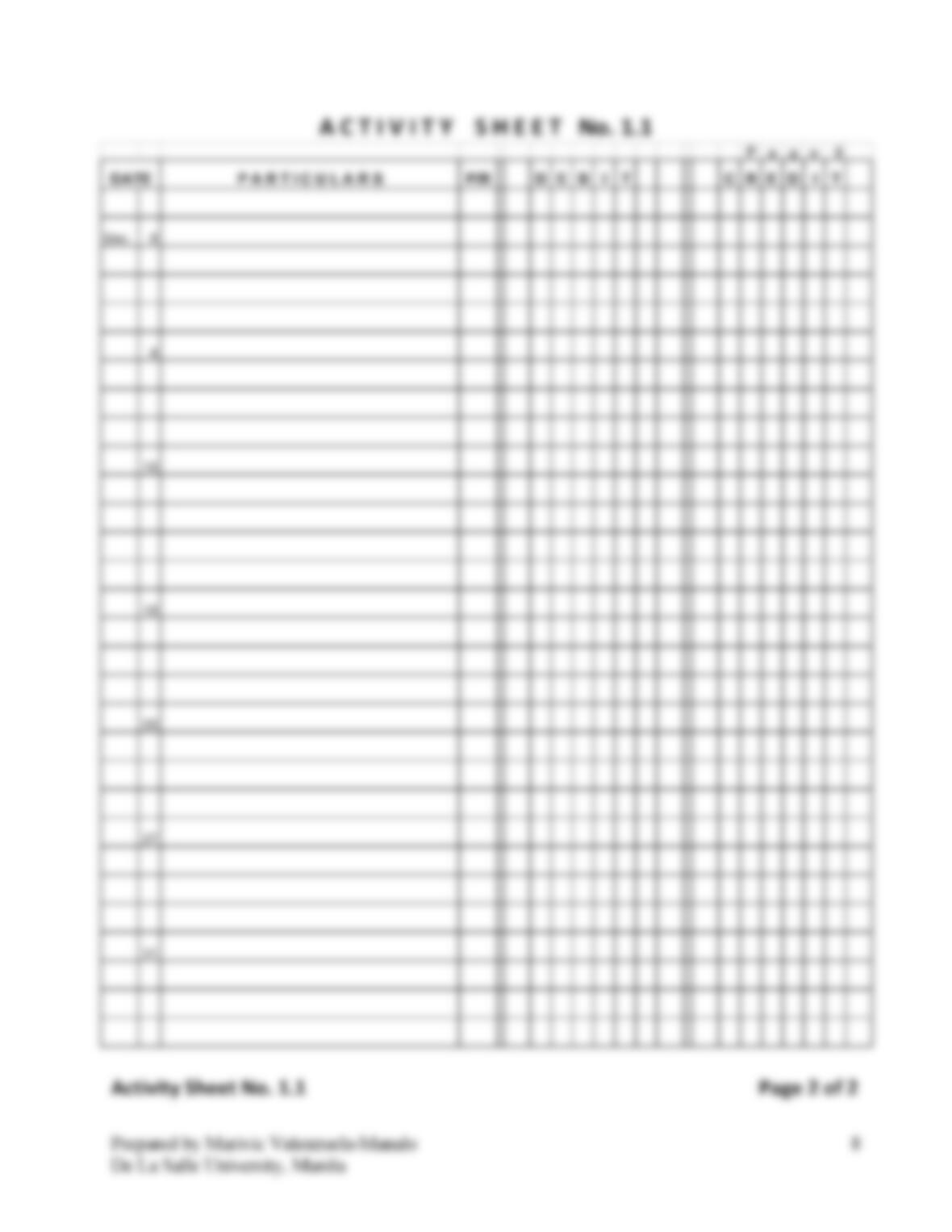
Using the following General Journal activity sheets, record the above transaction of CCS for the
month of December, 2020. December 1 transaction was done for your example on how to record
business transactions using the general journal.

A C T I V I T Y S H E E T No. 1.1
P a g e 7
P A R T I C U L A R S P/R D E B I T C R E D I T
Dec. 1Notes Receivable 30000
Service Income 30000
Received 5%, 3–month promisory note.
2
DATE