Advanced Accounting
Thirteenth Edition, Global Edition
Chapter 2
Stock Investments –
Investor Accounting
and Reporting
Copyrght © 2018 Pearson Education, Ltd. All Rights Reserved.

Copyright © 2018 Pearson Education, Ltd. All Rights Reserved.
Stock Investments: Objectives
2.1 Recognize investors’ varying levels of influence or
control, based on the level of stock ownership.
2.2 Understand how accounting adjusts to reflect the
economics underlying varying levels of investor
influence.
2.3 Identify factors beyond stock ownership that affect
an investor’s ability to exert influence or control over
an investee.
2.4 Apply the fair value/cost and equity methods of
accounting for stock investments.
2.5 Apply the equity method to stock investments.
2.6 Learn how to test goodwill for impairment.

Copyright © 2018 Pearson Education, Ltd. All Rights Reserved.
2.1: Levels of Influence or Control
Stock Investments –Investor Accounting and Reporting
Copyright © 2018 Pearson Education, Ltd. All Rights Reserved.
Levels of Influence
Fair
value
(cost)
method
Equity
method
Consolidated
financial
statements
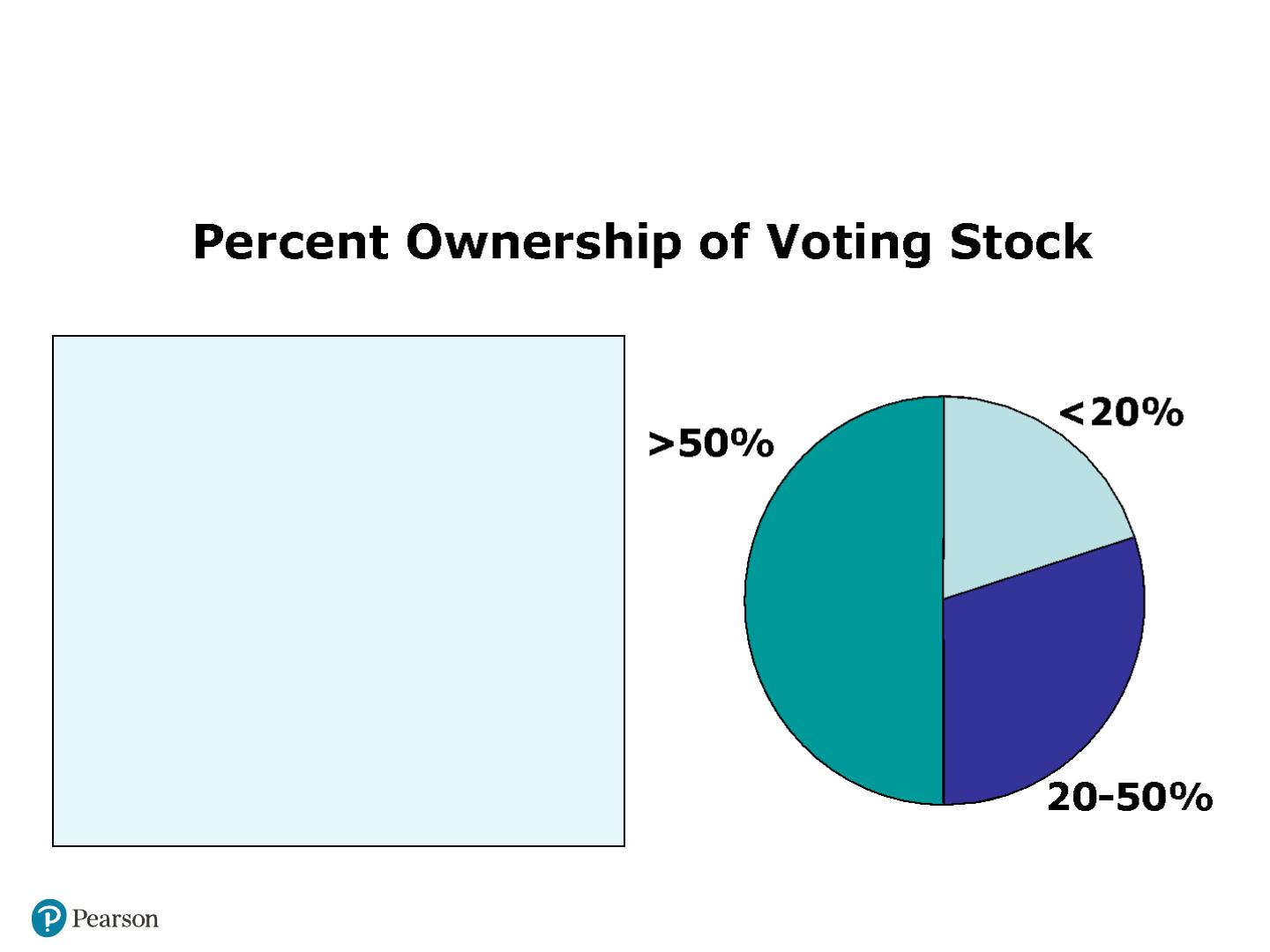
<20%
presumes lack of
significant influence
➔fair
value (cost) method
20% to 50%
presumes
significant influence
➔equity
method
>50%
presumes control ➔
consolidated financial
statements

Copyright © 2018 Pearson Education, Ltd. All Rights Reserved.
2.2: Accounting Reflects Economics
Stock Investments –Investor Accounting and Reporting

Copyright © 2018 Pearson Education, Ltd. All Rights Reserved.
Accounting for the Investment
Degree of
influence
Investment’s
carrying value
Investment
income
Lack of
significant
influence
Fair value (cost, if
nonmarketable)
Dividends declared
Significant
influence
Original cost adjusted
to reflect periodic
earnings and
dividends, e.g., a
proportionate share of
investee’s net assets
Proportionate share
of investee’s
periodic earnings
*
* The investor could manipulate its own investment income if income is measured by dividends.
Significant Influence
20% to 50% voting stock ownership is a
presumption of significant influence. Use the equity
method. Equity method is consistent with accrual-