1
Department of Accounting
ACCT 3210 – Advanced Management Accounting
Spring 2020
Course Outline – Sections L1, L2 & L3
Instructor: Dr. Terry Kwok (LSK 6005; Phone: 2358-7567; E-mail: actk@ust.hk)
Office Hours: By appointment (via Zoom Meeting)
T.A.: Ms. Carrie Leung (LSK 6066, Phone: 2358-7580, E-mail: accarrie@ust.hk)
Class time and venue:
Classes conducted online via Zoom
Classes will be conducted online via Zoom only until we change to mix mode. Please refer to the announcement
posted in Canvas.
When Physical Class resumes
L1: Tues & Thurs -12:00 noon to 1:20 pm; LSK1011
L2: Mon & Wed -10:30 am to 11:50 am; 2404 – 2/F at Main Academic Building (Lifts 17–18)
L3: Mon & Wed -12:00 noon to 1:20 pm; 2404 – 2/F at Main Academic Building (Lifts 17-18)
Course website: http://canvas.ust.hk
I Course Description:
Accounting information is essential for planning and controlling business operations and for making strategic and
operating decisions by senior managers. This course is built on the materials you have learned in Principles of
Accounting II (ACCT 2200) to introduce more advanced topics and techniques that are important for managing
business organizations. This course puts a greater emphasis on applications of management accounting tools to
tackle business problems.
Topics covered include analysis of cost behaviour, allocation of common and joint costs, use of cost information
in operational and strategic decisions, strategic profitability analysis and productivity analysis, decision-making
techniques, transfer pricing, and performance measurement and introduction of data analytics in accounting.
II Course Objectives:
By the end of this course, you should be able to:
1. Understand both the importance of management accounting for strategic and operational decisions for
organizations and the pitfalls of misusing management accounting information and techniques.
2. Solve problems arising in business planning and decisions, with the use of spreadsheet skill and quantitative
tools (such as the decision tree, regression analysis, the learning curve, and linear programming).
3. Evaluate various techniques for control and performance evaluation in a decentralized environment, and
provide recommendations for an effective control system.
4. Understand how data analytics are applied in accounting.
5. The course will also provide you with opportunities to gain exposure to more complex (and realistic) business
problems through real-life based cases.
6. Demonstrate team-work and leadership skills in solving problems in planning and controls.
7. Demonstrate communication skills through team work, and class discussions.
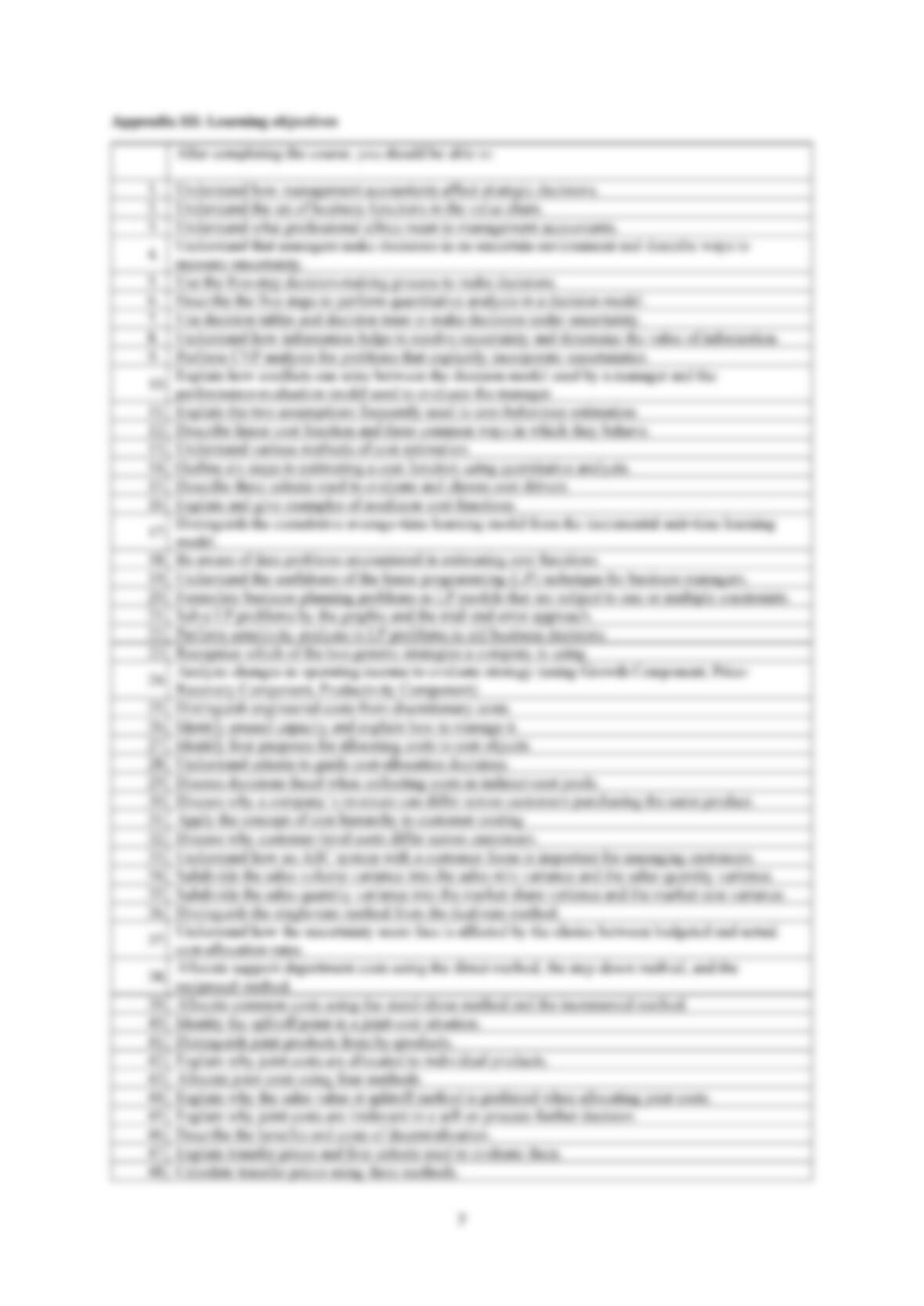
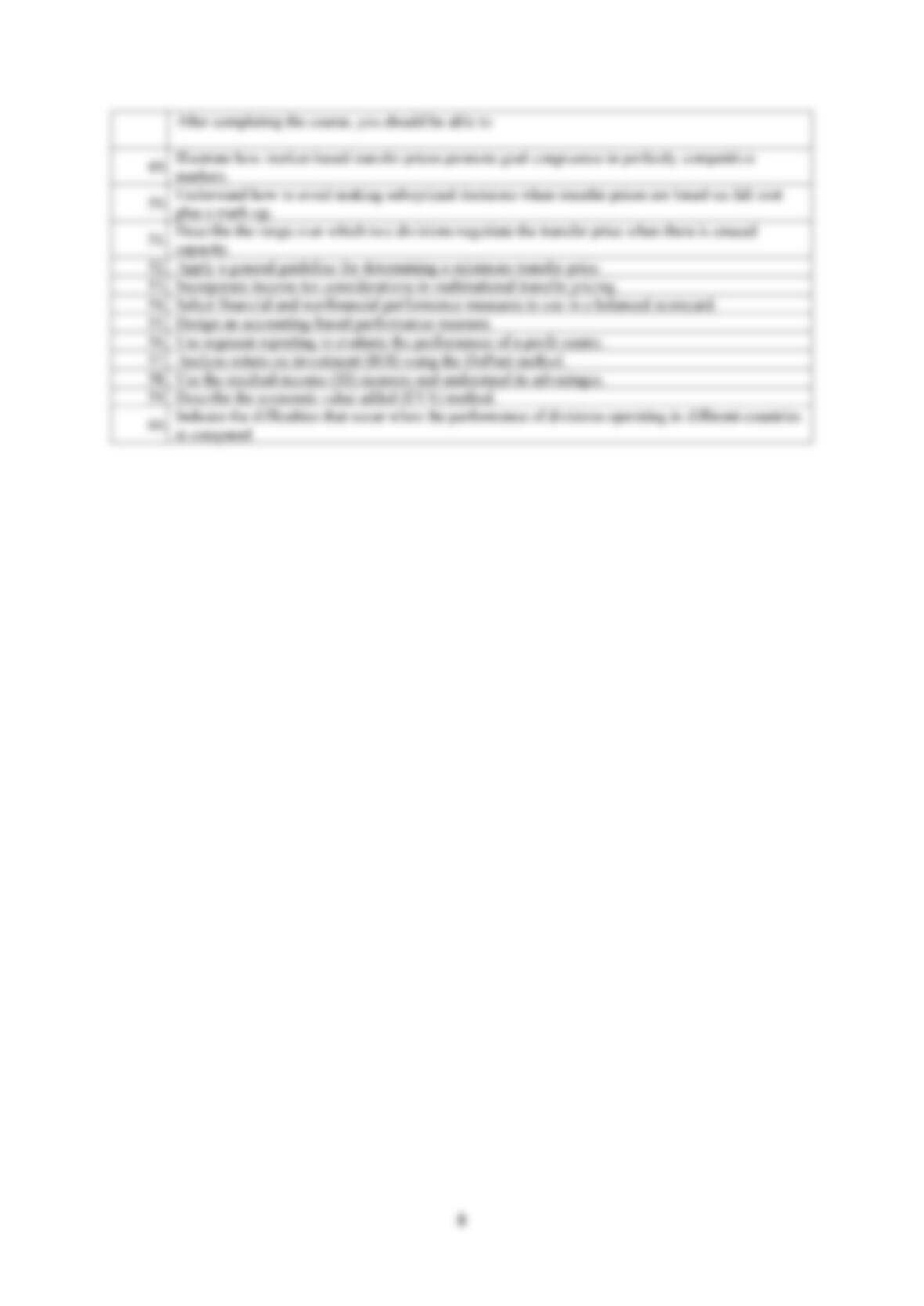
8. Detailed learning objectives are listed in the Appendix III below.
III Course Materials:
Required textbook
Horngren’s Cost Accounting: A Managerial Emphasis (16th Ed.), by Srikant M. Datar, and Madhav Rajan.
Pearson Education Inc.,
Reference Book
Accounting for Decision Making and Control (9th edition), by Jerold L. Zimmerman, McGraw-Hill Education
Lecture Ppts, Teaching Material, and Cases for group Assignments: available in Canvas before class
IV Teaching Methodology:
The course is taught in the form of lectures, in-class exercises and discussions, and group case studies. Students
are required to attend all classes and participate in class discussions and exercises. Readings and discussion
problems for each class are assigned in advance. It is important that students read the assigned chapters and
problems beforehand so that class time can be used efficiently.
V Grading
The overall grade is based on the following weighted average:
Class attendance / participation 5%
Homework assignments 7%
Group Assignments 18%
Midterm exam 25% (Thursday, April 2, 2020)
Final exam 45%
100%
Course Policy:
1. Attendance and participation
Students are required to attend all classes and arrive on time (via Zoom Meeting Online or physically