SPCS
Form 4 Principles of Accounts
Notes on Chapter 18
Capital and Revenue Expenditure
18.1 Capital expenditure
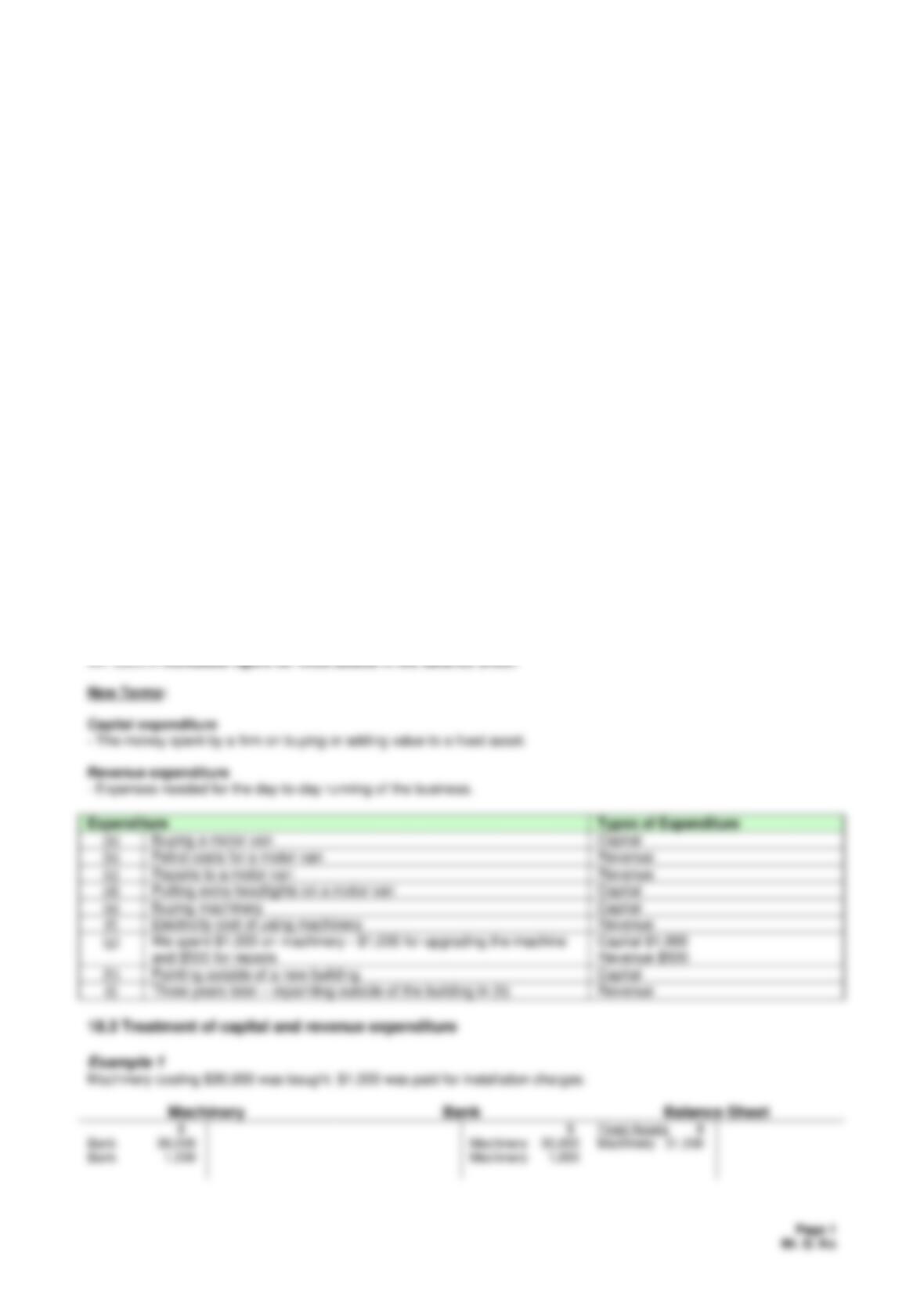
Capital expenditure is made when a firm spends money either to buy fixed assets, or add to the value of an existing fixed
asset. Included in such amounts should be those spent on:
(a) Acquiring fixed assets.
(b) Carriage inwards on an asset bought.
(c) Any other cost needed to get the fixed assets ready for use. These costs include installation, freight charges,
import duty, landing charges and legal costs of buying buildings – incidental costs.
Depreciation charged on fixed assets should include all the cost plus all the capital expenditure.
18.2 Revenue expenditure
Expenditure, which is not for increasing the value of fixed assets, but is for the running the business on a day–to-day
basis, is known as revenue expenditure.
The difference can be seen clearly with the total costs of using a motor van for a firm. To buy a new motor van is capital
expenditure. The motor van will be in use for several years and is therefore a fixed asset. To pay for petrol to use in the
motor van for the next few days is revenue expenditure. This is because the expenditure is used up in a few days and
does not add to the value of the fixed asset.
Examples of revenue expenditure include:
(a) Rent
(b) Repairs and maintenance
(c) Salaries and wages
(d) Utilities
Revenue expenditure is therefore chargeable to the trading and profit and loss account, whereas capital expenditure