Chapter 4
Systems Design: Process Costing
Solutions to Questions
4-1 A process costing system is
appropriate when a homogeneous product
is produced on a continuous basis.
4-2 Process costing and job-order
costing are similar in the following ways:
1. Both systems have the same basic
purposes, which are to assign
materials, labor, and overhead cost to
products and to provide a mechanism
for computing unit costs.
2. Both systems use the same basic
accounts.
3. Cost #ows through the accounts in
basically the same way in both
systems.
4-3 Costs are accumulated by
department in a process costing system.
4-4 Cost accumulation is simpler under
process costing because costs only need
to be identified by department—not by
separate job. Usually a company has only
a few departments, whereas there can be
hundreds or even thousands of jobs in a
job-order costing system.
4-5 A Work in Process account is
maintained for each separate processing
department in a process costing system.
4-6 The journal entry to transfer the
costs of partially completed goods from
the Mixing Department to the Firing
Department would be:
Work in Process, Firing……….………...….......
XXXX
Work in Process, Mixing…………………….
XXXX
4-7 The costs that might be added to
the Firing Department’s Work in Process
account would include: (1) cost transferred
in from the Mixing Department, (2)
materials cost, (3) labor cost, and (4)
overhead cost.
4-8 Under the weighted-average
method, the equivalent units of production
consist of units transferred to the next
department (or to finished goods) during
the period plus the equivalent units in the
department’s ending Work in Process
inventory.
4-9 A quantity schedule shows the
physical #ow of units through a
department during a period. It serves
several purposes. First, it provides the
manager with information about activity in
his or her department and also shows the
manager the stage of completion of any
in-process units. Second, it provides data
for computing the equivalent units and for
preparing the other parts of the production
report.
4-10 A unit of product accumulates cost
in each department that it passes through,
with the costs of one department added to
the costs of the preceding department in a
snowballing fashion.
© The McGraw-Hill Companies, Inc., 2005. All rights reserved.
Solutions Manual, Chapter 4 137

Brief Exercise 4-1 (30 minutes)
a. To record issuing raw materials for use in production:
Work in Process—Molding Department. . $28,000
Work in Process—Firing Department…... $5,000
Raw Materials……….……………......... $33,000
b. To record direct labor costs incurred:
Work in Process—Molding Department. . $18,000
Work in Process—Firing Department…... $5,000
Wages Payable….…......................... $23,000
c. To record applying manufacturing overhead:
Work in Process—Molding Department. . $24,000
Work in Process—Firing Department…... $37,000
Manufacturing Overhead….............. $61,000
d. To record transfer of un$red, molded bricks from the Molding
Department to the Firing Department:
Work in Process—Firing Department…... $67,000
Work in Process—Molding Department
$67,000
e. To record transfer of finished bricks from the Firing Department
to the finished goods warehouse:
Finished Goods……………....................... $108,000
Work in Process—Firing Department $108,000
f. To record Cost of Goods Sold:
Cost of Goods Sold…….......................... $106,000
Finished Goods………....................... $106,000
© The McGraw-Hill Companies, Inc., 2005. All rights reserved.
138 Introduction to Managerial Accounting, 2nd Edition

Brief Exercise 4-2 (10 minutes)
Weighted-Average Method
Equivalent Units
Materials
Conversio
n
Units transferred to the next
department 410,000 410,000
Work in process, October 31:
30,000 units × 70% 21,000
30,000 units × 50% 15,000
Equivalent units 431,000 425,000
© The McGraw-Hill Companies, Inc., 2005. All rights reserved.
Solutions Manual, Chapter 4 139

Brief Exercise 4-3 (15 minutes)
Weighted-Average Method
1. Work in process, May 1……………................................ 80,000
Started into production during May….…………….......... 300,000
Total kilograms in process………….………..................... 380,000
Deduct work in process, May 31................................. 50,000
Completed and transferred out during May..………...... 330,000
2. Kilograms to be accounted for:
Work in process, May 1 (materials 80% complete;
conversion 20% complete)….………………............... 80,000
Started into production during the month……….……. 300,000
Total kilograms to be accounted for............................ 380,000
Kilograms accounted for as follows:
Transferred out during the month..…........................ 330,000
Work in process, May 31 (materials 40% complete;
conversion 10% complete)….………………............... 50,000
Total kilograms accounted for……............................... 380,000
© The McGraw-Hill Companies, Inc., 2005. All rights reserved.
140 Introduction to Managerial Accounting, 2nd Edition

Brief Exercise 4-4 (15 minutes)
1.
Material
s Labor
Overhea
d
Work in process, May 1 $ 14,550 $23,620 $118,100
Cost added during May 88,350 14,330 71,650
Total cost (a) $102,900 $37,950 $189,750
Equivalent units of production
(b)
1,200 1,100 1,100
Cost per equivalent unit (a) ÷
(b)
$85.75 $34.50 $172.50
2.
Cost per EU for materials $ 85.75
Cost per EU for labor 34.50
Cost per EU for overhead 172.50
Total cost per EU
$292.7
5
© The McGraw-Hill Companies, Inc., 2005. All rights reserved.
Solutions Manual, Chapter 4 141

Brief Exercise 4-5 (30 minutes)
1. Computation of the total cost per EU:
Cost per EU for materials $24.00
Cost per EU for labor 7.00
Cost per EU for overhead 14.00
Total cost per EU $45.00
2. Computation of equivalent units in ending inventory:
Materials Labor
Overhea
d
Units in ending inventory 1,500 1,500 1,500
Percentage completed 90% 40% 40%
Equivalent units of
production
1,350 600 600
3. Cost Reconciliation
Total
Cost
Material
s Labor
Over–
head
Cost accounted for as
follows:
Transferred to the next
department: 18,000 units
at $45.00 per unit
$810,00
0 18,000 18,000 18,000
Work in process, ending:
Materials, at $24.00 per
EU 32,400 1,350
Labor, at $7.00 per EU 4,200 600
Overhead, at $14.00 per
EU 8,400 600
Total work in process 45,000
Total cost
$855,00
0
© The McGraw-Hill Companies, Inc., 2005. All rights reserved.
142 Introduction to Managerial Accounting, 2nd Edition

Exercise 4-6 (15 minutes)
Work in Process—Mixing……………….……………........330,000
Raw Materials Inventory..……….......................... 330,000
Work in Process—Mixing……………….……………........260,000
Work in Process—Baking…..….................................120,000
Wages Payable….…………................................... 380,000
Work in Process—Mixing……………….……………........190,000
Work in Process—Baking…..….................................90,000
Manufacturing Overhead.…….……...................... 280,000
Work in Process—Baking…..….................................760,000
Work in Process—Mixing………………................... 760,000
Finished Goods..…………………….………....................980,000
Work in Process—Baking.................................... 980,000
© The McGraw-Hill Companies, Inc., 2005. All rights reserved.
Solutions Manual, Chapter 4 143

Exercise 4-7 (20 minutes)
Weighted-Average Method
Quantit
y
Schedul
e
Pounds to be accounted for:
Work in process, May 1
(materials 100% complete,
labor and overhead 55%
complete) 30,000
Started into production during
May 480,000
Total pounds to be accounted for
510,000
Equivalent Units
Material
s
Labor &
Overhea
d
Pounds accounted for as follows:
Transferred to Packing
Department during May* 490,000 490,000 490,000
Work in process, May 31
(materials 100% complete,
labor and overhead 90%
complete) 20,000 20,000 18,000
Total pounds accounted for 510,000 510,000 508,000
*30,000 + 480,000 – 20,000 = 490,000.
© The McGraw-Hill Companies, Inc., 2005. All rights reserved.
144 Introduction to Managerial Accounting, 2nd Edition

Exercise 4-8 (30 minutes)
Weighted-Average Method
1. For the sake of brevity, only the portion of the quantity schedule from which the
equivalent units are computed is shown below.
Quantit
y Equivalent Units (EU)
Schedul
e Materials
Conversio
n
Units accounted for as follows:
Transferred to the next process 300,000 300,000 300,000
Work in process, June 30
(materials 50% complete,
conversion 25% complete) 40,000 20,000 10,000
Total units accounted for 340,000 320,000 310,000
2. Total
Cost
Material
s
Conversio
n
Whole
Unit
Cost to be accounted for:
Work in process, June 1
$ 71,50
0
$ 56,60
0 $ 14,900
Cost added by the department 599,500 385,000 214,500
Total cost to be accounted for (a)
$671,00
0
$441,60
0 $229,400
Equivalent units (b) 320,000 310,000
Cost per equivalent unit (a) ÷ (b) $1.38 + $0.74 = $2.12
© The McGraw-Hill Companies, Inc., 2005. All rights reserved.
Solutions Manual, Chapter 4 145

© The McGraw-Hill Companies, Inc., 2005. All rights reserved.
146 Introduction to Managerial Accounting, 2nd Edition

Exercise 4-9 (20 minutes)
Weighted-Average Method
Total
Equivalent Units
(EU)
Cost
Material
s
Conversio
n
Cost accounted for as follows:
Transferred to the next
process:
300,000 units at $2.12 each $636,00
0 300,000 300,000
Work in process, June 30:
Materials, at $1.38 per EU 27,600 20,000
Conversion, at $0.74 per EU
7,400 10,000
Total work in process 35,000
Total cost accounted for
$671,00
0
© The McGraw-Hill Companies, Inc., 2005. All rights reserved.
Solutions Manual, Chapter 4 147
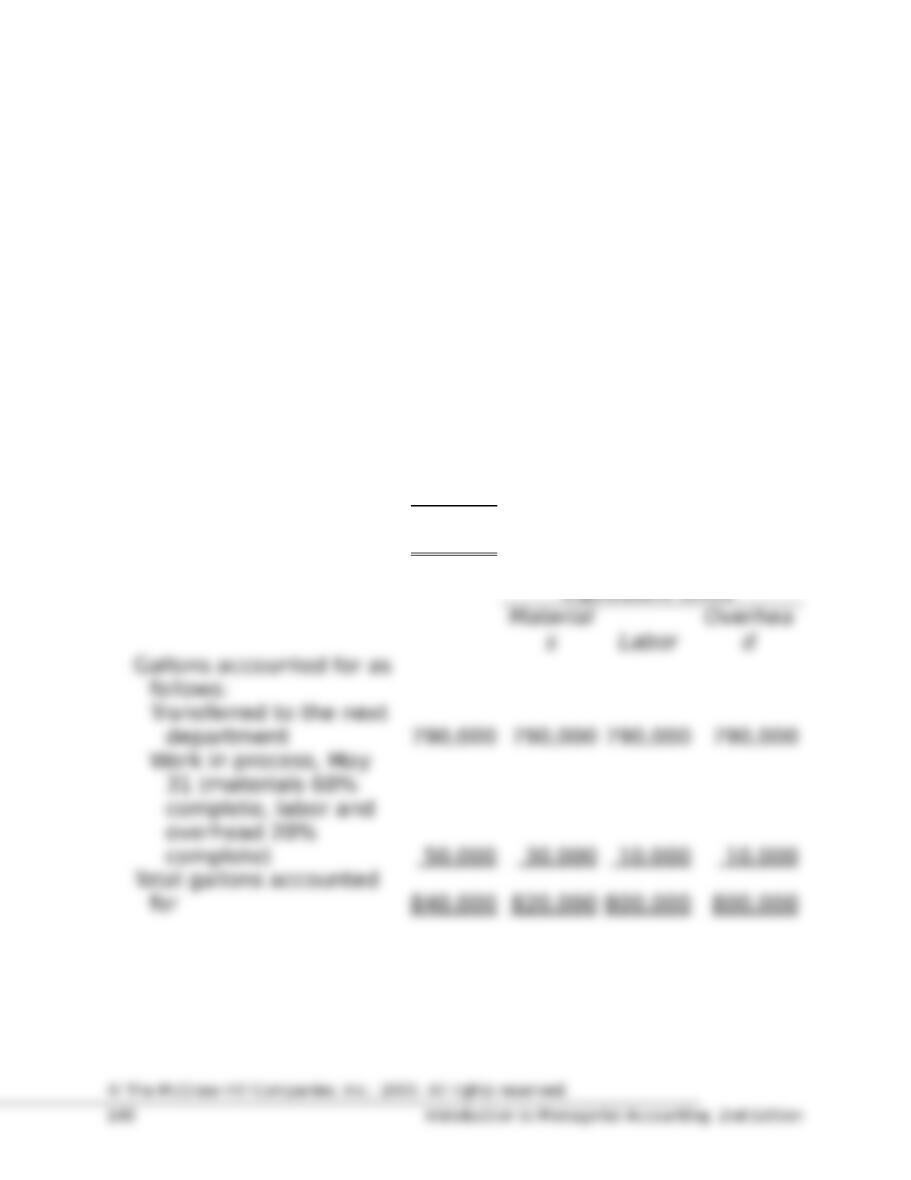
Exercise 4-10 (30 minutes)
Weighted-Average Method
1. Quantit
y
Schedul
e
Gallons to be accounted
for:
Work in process, May
1 (materials 80%
complete, labor and
overhead 75%
complete) 80,000
Started into
production 760,000
Total gallons accounted
for 840,000