CHAPTER STUDY OBJECTIVES
1. Explain the revenue recognition principle and the matching principle. The revenue
recognition principle dictates that companies recognize revenue in the accounting period in
which it is earned. The matching principle dictates that companies recognize expenses when
expenses make their contribution to revenues.
2. Differentiate between the cash basis and the accrual basis of accounting. Accrual-based
accounting means that companies record in the periods in which the events occur events that
change a company’s financial statements. Under the cash basis, companies record events only
in the periods in which the company receives or pays cash.
3. Explain why adjusting entries are needed and identify the major types of adjusting en-
tries. Companies make adjusting entries at the end of an accounting period. These entries
ensure that companies record revenues in the period in which they are earned and that com-
panies recognize expenses in the period in which they are incurred. The major types of
adjusting entries are prepaid expenses, unearned revenues, accrued revenues, and accrued
expenses.
4. Prepare adjusting entries for prepayments. Prepayments are either prepaid expenses or
unearned revenues. Companies make adjusting entries for prepayments at the statement date
to record the portion of the prepayment that represents the expense incurred or the revenue
earned in the current accounting period.
5. Prepare adjusting entries for accruals. Accruals are either accrued revenues or accrued
expenses. Adjusting entries for accruals record revenues earned and expenses incurred in the
current accounting period that have not been recognized through daily entries.
6. Describe the nature and purpose of the adjusted trial balance. An adjusted trial balance is
a trial balance that shows the balances of all accounts, including those that have been adjust-
ed, at the end of an accounting period. The purpose of an adjusted trial balance is to show the
effects of all financial events that have occurred during the accounting period.
7. Explain the purpose of closing entries. One purpose of closing entries is to transfer the re-
sults of operations for the period to Retained Earnings. A second purpose is to “zero–out” all
temporary accounts (revenue accounts, expense accounts, and dividends) so that they start
each new period with a zero balance. To accomplish this, companies close all temporary ac-
counts at the end of an accounting period. They make separate entries to close revenues and
expenses to Income Summary, Income Summary to Retained Earnings, and Dividends to Re-
tained Earnings. Only temporary accounts are closed.
8. Describe the required steps in the accounting cycle. The required steps in the accounting
cycle are: (a) analyze business transactions, (b) journalize the transactions, (c) post to ledger
accounts, (d) prepare a trial balance, (e) journalize and post adjusting entries, (f) prepare an
adjusted trial balance, (g) prepare financial statements, (h) journalize and post closing entries,
and (i) prepare a post-closing trial balance.
*9. Describe the purpose and the basic form of the work sheet. The work sheet is a device to
make it easier to prepare adjusting entries and the financial statements. Companies often pre-
pare a work sheet on a computer spreadsheet. The sets of columns of the work sheet are, from
left to right, the unadjusted trial balance, adjustments, adjusted trial balance, income statement,
and balance sheet.

Test Bank for Financial Accounting: Tools for Business Decision Making
4-2
TRUE-FALSE STATEMENTS
1________ The time period assumption states that the economic life of a business entity can be
divided into artificial time periods.
2________ The revenue recognition principle dictates that revenue be recognized in the account-
ing period in which it is earned.
3________ Expense recognition often follows revenue recognition.
4________ The revenue recognition principle and the matching principle are helpful guides used
in determining net income or net loss for a period.
5________ The matching principle requires that efforts be related to accomplishments.
6________ The matching concept supports accrual accounting principles.
7________ Applying accrual accounting results in a more accurate measurement of net income
for the period than does cash basis accounting.
8________ Income will always be greater under the cash basis of accounting than under the ac-
crual basis of accounting.
9________ The cash basis of accounting is not in accordance with generally accepted account-
ing principles.
10________ Adjusting entries are not necessary if the trial balance debit and credit columns bal-
ances are equal.
11________ An adjusting entry would adjust a revenue so it is reported when it is paid.
12________ An adjusting entry to a prepaid expense is required to recognize expired expenses.
13________ An adjusting entry always involves two balance sheet accounts.
14________ An adjusting entry always involves a balance sheet account and an income statement
account.
15________ Revenue received before it is earned and expenses paid before being used or con-
sumed are both initially recorded as liabilities.
16________ Revenue received before it is earned and expenses used or consumed before being
paid are both initially recorded as liabilities.
17________ Accrued revenues are revenues that have been received but not yet earned.
18________ If prepaid costs are initially recorded as an asset, no adjusting entries will be required
in the future.
19________ The cost of a depreciable asset less accumulated depreciation reflects the book value
of the asset.
20________ The book value of a depreciable asset is always equal to its market value because
depreciation is a valuation technique.
21________ Accumulated Depreciation is a liability account and has a credit normal account bal–
ance.
22________ Unearned revenue is a prepayment that requires an adjusting entry when services
are performed.

A Further Look at Financial Statements
4-3
23________ A contra asset account is subtracted from a related account in the balance sheet.
24________ Depreciation is a valuation concept.
25________ A depreciable asset’s original cost typically will be shown on the balance sheet.
26________ Financial statements can be prepared from the information provided by an adjusted
trial balance.
27________ Cash is a temporary account.
28________ The post-closing trial balance will contain only permanent—balance sheet—accounts.
29________ Accounts receivable is a permanent account.
30________ Financial statements must be prepared before the closing entries are made.
31________ In the accounting cycle, closing entries are prepared before adjusting entries.
32________ Closing entries result in the transfer of net income or net loss into the Retained Earn-
ings account.
33________ The post closing trial balance will have fewer accounts than the adjusted trial bal-
ance.
34________ The accounting cycle begins with the journalizing of the transactions.
MULTIPLE CHOICE QUESTIONS
35________ The time period assumption states that
a. a transaction can only affect one period of time.
b. estimates should not be made if a transaction affects more than one time period.
c. adjustments to the enterprise’s accounts can only be made in the time period when the
business terminates its operations.
d. the economic life of a business can be divided into artificial time periods.
36________ One of the accounting concepts upon which adjustments for prepayments and accru-
als are based is
a. matching.
b. cost.
c. monetary unit.
d. economic entity.
37.______ An accounting time period that is one year in length is called
a. a fiscal year.
b. an interim period.
c. the time period assumption.
d. a reporting period.

Test Bank for Financial Accounting: Tools for Business Decision Making
4-4
38.______ Management usually wants ________ financial statements and the IRS requires all
businesses to file _________ tax returns.
a. annual, annual
b. monthly, annual
c. quarterly, monthly
d. monthly, monthly
39.______ In general, the shorter the time period, the difficulty of making the proper adjustments
to accounts
a. is increased.
b. is decreased.
c. is unaffected.
d. depends on if there is a profit or loss.
40.______ Which of the following is not generally an accounting time period?
a. A week
b. A month
c. A quarter
d. A year
41.______ The revenue recognition principle dictates that revenue should be recognized in the
accounting records
a. when cash is received.
b. when it is earned.
c. at the end of the month.
d. in the period that income taxes are paid.
42.______ In a service-type business, revenue is considered earned
a. at the end of the month.
b. at the end of the year.
c. when the service is performed.
d. when cash is received.
43.______ The matching principle matches
a. customers with businesses.
b. expenses with revenues.
c. assets with liabilities.
d. creditors with businesses.
44.______ Javier’s Tune-Up Shop follows the revenue recognition principle. Javier services a car
on August 31. The customer picks up the vehicle on September 1 and mails the payment to
Javier on September 5. Javier receives the check in the mail on September 6. When should
Javier show that the revenue was earned?
a. August 31
b. August 1
c. September 5
d. September 6

A Further Look at Financial Statements
4-5
45.______ A company spends $20 million dollars for an office building. Over what period should
the cost be written off?
a. When the $20 million is expended in cash
b. All in the first year
c. Over the useful life of the building
d. After $20 million in revenue is earned
46________ The matching principle states that expenses should be matched with revenues. An-
other way of stating the principle is to say that
a. assets should be matched with liabilities.
b. efforts should be matched with accomplishments.
c. dividends should be matched with stockholder investments.
d. cash payments should be matched with cash receipts.
47________ Which principle dictates that efforts (expenses) be recorded with accomplishments
(revenues)?
a. Cost principle.
b. Periodicity principle.
c. Revenue recognition principle.
d. Matching principle.
48________ A flower shop makes a large sale for $1,000 on November 30. The customer is sent
a statement on December 5 and a check is received on December 10. The flower shop fol-
lows GAAP and applies the revenue recognition principle. When is the $1,000 considered to
be earned?
a. December 5
b. December 10
c. November 30
d. December 1
49.______ A furniture factory’s employees work overtime to finish an order that is sold on Janu-
ary 31. The office sends a statement to the customer in early February and payment is
received by mid-February. The overtime wages should be expensed in
a. January.
b. February.
c. the period when the workers receive their checks.
d. either January or February depending on when the pay period ends.
50________ Which is not an application of revenue recognition?
a. Recording revenue as an adjusting entry on the last day of the accounting period.
b. Accepting cash from an established customer for services to be performed over the next
three months.
c. Billing customers on June 30 for services completed during June.
d. Receiving cash for services performed.

Test Bank for Financial Accounting: Tools for Business Decision Making
4-6
51.______ On April 1, 2007, M Corporation paid $48,000 cash for equipment that will be used in
business operations. The equipment will be used for four years. M records depreciation ex-
pense of $9,000 for the calendar year ending December 31, 2007. Which accounting
principle has been violated? Why?
a. Depreciation principle, because depreciation expense is $12,000 per year.
b. No principle has been violated because M has correctly matched the expense for using
the equipment to the period it generated revenue.
c. Matching principle because the cash was paid in 2007 and should be expensed in 2007.
d. Matching principle because depreciation expense should be $8,000.
52________ Expenses sometimes make their contribution to revenue in a different period than
when the expense is paid. When wages are incurred in one period and paid in the next peri-
od, this often leads to which account appearing on the balance sheet at the end of the first
period?
a. Due from Employees
b. Due to Employer
c. Wages Payable
d. Wages Expense
53.______ A small company may be able to justify using a cash basis of accounting if they have
a. sales under $1,000,000.
b. no accountants on staff.
c. few receivables and payables.
d. all sales and purchases on account.
54.______ Which statement is correct?
a. As long as a company consistently uses the cash basis of accounting, generally accepted
accounting principles allow its use.
b. The use of the cash basis of accounting violates both the revenue recognition and match-
ing principles.
c. The cash basis of accounting is objective because no one can be certain of the amount
of revenue until the cash is received.
d. As long as management is ethical, there are no problems with using the cash basis of
accounting.
A Further Look at Financial Statements
4-7
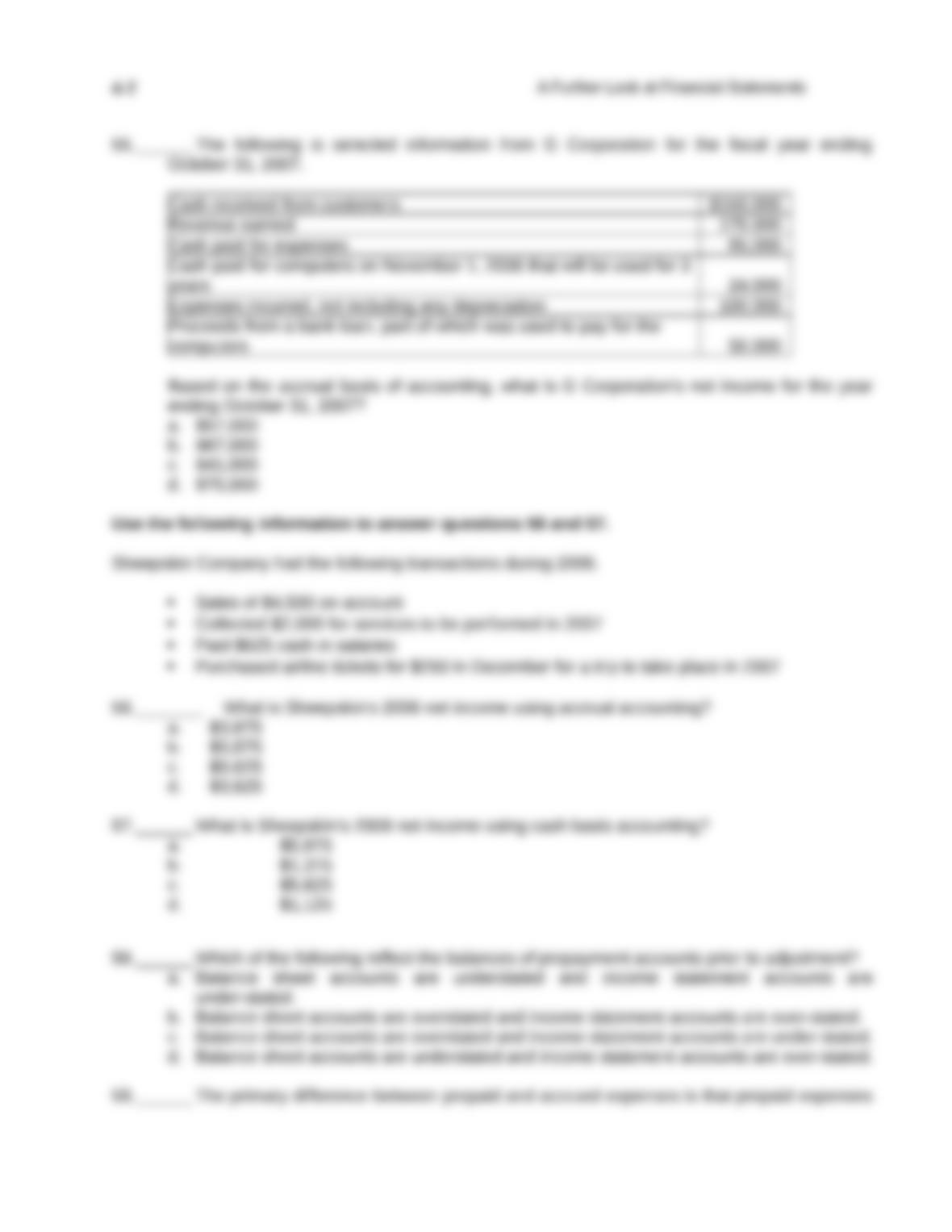
55.______ The following is selected information from G Corporation for the fiscal year ending
October 31, 2007.
Cash received from customers
$150,000
Revenue earned
175,000
Cash paid for expenses
85,000
Cash paid for computers on November 1, 2006 that will be used for 3
years
24,000
Expenses incurred, not including any depreciation
100,000
Proceeds from a bank loan, part of which was used to pay for the
computers
50,000
Based on the accrual basis of accounting, what is G Corporation’s net income for the year
ending October 31, 2007?
a. $57,000
b. $67,000
c. $41,000
d. $75,000
Use the following information to answer questions 56 and 57.
Sheepskin Company had the following transactions during 2006.