ACADEMIC ESSAY
WRITING
For students at Charles Darwin University
A resource to
assist tutors
working with
Indigenous
students

Table of Contents
The academic world 3
Critical thinking 4
Preparing to write an essay 6
Unpacking the essay question 6
Looking at the marking rubric 7
Understanding a Brainstorm of the essay topic 8
Developing a Taxonomy for the essay topic 9
Academic essay structure 10
A word on academic language 10
Writing a thesis statement 11
Writing an introduction 12
A note on using headings 12
Writing a paragraph 13
Essay: An annotated example 14
Referencing 20
In-text referencing 20
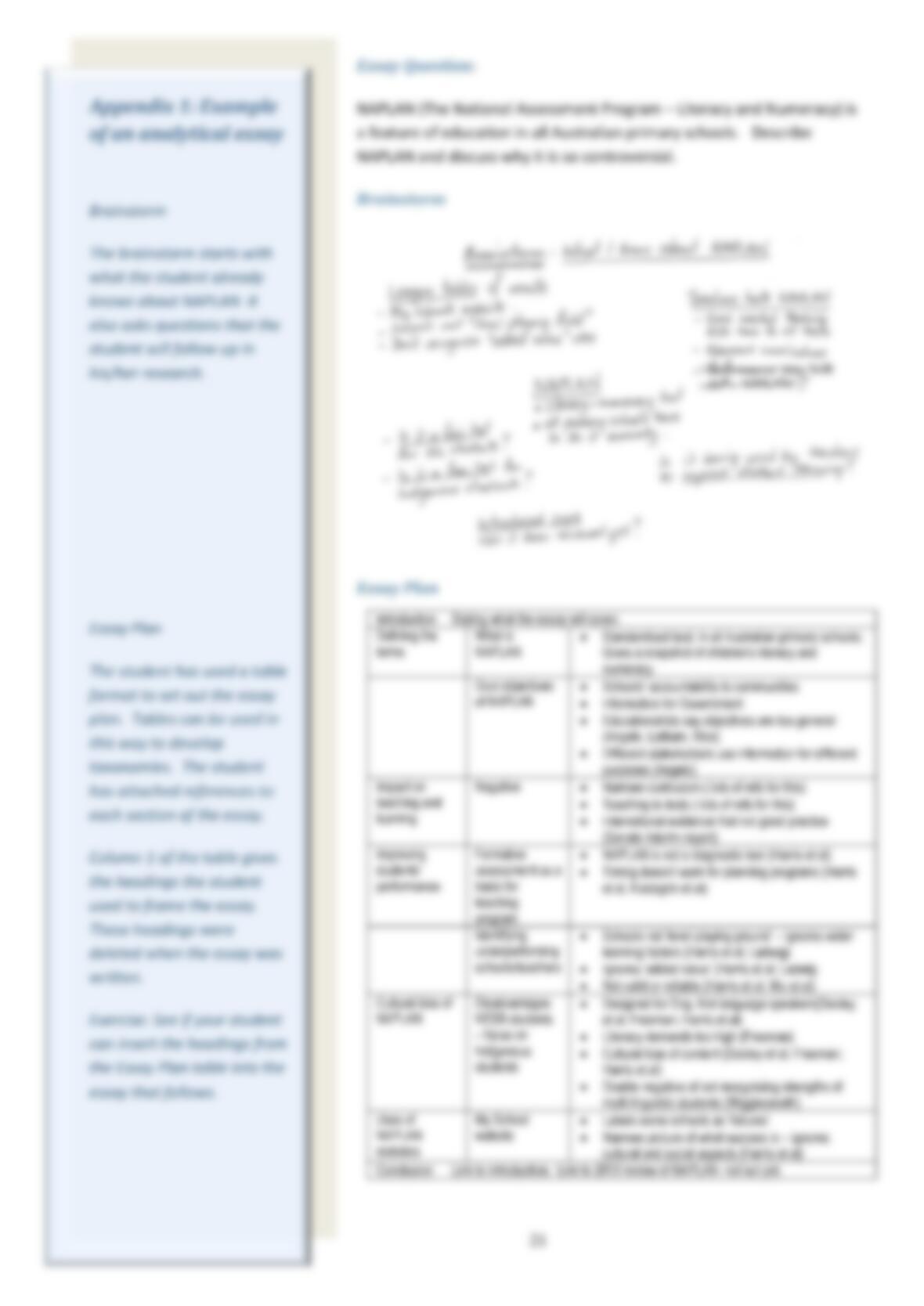
Appendix 1: Analytical essay 21
ACKNOWLEDGEMENTS
Thanks to Jamie Pomfrett for providing original materials for this
guide. Thanks also to Jamie, Debra Dank and David McClay PhD
for reviewing this document.
Lesley MacGibbon PhD
ACIKE Staff Development
Charles Darwin University
Purpose of this
booklet
This booklet aims to provide
resources to tutors who
work with Indigenous
students at Charles Darwin
University. It is intended to
provide you with
information and exercises to
assist you to scaffold
students to be successful in
their university studies. We
focus on writing academic
essays, because this is a skill
student’s need in most
university courses, and is a
skill that can be transferred
to assessments in other
units.
We know that students
bring a wide range of skills
and life experiences to the
university setting. What we
hope to do is to assist you,
as tutor, to build on the
students’ existing skills and
knowledge, with
transferrable skills that will
enable them to succeed at
university. Our philosophy
aligns with the old proverb:
“Give a man a fish and you
feed him for a day, but
teach him to fish, you feed
him for life.”
2

Exercise: Rules of the game
Ask your student which sport they play or follow. On paper or
whiteboard draw up two columns. In one column list the
rules of the game as the student identifies them. In the other
column, list the rules of writing academic essays. Get the
student to help to identify these if they can. Your completed
list might look something like this:
Rules of soccer(football)
Rules of essay writing
You cannot pick up the ball
unless you are goalie.
You must analyse the
question carefully to make
sure you answer what is
asked.
You can head the ball in
the air.
You must use formal
academic English – not slang
or txt language.
You must play within the
lines of the field.
You cannot just write your
opinion. You must back
everything you write with
evidence (what other people
have written).
You cannot physically push
or shove players on the
other team.
Different lecturers may have
different rules about what
academic language is – you
will need to check with them.
Games are usually 45 mins
each half.
You must reference where
you got your information
from.
You must obey the Referee
even if you don’t agree
with him or her.
There are particular forms of
referencing you must use.
You need to stay onside.
You must not copy other
people’s work (plagiarism).
You must wear shin guards
to protect your ankles.
You need to write in
paragraphs- start with an
introduction and finish with a
conclusion.
The Academic World
The ‘academic world’ and
the ‘real world’ are not the
same.
Levin (2004) explains that
the ‘academic world’ and
the ‘real world’ are not the
same, and students need to
learn the differences
between these worlds.
The real world is where we
experience our lives – we
live and work, raise children,
play or watch sport, spend
time with family and friends
and interact with the
natural world. A lot of what
we know about the real
world is from our
experiences.
The academic world on the
other hand is one of
theories, explanations, ideas
and critiques. We can’t
experience them the same
way as we experience the
real world, through seeing,
hearing, touching, tasting,
smelling. In the academic
world we learn from what is
spoken, or more often
written, about the world.
This means that in the
academic world you learn at
second hand, from what
other people have written,
rather than from your own
experience. Levin (2004, p
5) argues that:
“The culture of higher
education in the Western
world is very much a culture
of the written world”. 3

Exercise: Critical thinking 1
1. Show your students a standard
bottle of water – or show the picture
of a bottle of water, and ask them to
describe this.
When describing they should just tell
you what they see –
it is a clear plastic bottle
the label says it is ‘spring’ water
it has a white cap
etc
2. Ask your students to think critically
about this bottle of water. You
might need to ask them the question
“So what? This is a bottle of water,
what else do we know about bottled
water?”
The students should be able to come
up with things that might include:
It costs $4 for a bottle of
water this size from the
supermarket
Plastic bottles like this are a
problem in landfill
At home we drink bottled
water because our tap water
tastes bad
Bottled water isn’t any
better than the water that
comes from our taps
We don’t take bottled water
when we go country because
then we drink from the
spring
Critical thinking
Students often have trouble
understanding what we
mean by “critical thinking”.
It is worthwhile spending
some time exploring ideas
around critical thinking, and
the difference between
description and analysis or
critical thinking. We have
found the following
exercises to be very helpful.
4

Exercise: Critical thinking 2
Ask your student to imagine that where they live has just been struck by
a cyclone. Describe what they might see: List their descriptions on the
left-hand column. Then ask them to imagine that they are the civil
defence wardens for their neighbourhood. Get them to think critically
about what they described, and write what they identify when thinking
critically. For example:
Cyclone: description
Cyclone: critical thinking
The houses seem to be
OK, but garages and
sheds have been blown
down.
Are there any injured people in
the houses?
Are any of the buildings in
danger of falling down and
injuring people?
Some of the streets are
flooded.
It looks as though the
water is up to one metre
deep.
Are there people who have
been cut off by the water that
need rescuing?
Is there still fresh water coming
from the taps?
What type of vehicle is needed
to get through the flooding?
There are trees blown
down over roads and
power lines.
Are any of the power lines still
active?
Are they a danger to anyone?
Is there any power in the
neighbourhood?
Are the roads accessible, or are
they blocked to traffic by live
power lines or fallen trees?
Etc
Etc
Etc
Etc
Why do we need critical
thinking?
Students often ask why they
need to develop critical
thinking and why they need
to demonstrate it in an
essay. Most jobs require
people to be able to think
critically, and essay writing
is one way that the
university can see that
students are developing
critical thinking. In many
jobs people are required to
write reports that will guide
the action of others – for
example in nursing, and
critical thinking is required
to do this.
5

Unpacking the essay question
Usually the essay question will have some direction words that give clues
about what is wanted in the essay (Rolls & Wignell 2013). These words
may be “describe”, “explain”, “argue”, “discuss”, “critique” etc.
Describe: Write about the facts, process or event. Write in a systematic
order, and emphasise the most important points. You are not expected to
explain or interpret.
Explain: You will need to analyse, not simply describe or summarise. You
need to focus on the ‘why’ or ‘how’ of a particular issue, to clarify reasons,
causes and effects.
Argue: If you are asked to argue, you need to systematically support or
reject a point of view by presenting evidence. You also need to show that
you are aware of the opposing point of view.
Discuss: You present a point of view. This will include both description
and interpretation. Your opinion should be supported by argument and
evidence from other writings.
Critique: A critique is where you identify and discuss both the positive
and negative aspects of a topic.
Compare and contrast: Find the similarities and differences between two
or more ideas, events or interpretations.
Examples of essay questions:
NAPLAN (The National Assessment Program – Literacy and Numeracy) is a
feature of education in all Australian Primary schools. Describe NAPLAN
and discuss why it is so controversial.
Critically analyse the key concepts of working cross-culturally, specifically
in regards to effective communication and the impact on your work
practice.
Outline and analyse the key components of a framework for health
professionals to engage in effective and respectful communication with
Indigenous peoples, especially in regards to the delivery of health
services. Describe how this could potentially be viewed as part of a
strategy across a number of levels to systematically lift the cultural
competency of mainstream health services.
PREPARING TO
WRITE AN ESSAY
Unpacking the essay
question
Work with the student to
analyse and decipher the
question.
What does the lecturer want
in the essay?
Even if you think that the
lecturer has set a silly
question, it is what the
student must answer.
Help the student unpack the
question.
6
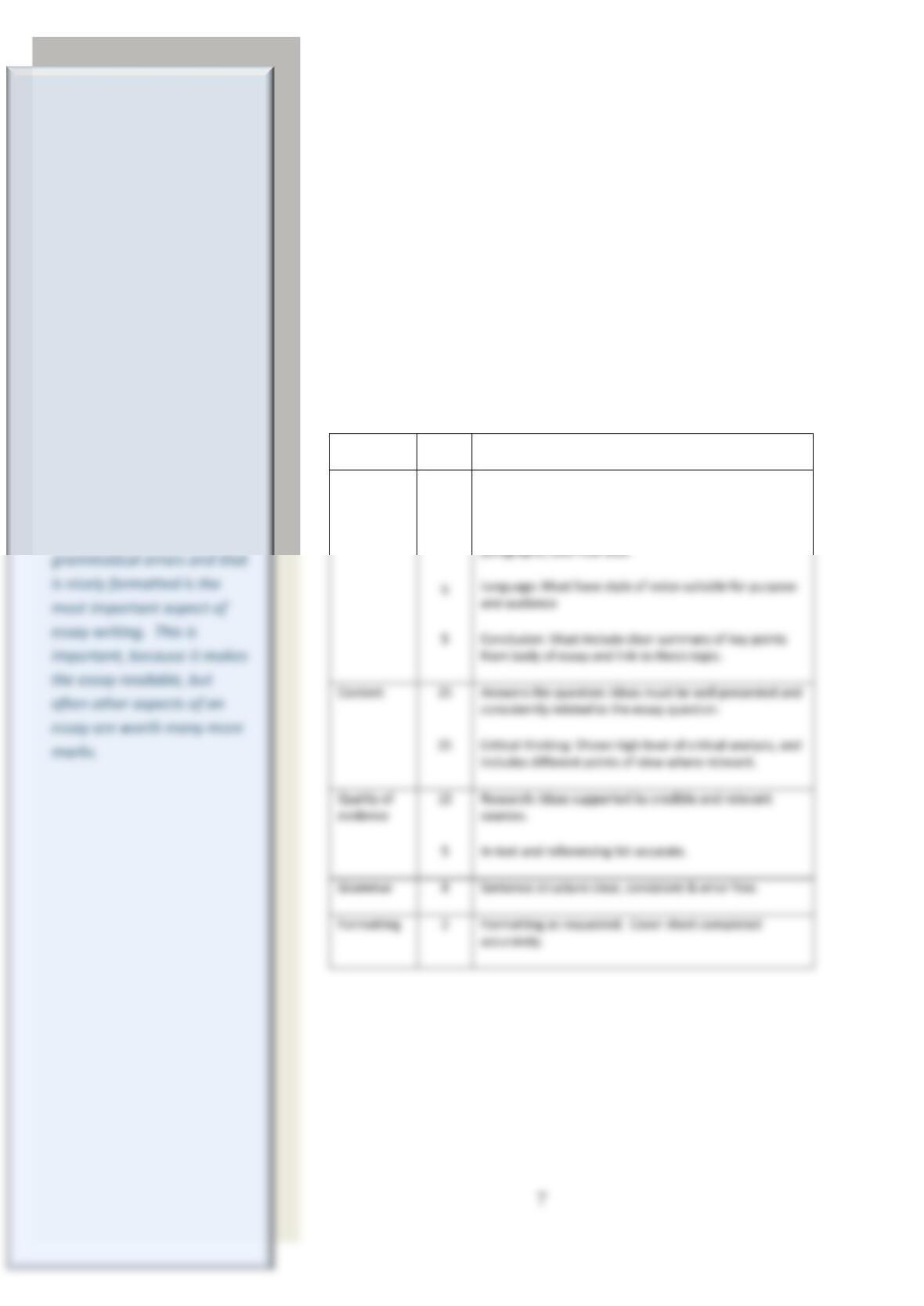
Example of a marking rubric
In the following example of a rubric, what are the three aspects of the essay
that the lecturer considers most important? Where should the student put
most effort? How important is text organisation and essay structure?
points
For maximum points essay must
Text
organisation
and essay
structure
5
Introduction: Must have clear thesis statement aligned
to body of essay
5
Body of essay: Must be well structured, have cohesive
Looking at the
marking rubric
In most units at Charles
Darwin University, a
marking guide or marking
rubric is provided.
Go over this with your
students because it usually
gives a clear picture of what
the lecturer is looking for in
the essay. It assigns
percentages of the marks for
particular things.
Many students believe that
having an essay free of
5
Conclusion: Must include clear summary of key points
Content
Answers the question: Ideas must be well presented and
Critical thinking: Shows high level of critical analysis, and
Quality of
evidence
Research: Ideas supported by credible and relevant
sources.