Chapter 7
Profit Planning
True/False
1. The sales budget is usually prepared before the production budget.
Level: Easy LO: 1,2,3 Ans: T
2. The cash budget is the starting point in preparing the master budget.
Level: Medium LO: 1,8 Ans: F
3. The first budget a company prepares in a master budget is the production budget.
Level: Medium LO: 1 Ans: F
4. One of the weaknesses of budgets is that they are of little value in uncovering potential bottlenecks in
an organization.
Level: Medium LO: 1 Ans: F
5. One of the advantages of a self-imposed budget is that the person directly involved in an activity is
more likely to be in a position to make good budget estimates.
Level: Easy LO: 1 Ans: T
6. The basic idea behind responsibility accounting is that top management is responsible for preparing
detailed budgets by which the performance of middle and lower management will be evaluated.
Level: Easy LO: 1 Ans: F
7. Budgeting is a trade-off between planning and control in that increased use of budgeting will usually
improve planning but will weaken control.
Level: Medium LO: 1 Ans: F
8. The sales budget often includes a schedule of expected cash collections.
Level: Easy LO: 2 Ans: T
9. Uncollectible amounts on credit sales to customers will be listed as cash outflows on the schedule of
expected cash collections.
Level: Medium LO: 2 Ans: F
Brewer, Introduction to Managerial Accounting, 3/e 101
10. The number of units to be produced in a period can be determined by adding the expected sales to the
desired ending inventory and then deducting the beginning inventory.
Level: Medium LO: 3 Ans: T
11. When preparing a direct materials budget, beginning inventory for raw materials should be added to
production needs, and desired ending inventory should be subtracted to determine the amount of raw
materials to be purchased.
Level: Medium LO: 4 Ans: F
12. The manufacturing overhead budget provides a schedule of all costs of production other than direct
materials and direct labor.
Level: Easy LO: 6 Ans: T
13. Both variable and fixed manufacturing overhead costs are included in the selling and administrative
expense budget.
Level: Medium LO: 7 Ans: F
14. On a cash budget, the total amount of budgeted cash payments for manufacturing overhead should not
include any amounts for depreciation on factory equipment.
Level: Easy LO: 8 Ans: T
15. In zero-base budgeting, only changes from the prior budget must be justified.
Level: Easy LO: 11 Ans: F
Multiple Choice
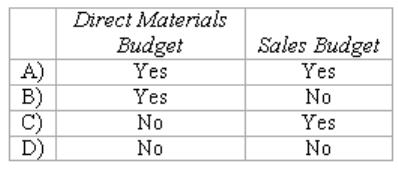
16. Which of the following budgets are prepared before the production budget?
A) A Above
B) B Above
C) C Above
D) D Above
Level: Medium LO: 1 Ans: C
Brewer, Introduction to Managerial Accounting, 3/e102
Brewer, Introduction to Managerial Accounting, 3/e 103
17. Which of the following represents the normal sequence in which the below budgets are prepared?
A) Sales, Balance Sheet, Income Statement
B) Balance Sheet, Sales, Income Statement
C) Sales, Income Statement, Balance Sheet
D) Income Statement, Sales, Balance Sheet
Level: Medium LO: 1 Ans: C
18. The budget method that maintains a constant twelve month planning horizon by adding a new month
on the end as the current month is completed is called:
A) an operating budget.
B) a capital budget.
C) a continuous budget.
D) a master budget.
Level: Easy LO: 1 Ans: C
19. In preparing a master budget, top management is generally best able to:
A) prepare detailed departmental-level budget figures.
B) provide a perspective on the company as a whole.
C) point out the particular persons who are to blame for inability to meet budget goals.
D) responses a, b, and c are all correct.
Level: Easy LO: 1 Ans: B
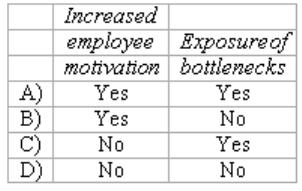
20. Which of the following benefits could an organization reasonably expect from an effective budget
program?
A) A Above
B) B Above
C) C Above
D) D Above
Level: Easy LO: 1 Ans: A
21. Which of the following is an advantage of implementing a self-imposed budgeting system?
A) Budgeting is quick and easy because only a few individuals are involved in the budgeting process.
B) Upper level management does not have to review budget estimates.
C) Motivation to meet budget estimates is usually enhanced.
D) All of the above.
Brewer, Introduction to Managerial Accounting, 3/e104
Level: Easy LO: 1 Ans: C
Brewer, Introduction to Managerial Accounting, 3/e 105
22. All the following are considered to be benefits of participative budgeting, except for:
A) Individuals at all organizational levels are recognized as being part of a team; this results in greater
support for the organization.
B) The budget estimates are prepared by those in directly involved in activities.
C) When managers set their own targets for the budget, top management need not be concerned with the
overall profitability of operations.
D) Managers are held responsible for reaching their goals and cannot easily shift responsibility by
blaming unrealistic goals set by others.
Source: CMA, adapted
Level: Easy LO: 1 Ans: C
23. Which of the following is NOT an objective of the budgeting process?
A) To communicate management’s plans throughout the entire organization.
B) To provide a means of allocating resources to those parts of the organization where they can be used
most effectively.
C) To ensure that the company continues to grow.
D) To uncover potential bottlenecks before they occur.
Level: Easy LO: 1 Ans: C
24. When preparing a production budget, the required production equals:
A) budgeted sales + beginning inventory + desired ending inventory.
B) budgeted sales – beginning inventory + desired ending inventory.
C) budgeted sales – beginning inventory – desired ending inventory.
D) budgeted sales + beginning inventory – desired ending inventory.
Source: CIMA, adapted
Level: Easy LO: 3 Ans: B
25. The direct labor budget is based on:
A) the desired ending inventory of finished goods.
B) the beginning inventory of finished goods.
C) the required production for the period.
D) the required materials purchases for the period.
Level: Easy LO: 5 Ans: C
Brewer, Introduction to Managerial Accounting, 3/e106
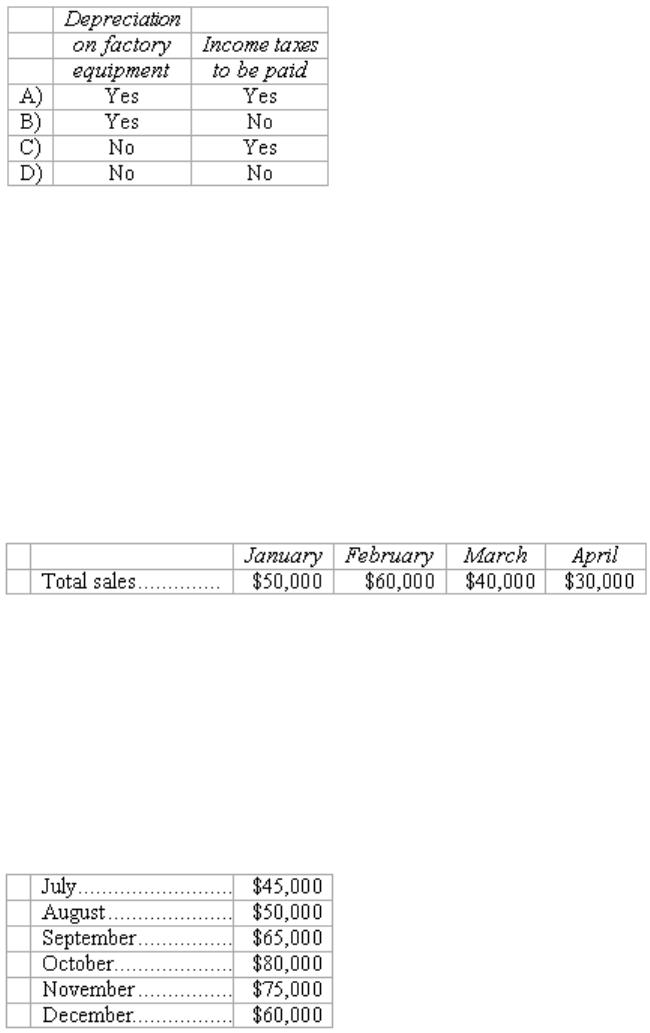
26. Which of the following might be included as a disbursement on a cash budget?
A) A Above
B) B Above
C) C Above
D) D Above
Level: Medium LO: 8 Ans: C
27. Thirty percent of Sharp Company’s sales are for cash and 70% are on account. Sixty percent of the
account sales are collected in the month of sale, 25% in the month following sale, and 12% in the second
month following sale. The remainder is uncollectible. The following are budgeted sales data for the
company:
Total cash receipts in April are expected to be:
A) $24,640
B) $35,200
C) $31,560
D) $33,640
Level: Medium LO: 2 Ans: D
28. Razz Company is estimating the following sales:
Sales at Razz are normally collected as follows: 10% in the month of sale; 60% in the month following
the sale; and the remaining 30% in the second month following the sale. In Razz’s budgeted balance sheet
at December 31, at what amount will accounts receivable be shown?
A) $49,500
B) $76,500
C) $120,500
Brewer, Introduction to Managerial Accounting, 3/e 107
D) $135,500
Level: Medium LO: 2 Ans: B
Brewer, Introduction to Managerial Accounting, 3/e108

29. On January 1, Colver Company has 6,500 units of Product A on hand. During the year, the company
plans to sell 15,000 units of Product A, and plans to have 5,000 units on hand at year end. How many
units of Product A must be produced during the year?
A) 13,500
B) 16,500
C) 15,000
D) 20,000
Level: Easy LO: 3 Ans: A
30. Douglas Company plans to sell 24,000 units of Product A during July and 30,000 units during August.
Sales of Product A during June were 25,000 units. Past experience has shown that end-of-month
inventory should equal 3,000 units plus 30% of the next month’s sales. On June 30 this requirement was
met. Based on these data, how many units of Product A must be produced during the month of July?
A) 28,800
B) 22,200
C) 24,000
D) 25,800
Level: Medium LO: 3 Ans: D
31. Villi Manufacturing Corporation’s most recent sales budget indicates the following expected sales (in
units):
Villi wants to maintain a finished goods inventory of 20% of the next month’s expected sales. How many
units should Villi plan on producing for the month of August?
A) 268,000 units
B) 282,000 units
C) 291,000 units
D) 337,000 units
Level: Medium LO: 3 Ans: B
32. Sharp Company, a retailer, plans to sell 15,000 units of Product X during the month of August. If the
company has 2,500 units on hand at the start of the month, and plans to have 2,000 units on hand at the
end of the month, how many units of Product X must be purchased from the supplier during the month?
A) 14,500
B) 15,500
C) 15,000
D) 17,000
Level: Easy LO: 3 Ans: A
Brewer, Introduction to Managerial Accounting, 3/e 109
33. The following are budgeted data:
One pound of material is required for each finished unit. The inventory of materials at the end of each
month should equal 20% of the following month’s production needs. Purchases of raw materials for
February should be:
A) 19,600 pounds
B) 20,400 pounds
C) 18,400 pounds
D) 18,600 pounds
Level: Medium LO: 4 Ans: C
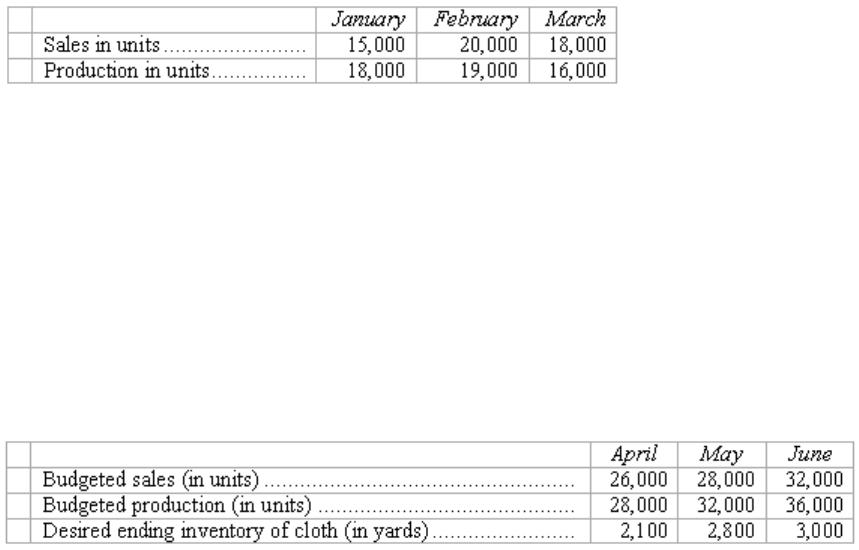
34. Rhett Company manufactures and sells dress shirts. Each shirt (unit) requires 3 yards of cloth.
Selected data from Rhett’s master budget for next quarter are shown below:
How many yards of cloth should Rhett plan on purchasing in May?
A) 84,700 yards
B) 96,700 yards
C) 98,100 yards
D) 98,800 yards
Level: Medium LO: 4 Ans: B
35. Sparks Company has a cash balance of $7,500 on April 1. The company must maintain a minimum
cash balance of $6,000. During April, cash receipts of $48,000 are planned. Cash disbursements during
the month are expected to total $52,000. Ignoring interest payments, during April the company will need
to borrow:
A) $3,500
B) $2,500
C) $6,000
D) $4,000
Level: Easy LO: 8 Ans: B
36. For May, Young Company has budgeted its cash receipts at $125,000 and its cash disbursements at
$138,000. The company’s cash balance on May 1 is $17,000. If the desired May 31 cash balance is
$20,000, then how much cash must the company borrow during the month (before considering any
interest payments)?
A) $4,000
B) $8,000
C) $12,000
Brewer, Introduction to Managerial Accounting, 3/e110
D) $16,000
Level: Easy LO: 8 Ans: D
Brewer, Introduction to Managerial Accounting, 3/e 111
37. Milano Corporation is working on its direct labor budget for the next two months. Each unit of output
requires 0.50 direct labor-hours. The direct labor rate is $9.80 per direct labor-hour. The production
budget calls for producing 6,400 units in October and 6,300 units in November. If the direct labor work
force is fully adjusted to the total direct labor-hours needed each month, what would be the total
combined direct labor cost for the two months?
A) $30,870
B) $31,360
C) $62,230
D) $31,115
Level: Easy LO: 5 Ans: C
38. Morie Corporation is working on its direct labor budget for the next two months. Each unit of output
requires 0.75 direct labor-hours. The direct labor rate is $8.10 per direct labor-hour. The production
budget calls for producing 2,000 units in March and 2,300 units in April. The company guarantees its
direct labor workers a 40-hour paid work week. With the number of workers currently employed, that
means that the company is committed to paying its direct labor work force for at least 1,760 hours in total
each month even if there is not enough work to keep them busy. What would be the total combined direct
labor cost for the two months?
A) $28,512.00
B) $26,406.00
C) $28,228.50
D) $26,122.50