1 / 8
2nd Semester 2020/21
Asalaïs PAROT-URROZ 20202045
FINAL EXAMINATION
Time allowed: 2 hours
Course : Principles of Accounting II – AC311E
Instructors : Bakr AL GAMRH, Raoul GROSSET, Alexander NIESS,
Karen RANKIN, Tipu SULTAN
STUDENTS INSTRUCTIONS
Answer
Answer in English
Answers must be entered directly into this document.
Calculator
Calculator allowed
Dictionary
Dictionary allowed
Documentation
Documentation allowed
INTENDED LEARNING OUTCOMES (ILOs) TESTED BY THE EXAM
1) Distinguish between financial accounting and management accounting. They should also be able to outline the
role management accounting plays in planning, control and decision-making.
2) Describe the main concepts used for classifying costs: by nature, by variability (fixed and variable costs), by
directness (direct and indirect costs).
3) Perform cost-volume-profit analysis: calculate the break-even point for a product or service as well as sales
necessary for achieving a target profit.
4) Use cost information for making decisions. They should be able to make reasonable choices about
accepting/rejecting special contracts, using scarce resources, making/buying components, pricing products.
5) Calculate the full costs of a product, a service or a particular job. This includes applying the basic overhead cost
allocation methods.
6) Prepare the company’s main budgets and consolidate them into the master budgets. They should also be able to
explain the interlinking of the various budgets within the business.
100 marks in total, awarded according to the following table:
Question 1
35 points
Question 2
15 points
Question 3
17 points
Question 4
23 points
Question 5
10 points
Total
100 points
FINAL EXAMINATION
PRINCIPLES OF ACCOUNTING II – AC311E
Enter your answers directly in the spaces provided in the blue boxes below.
Add additional lines as needed.
Make sure that you include all the necessary workings for your calculations.
Question 1: Cost Behaviour and Cost-Volume-Profit Analysis (35 points)
Walt’s Woodwork Company makes and sells wooden shelves. Walt’s carpenters make the shelves in
the company’s rented building. Walt has a separate office at another location that also includes a
showroom where customers can view sample shelves and ask questions of salespeople. The company
sells all the shelves it produces each year and keeps no inventories. Assume that direct labor costs vary
directly with the number of units produced.
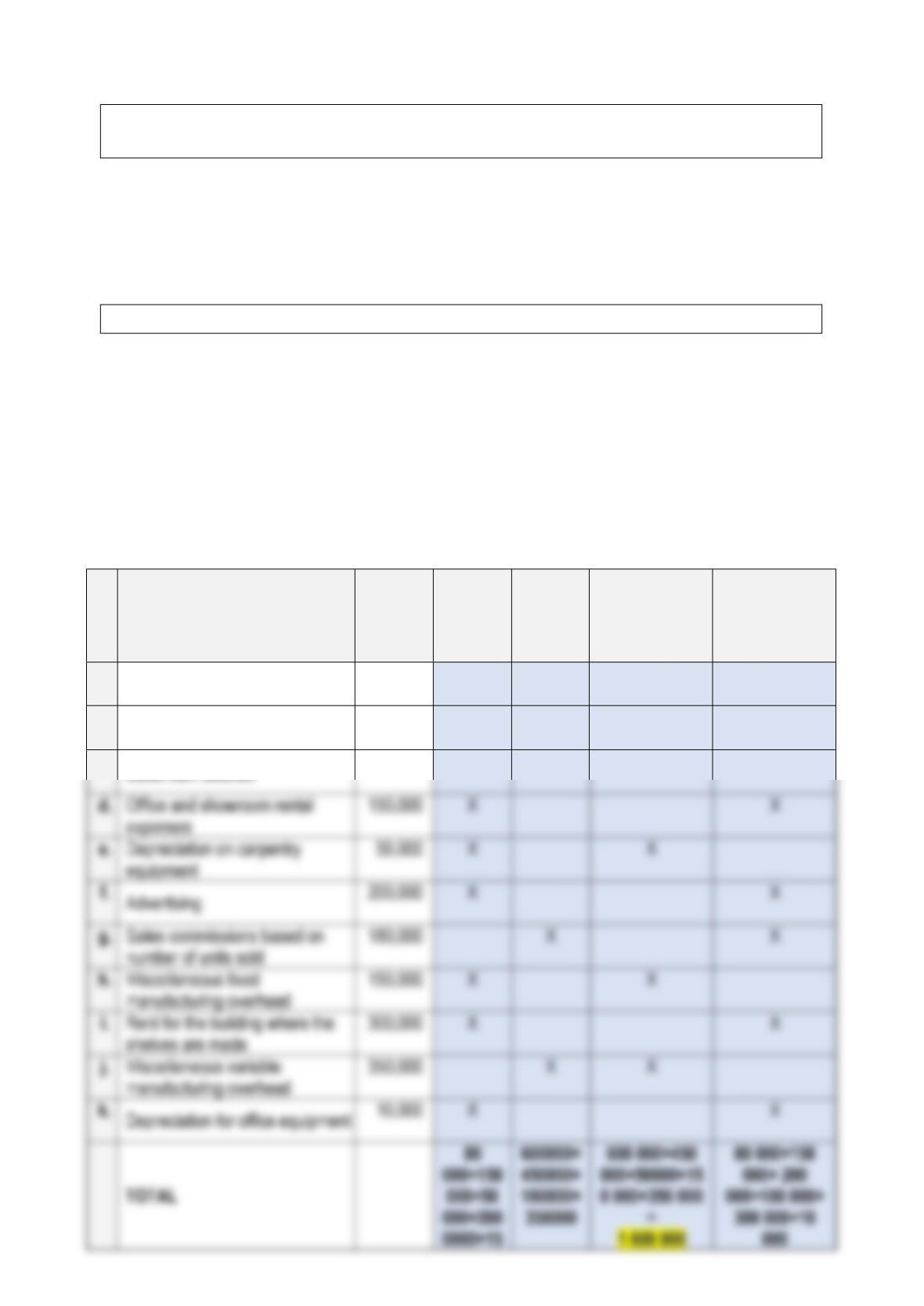
The following table contains cost information for the past year; 50,000 units had been produced and
sold at a sales price of € 70 per unit:
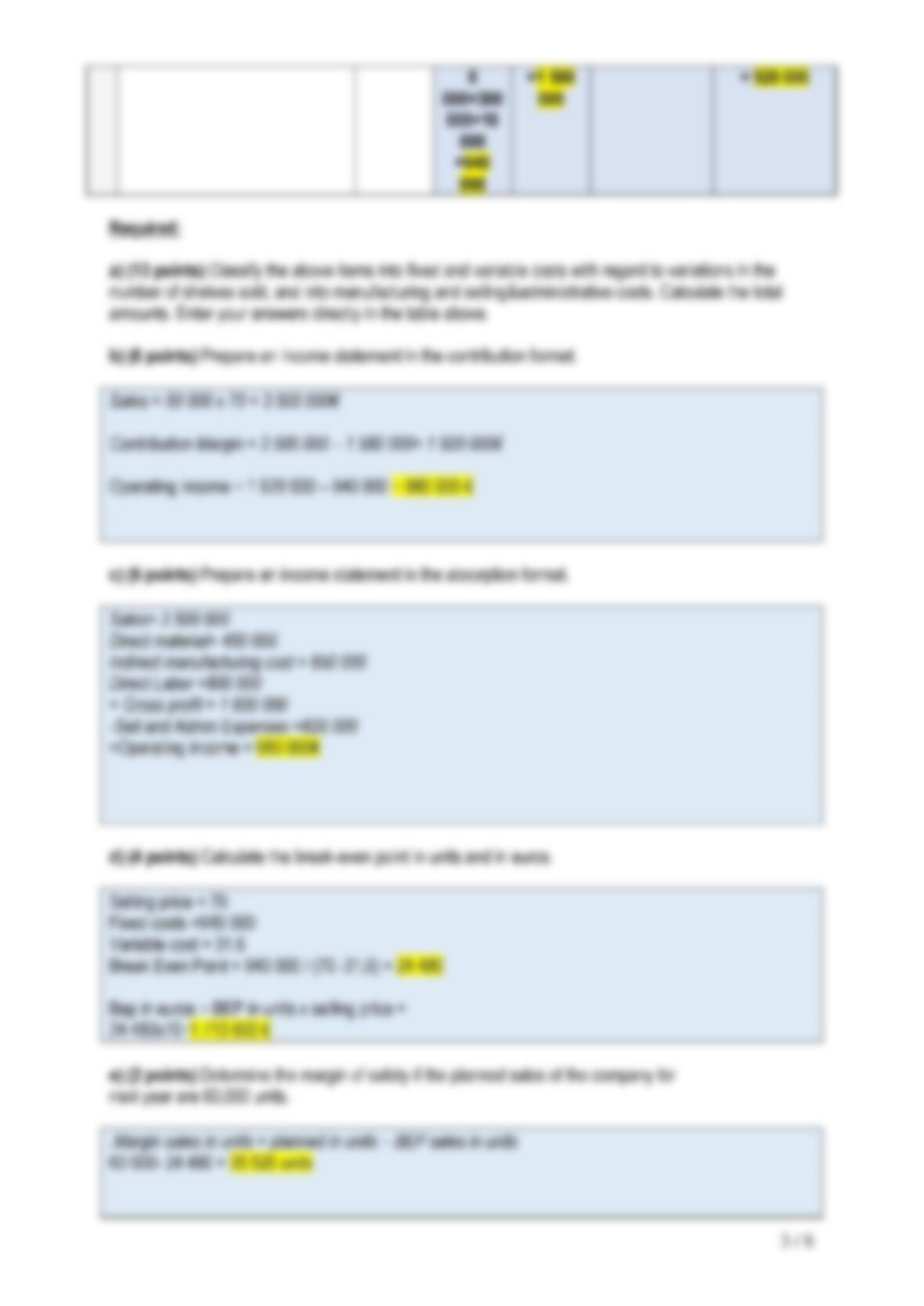
Fixed
cost
Variable
cost
Manufacturing
cost
Selling &
administrative
cost
a.
Carpenter labor cost to make
shelves
600,000
X
X
b.
Wood to make the shelves
450,000
X
X
c.
80,000
X
X
Sales staff salaries
d.
expenses
150,000
X
X
e.
equipment
50,000
X
X
Advertising
200,000
X
X
h.
manufacturing overhead
150,000
X
X
shelves are made
300,000
X
X
manufacturing overhead
350,000
X
X
k.
Depreciation for office equipment
10,000
X
X