FBA Part C
1
Functional Behavior Assessment / Behavior Improvement Program Part C: Outcomes
FBA Part C
2
Introduction
Client Background
Jackson is a 28 year old Caucasian male diagnosed with mental retardation and
seizures. He is very small, and his appearance has been described as that of a ten year old
child. In the past he has used this to his advantage to get staff to assist or complete his
chores or activities for him. Jackson utilizes mands, pointing, gestures and a wide variety
of ASL or home-made signs to communicate. He has a long history of dangerous /
challenging behaviors, and at one point was residing in a residential intensive care facility
for 15 years prior to his step-down placement at a local intensive behavioral group home.
He has been attending the Enterprises Adult Day Training (ADT) Center five days per
week since 2007. His level of abilities, his needs, and the intensity of his behaviors
necessitate a 1:1 staff to client ratio, as well as the use of additional behavior analysis
supports.
Problem Behavior
While there are several behaviors targeted for replacement and reduction, for
purposes of brevity, this outcome paper will focus primarily on aggressive responses.
Aggressions were defined as attempts or actual slaps or smacks to others with an open
hand, hitting others with a closed fist, shoving, kicking, poking, and biting others.
Aggressions have resulted in immediate red marks, swelling and even tissue damage for
his victims. Jackson has a long history of aggressions as reported by his family, support
coordinator, and information obtained in a records review. His behaviors were so intense
and dangerous to himself and others, that the use of emergency physical management
procedures had to be implemented for his safety and the safety of others. A functional
FBA Part C
3
assessment and functional analysis were conducted to identify the maintaining variables.
The results of these were used to develop the individualized behavior program as well as
identify functional equivalent replacement behaviors.
Functional Assessment and Analysis
Results of Functional Assessment
Upon admission the client was placed on a baseline status with data recorded in a
variety of formats, including a frequency and duration measures, sequence and pattern
analyses, ABC, anecdotal and narrative recording performed by the assigned direct care
staff and this clinician. On some occasion Jackson was video taped so this clinician could
review the aggressions at a later time to identify any other environmental variables that
could be maintaining or reinforcing the aggressive responses. Baseline data was utilized
to perform the functional assessment, as well as probes, environmental manipulations,
records reviews, and interviews with reliable reporters (mother, support coordinator,
previous staff, etc.).
Initially it was hypothesized that aggressions had been maintained by
escape/avoidance of tasks / demands / ADL’s or the staff in the past has completed the
task for him. In some cases it appears that aggression is maintained by attention
(increases physical proximity, increased interactions such as talk time especially with
preferred staff, increase in the number of staff present) he receives for engaging in this
behavior. For example, Jackson had been observed to be smiling when he shoves or
pokes. Hit mother has indicated this was a frequent occurrence in the past at a group
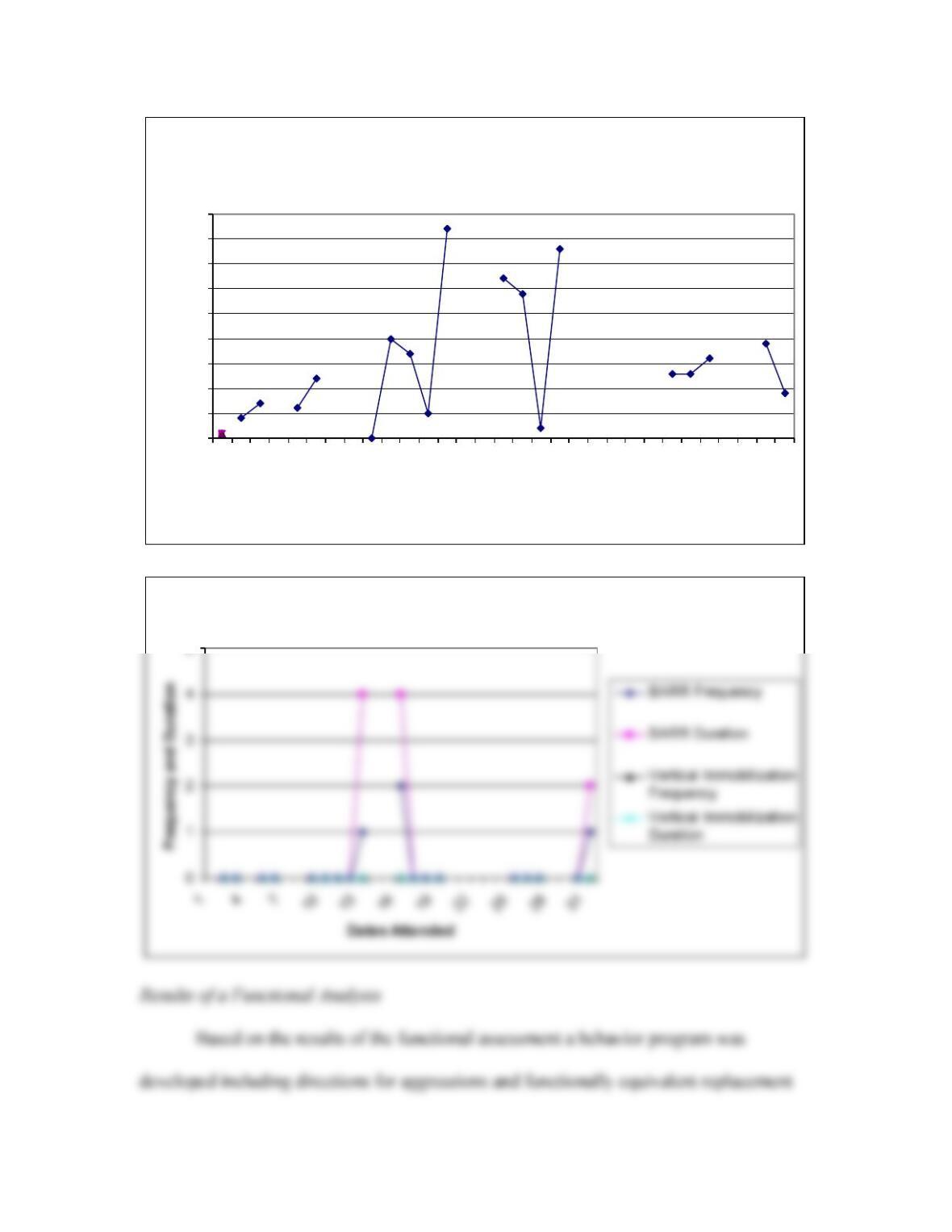
home. Below is the initial baseline data for aggressions, as well as the use of emergency
physical management procedures.
FBA Part C
4
Jackson’s Baseline Dangerous /Challenging Behavior
July 2007
0
5
10
15
20
25
30
35
40
45
1
3
5
7
9
11
13
15
17
19
21
23
25
27
29
31
Dates Attended
Frequency
Note: ADT days are six hours long
Jacson’s Baseline Emergency Reactive Strategies July 2007