1
2
3
4
5
6
7
8
9
10
11
12
13
14
15
16
17
18
19
20
21
22
23
24
25
26
27
28
29
30
31
32
33
34
35
36
37
38
39
40
41
42
43
44
45
46
47
48
49
50
51
52
53
54
55
56
A B C D E F G H I J
Ch 7 Mini Case 5/11/2003
Situation
Features of Common Stock
Classified Stock
THE DISCOUNTED DIVIDEND APPROACH
D 1+D 2+. . . . D n
( 1 + r s ) ( 1 + r s ) 2 ( 1 + r s ) n
VALUING STOCKS WITH A CONSTANT GROWTH RATE
The dividend stream theoretically extends on out forever, i.e., n = infinity. Obviously, it would not be feasible to deal
with an infinite stream of dividends, but fortunately, an equation has been developed that can be used to find the PV
of the dividend stream, provided it is growing at a constant rate.
Naturally, trying to estimate an infinite series of dividends and interest rates forever would be a tremendously
difficult task. Now, we are charged with the purpose of finding a valuation model that is easier to predict and
construct. That simplification comes in the form of valuing stocks on the premise that they have a constant growth
rate.
(2.) What is a constant growth stock? How are constant growth stocks valued?
Here is the basic dividend valuation equation:
Classified Stock carries special provisions. For example, shares could be classified as founders shares which come
with voting rights but dividend restrictions.
b. (1.) Write out a formula that can be used to value any stock, regardless of its dividend pattern.
The value of any financial asset is equal to the present value of future cash flows provided by the asset. When an
investor buys a share of stock, he or she typically expects to receive cash in the form of dividends and then,
eventually, to sell the stock and to receive cash from the sale. Moreover, the price any investor receives is dependent
upon the dividends the next investor expects to earn, and so on for different generations of investors. Thus, the
stock’s value ultimately depends on the cash dividends the company is expected to provide and the discount rate used
to find the present value of those dividends.
Chapter 7. Mini Case
P 0 =
a. Describe briefly the legal rights and privileges of common stockholders.
Sam Strother and Shawna Tibbs are senior vice-presidents of the Mutual of Seattle. They are co-directors of the
company’s pension fund management division, with Strother having responsibility for fixed income securities
(primarily bonds) and Tibbs being responsible for equity investments. A major new client, theNorthwestern
Municipal Alliance, has requested that Mutual of Seattle present an investment seminar to the mayors of the
represented cities, and Strother and Tibbs, who will make the actual presentation, have asked you to help them.
To illustrate the common stock valuation process, Strother and Tibbs have asked you to analyze the Temp Force
Company, an employment agency that supplies word processor operators and computer programmers to businesses
with temporarily heavy workloads. You are to answer the following questions.
1. Common Stock represents ownership 2. Ownership implies control 3. Stockholders elect directors 4. Directors hire
management who attempt to maximize stock price.
57
58
59
60
61
62
63
64
65
66
67
68
69
70
A B C D E F G H I J
D 1
( r s – g )
In this stock valuation model, we first assume that the dividend and stock will grow forever at a constant growth rate.
Naturally, assuming a constant growth rate for the rest of eternity is a rather bold statement. However, considering
the implications of imperfect information, information asymmetry, and general uncertainty, perhaps our assumption
of constant growth is reasonable. It is reasonable to guess that a given will experience ups and downs throughout its
life. By assuming constant growth, we are trying to find the average of the good times and the bad times, and we
assume that we will see both scenarios over the firm’s life. In addition to assuming a constant growth rate, we will
be estimating a long-term required return for the stock. By assuming these variables are constant, our price equation
for common stock simplifies to the following expression:
In this equation, the long-run growth rate (g) can be approximated by multiplying the firm’s return on assets by the
retention ratio. Generally speaking, the long-run growth rate of a firm is likely to fall between 5 and 8 percent a
year.
P 0 =
71
72
73
74
75
76
77
78
79
80
81
82
83
84
85
86
87
88
89
90
91
92
93
94
95
96
97
98
99
100
101
102
103
104
105
106
107
108
109
110
111
112
113
114
115
116
117
118
119
120
121
122
123
124
125
126
A B C D E F G H I J
EXAMPLE: CONSTANT GROWTH
0 1 2 3 Continue to Infinty
Do =2.00 2.12 2.2472 2.3820
1.876
1.760
1.651
Etc.
??
Constant Growth Model:
D 0 = $2.00
g = 6%
r s =13.0%
D 1D 0 (1+g) $2.12
( r s – g ) ( r s – g ) 0.07
P 0 =$30.29
Stock Price 1 year from now
D 2
( r s – g )
2.2472
0.07
P1 = 32.10
Dividend Yield =
D1
C&G Yield =
P1-P0
P0P0
Dividend Yield =
2.12
C&G Yield =
$1.82
$30.29 $30.29
Dividend Yield =
7.00%
C&G Yield =
6.00%
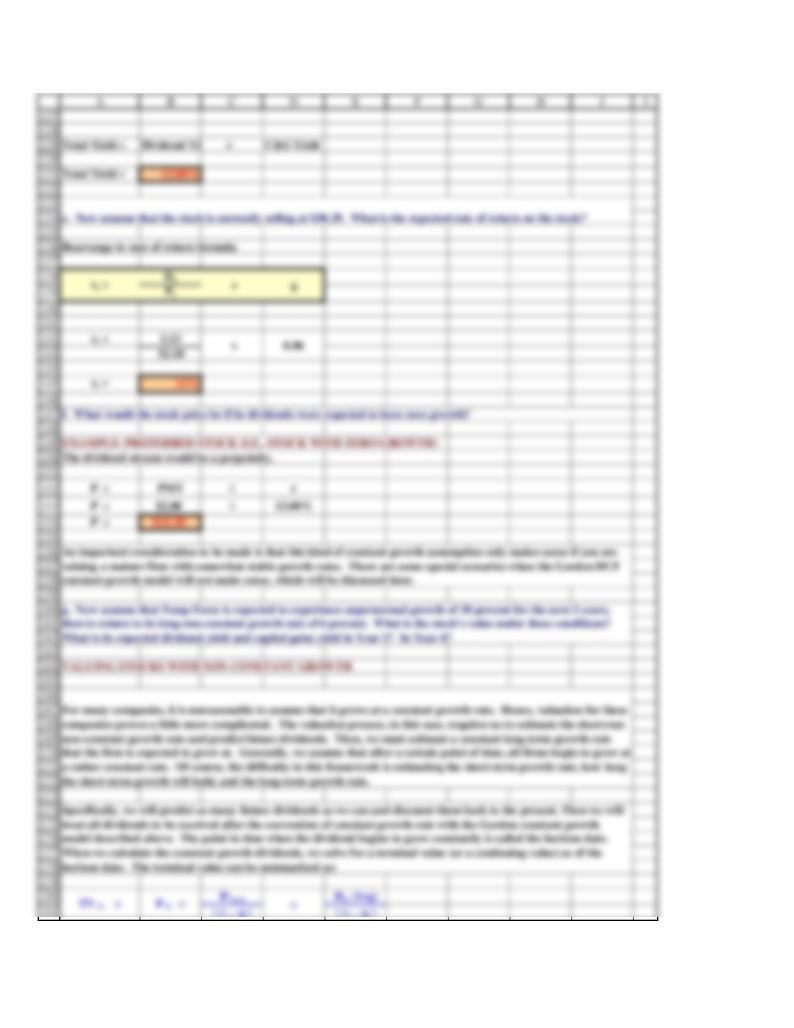
(1.) What is the firm’s expected dividend stream over the next 3 years?
(2.) What is the firm’s current stock price?
(4.) What are the expected dividend yield, the capital gains yield, and the total return during the first year?
=
In this equation, the long-run growth rate (g) can be approximated by multiplying the firm’s return on assets by the
retention ratio. Generally speaking, the long-run growth rate of a firm is likely to fall between 5 and 8 percent a
year.
(c.) What happens if a company has a constant g which exceeds rs? Will many stocks have expected g > rs in the
short run (i.e., for the next few years)? In the long run (i.e., forever)? Answer: See Chapter 7 Mini Case Show
c. Assume that Temp Force has a beta coefficient of 1.2, that the risk-free rate (the yield on T-bonds) is 7 percent,
and that the market risk premium is 5 percent. What is the required rate of return on the firm’s stock?
d. Assume that Temp Force is a constant growth company whose last dividend (D0, which was paid yesterday) was
$2.00, and whose dividend is expected to grow indefinitely at a 6 percent rate.
(3.) What is the stock’s expected value 1 year from now?
P 1 =
P1 =
CAPM = rRF + b (rRF-rM)
7% + 1.2(5%) = 13%
P 0 =
=