A STUDY ON THE DETERMINANT FOR FAMILY TAKAFUL CONSUMPTION
BACHELOR OF BUSINESS ADMINISTRATION (HONS) FINANCE
FACULTY OF BUSINESS MANAGEMENT
UNIVERSITI TEKNOLOGI MARA KELANTANG
KAMPUS KOTA BHARU
I, NURUL NADIA BINTI HARUN, (I/C NUMBER: 880920-03-5432)
Hereby declares that:
•This work has not previously been accepted in substance for any
degree, locally or overseas, and is not being concurrently
submitted for this degree or any other degrees.
•This project paper is the result of my independent work and
investigation except where it is otherwise stated.

•All verbatim extract have been distinguish by quotation marks and
source of my information have been specifically
acknowledgement.
Signature: ____________________ Date: _________________
LETTER OF TRANSMITTAL
Bachelor in Business Administration (Hons) Finance
Universiti Teknologi Mara (UiTM) Kampus kota bharu,
Kota Bharu,, Kelantan. April 2011
Associate Prof. Safri Bin Ya
The Head of Programme,
Bachelor of Business Administration (Hons) Finance,
Faculty of Business Management
University Teknologi MARA UiTM;

Kota Bharu, Kelantan.
Dear Sir,
SUBMISSION OF PROJECT PAPER
Attached is the project paper titled A study on the determinant for
Family Takaful consumption. To fulfill the requirement needed by the
Faculty of Business Management, Universiti Teknologi MARA
Your kindness in accepting the unbounded thesis is very much
appreciated.
Thank you.
Yours sincerely,
*€¦*€¦*€¦*€¦*€¦*€¦*€¦*€¦*€¦*€¦*€¦*€¦*€¦*€¦*€¦*€¦*€¦.
NURUL NADIA BINTI HARUN2009804722Bachelor of Business
Administration (Hons) Finance
ABSTRACT
This study attempts to determine the determinants for Family Takaful
consumption, whether population, interest rate and GDP related to the
demand for Family Takaful. This study uses 10 data that is collected
from annual report of Etiqa Takaful 1997 to 2006. The data collected
was then tested on the multiple regression analysis and then were use
to test the hypothesis in this study.
CHAPTER 1: INTRODUCTION
1.1 Background of study
The development of Takaful industry
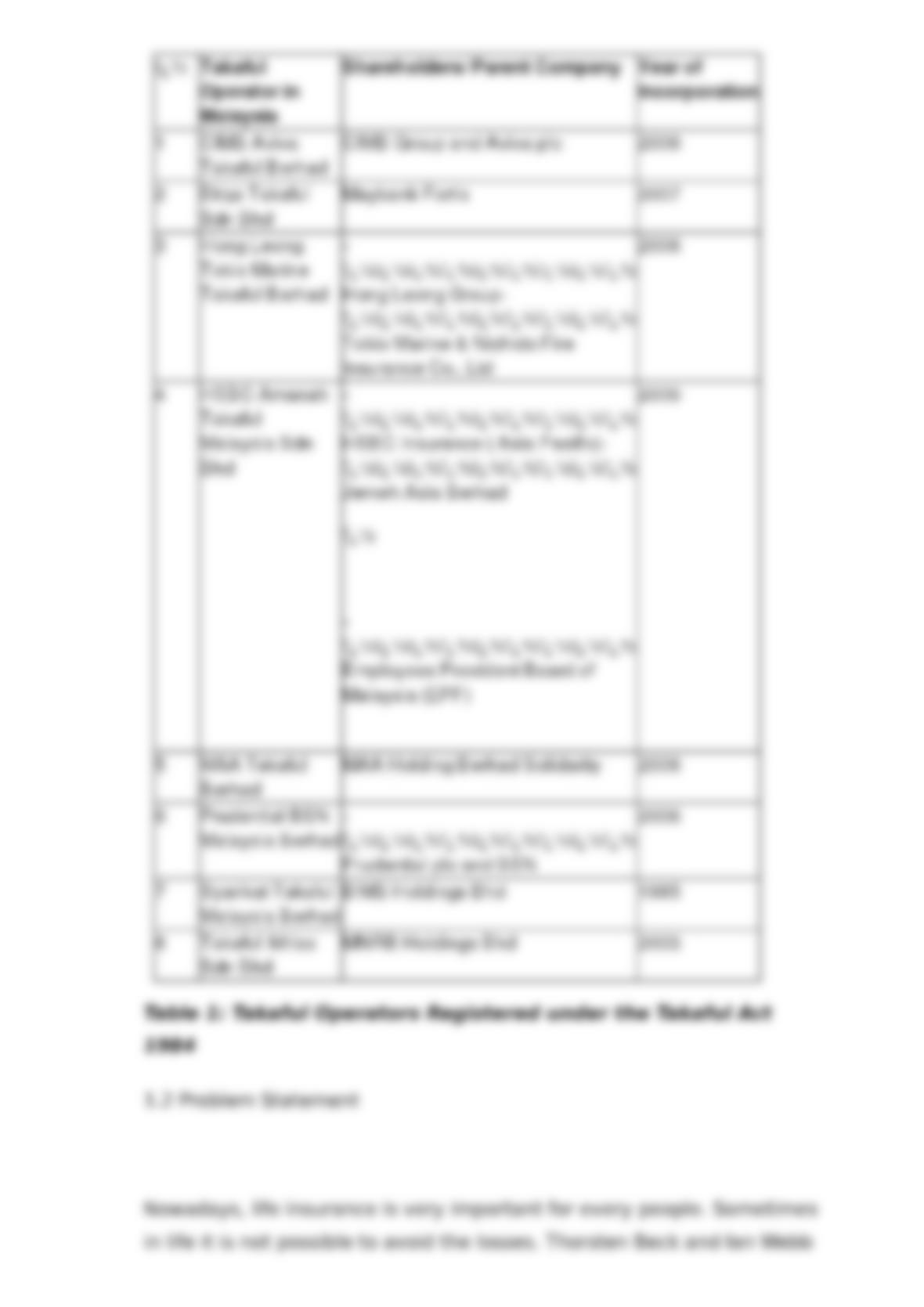
The development of the Takaful industry in Malaysia in the early 1980s
was inspired by the prevailing needs of the Muslim public for a
Shariah-compliant alternative to conventional insurance, as well as to
complement the operation of the Islamic bank that was established in
1983. It was, to a large extent, triggered by the decree issued by the
Malaysian National Fatwa Committee which ruled that life insurance in
its present form is a void contract due to the presence of the elements
of Gharar (uncertainty), Riba (usury) and Maisir (gambling). A Special
Task Force was established by the Government in 1982 to study the
viability of the setting up of an Islamic insurance company following the
recommendations of the Task Force, the Takaful Act was enacted in
1984 and the first Takaful operator was incorporated in Malaysia in
November 1984. The Takaful industry in Malaysia has consistently
registered strong growth in the last 20 years. It has proven to be
resilient in the face of intense competition from the more advanced
insurance industry. The industry has recorded average annual growth
rates of 57.9% and 44% in assets and net contributions respectively
since 1986.
Overview of Takaful
Takaful is a system of Islamic insurance based on the principle of mutual
cooperation (taawun) and donation (tabarru), where the risk is shared
collectively and voluntarily by the group of participants. It is derived
from an Arabic word meaning joint guarantee orguaranteeing each
other(Mahmood, 2008). It is an arrangement by a group of people with
common interests to guarantee or protect each other from certain
defined misfortunes such as premature death, disability and property
damages (Obaidulllah, 2005). Under Takaful schemes, participants
mutually agree to guarantee and to protect each other against a
defined loss or damage, by jointly providing financial assistance to any
members suGering from a loss.
As a concept, insurance does not contradict the Islamic principles since
it is essentially a system of mutual help. However, the operation of
conventional insurance involves the elements of uncertainty (gharar)
and gambling (maysir) in the contract of insurance, and usury (riba) in
its investment activities, which do not conform to the requirements of
Shariah. Gharar, may exist with regard to the scope of coverage, terms
of the contract and source of the claim payments. Maysir, may arise
from any speculative element present in a contract, such as an unequal
exchange of the amount of money. Riba, or excessive profit, may arise
from financial interest received from the investment of funds collected
from the participants. Avoidance of these elements is essential in an
insurance system acceptable by the Syariah, and this is where Takaful
diGers with the conventional insurance. Takaful arrangement embraces
the elements of mutual cooperation, shared responsibility, mutual
protection, and joint indemnity (Central Bank of Malaysia, Takaful
Industry Review, 2005).
Takaful is a system of Islamic insurance based on the principle of mutual
cooperation (taawun) and donation (tabarru), where the risk is shared
collectively and voluntarily by the group of participants. In
aTakafultransaction, the party called the participant(insured),whopays a
particular amount of money known as contribution (premium) to
another, who is known asTakafuloperator (insurer) with a mutual
agreement that, the operator is under a legal responsibility to provide
the participant with a financial security against unexpected loss or
damage caused to the subject matter of the policy should one occurs
within the agreed period of the policy. Takaful is designed to provide
protection against individual and businesses.
According to The Banker (2001), the Islamic insurance sector
orTakafulhas expanded in many major markets and in Muslim
dominated countries around the world. Among the Top 25 companies in
the world, ranked by The Banker, Bruneis Takaful IBB Bd is first followed
by SCAs of Iran Insurance Company and Malaysias Syarikat Takaful