Running head: A MANAGERIAL ACCOUNTING ANALYSIS 1
A Managerial Accounting Analysis of Delta Air Lines
Ryan C. Noblin
Embry Riddle Aeronautical University – Worldwide
MBAA 517: Managerial Accounting for Decision Making
Dr. Kwabena Banahene
March 7, 2021
A MANAGERIAL ACCOUNTING ANALYSIS 2
A Managerial Accounting Analysis of Delta Air Lines
This paper is a managerial accounting analysis of the publicly traded Delta Air Lines
(DAL) and its operations within the international business environment. Specifically, this paper
will provide an overview of DAL to include the company’s principal goods and services, its
market share, and its geographic locations. Additionally, this paper will discuss the potential
benefits and ramifications of DAL implementing activity-based costing (ABC) and standard
costs within its accounting structure. Finally, it will provide an analysis of DAL’s future plans in
terms of relevant costs, and how relevant costs could be used in its decision making. Data for this
paper will be collected using DAL’s various company web pages, financial statistics, and market
research.
Overview of Delta Air Lines
Delta Air Lines is a publicly traded company under the New York Stock Exchange
symbol DAL. Founded in 1925, as a crop-dusting operation, and later incorporated as Delta Air
Service in 1928, “the Atlanta-based company transports more than 170 million passengers every
year with connections to some 321 destinations in the world” (Mazareanu, 2020), operating 760
commercial aircraft (Delta, 2021). As an international business, DAL operates around the globe,
employing over 7,500 international employees, and is committed to sustainability by investing in
advancements of cleaner air travel and reduced carbon emissions and waste.
Principal Goods and Services
DAL is most notably known for its commercial passenger air travel, conducting nearly
15,000 flights each day. Its passengers can choose from one of three rates: first class, Delta
Comfort, and economy on nearly all DAL aircraft. Standard in-flight amenities, such as Wi–Fi,
entertainment/movies, and snack and beverage services, are provided on all flights, with
A MANAGERIAL ACCOUNTING ANALYSIS 3
additional services offered on international flights. Most recently, Delta has partnered with
Wheels Up, a private aviation company, to offer charter flights for business, collegiate sports
teams, etc.
Additionally, DAL conducts cargo operations from 13 U.S. airports and over 70
international airports. “From packages to pallets, Delta Cargo presents worldwide charter
solutions that are available to companies with urgent shipping needs” (Delta Cargo n.d.). On top
of general cargo needs, DAL offers express shipment services for small, heavy, and critical
packages, and specialized shipments, such as pets, perishable, time-sensitive products,
temperature-sensitive pharmaceuticals, and high-value, vulnerable items. All monitoring of
shipments is conducted at the Delta Cargo Control Center (CCC) and, depending on the type of
shipment, customers have the option of attaching their own Global Positioning System (GPS)
device to their package for real-time tracking.
Market Share
Prior to the COVID-19 pandemic, the air transportation market was showing steady
increases, year after year. Even as airlines attempt to recover from the economic set back, the
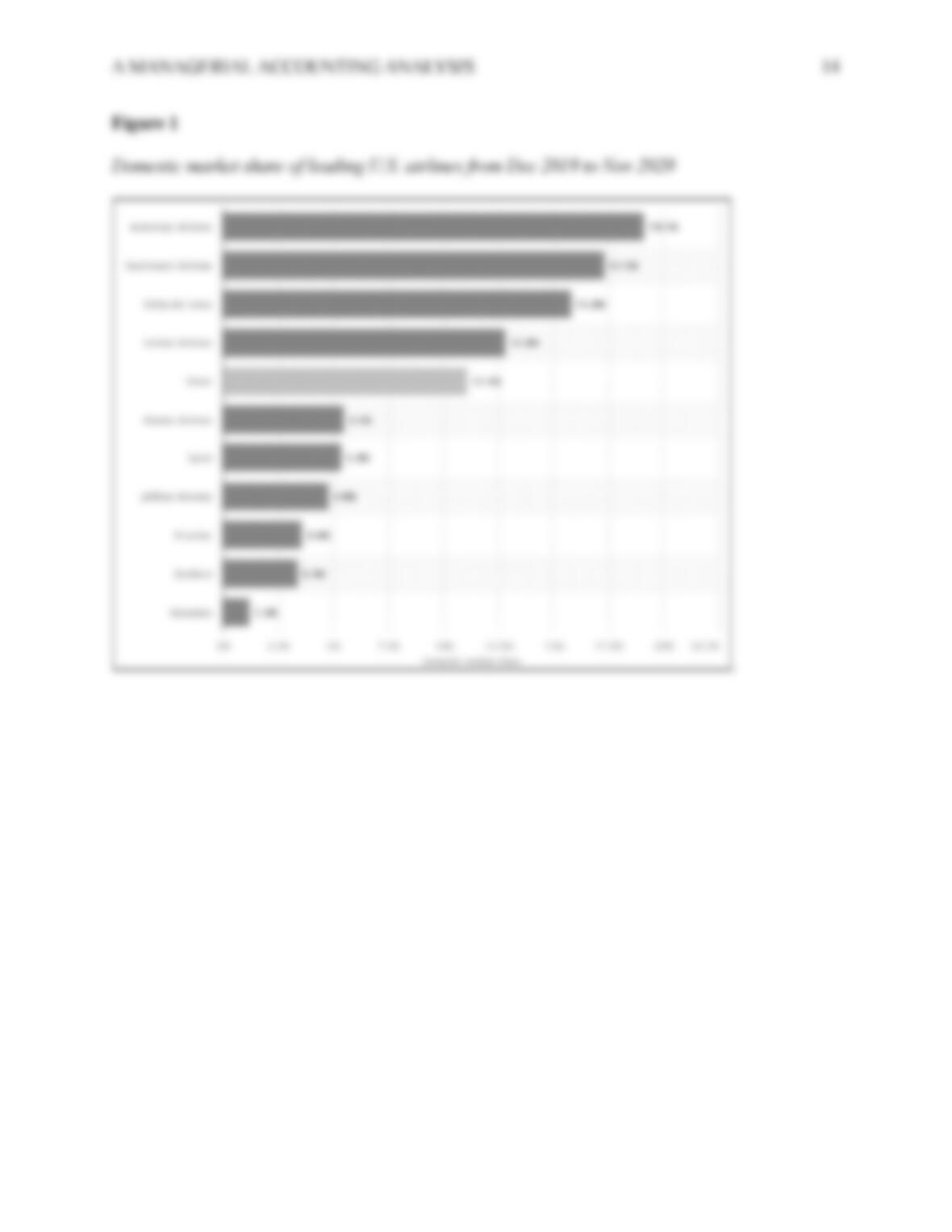
market still holds strong. American Airlines, Southwest Airlines, DAL, and United Airlines are
the top ranked airlines based on 2020 domestic market share, and as seen in Figure 1
(Mazareanu, 2021). DAL was third overall with a domestic market share of 15.8 percent.
Geographic Locations
DAL operates in almost every corner of the globe, although the majority of its operations
are in the United States. Headquartered in Atlanta, Georgia, DAL conducts flights to over 300
destination, to include the United States, Europe, Asia, Latin America, and Mexico. This
encompasses both passenger and cargo operations.
A MANAGERIAL ACCOUNTING ANALYSIS 4
Major Competitors
Competition between airlines have become quite fierce in the past decades, due to the
constant focus on cutting costs. The more an airline can cut costs, the better they can offer
cheaper air fare and attract more customers. Based on the data shown in Figure 1, it stands to
reason that DAL’s major competitors are American and Southwest Airlines. However, even
though DAL outperforms United Airlines, they are still a strong contender year after year.
Activity Based Costing in Delta Air Lines
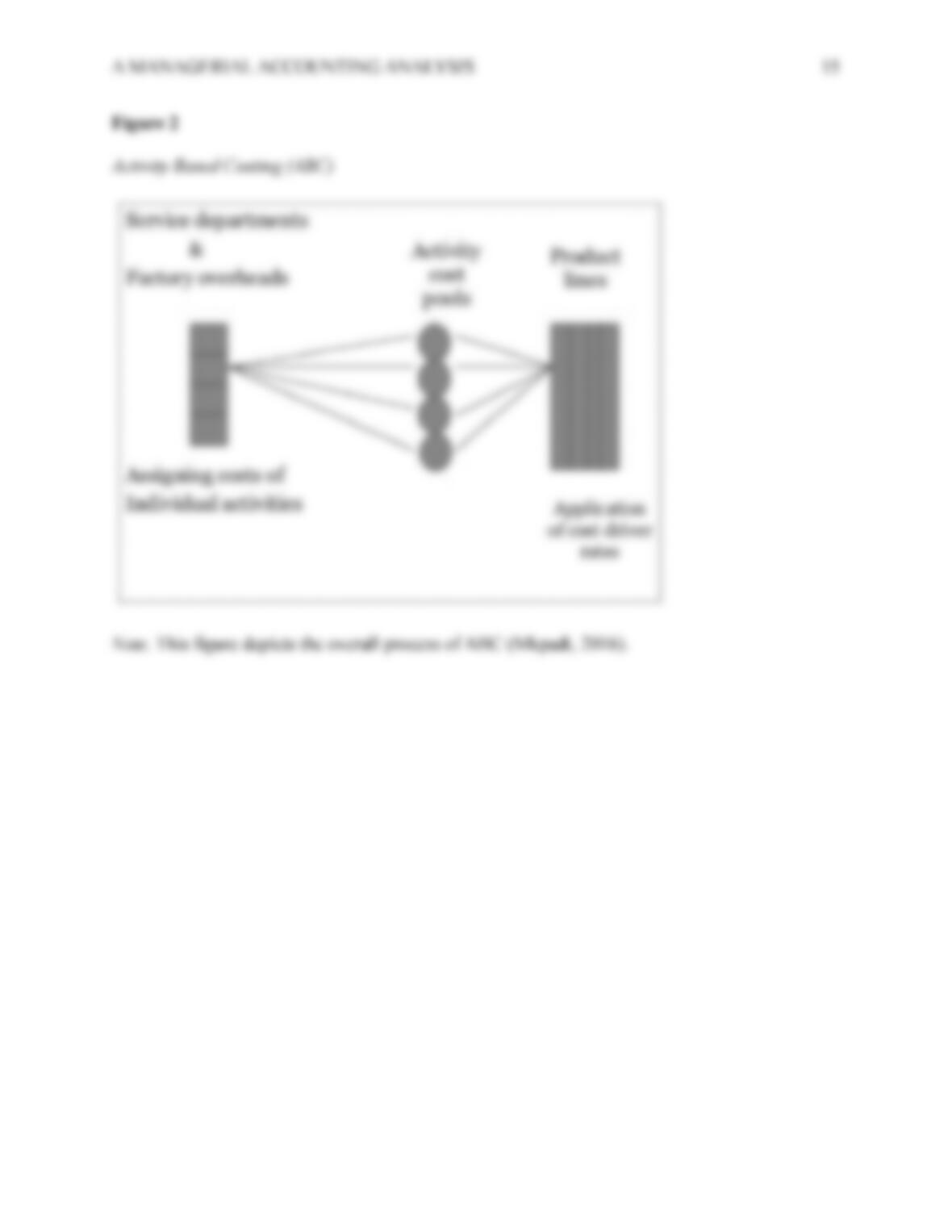
“Activity-based costing (ABC) is an accounting method used to assign overhead and
indirect costs to the production of goods and services (Smyth, 2019). Essentially, costs are
pooled together based on certain activities and then delegated to different products or services, as
depicted in Figure 2. The airline industry operates off a very small profit margin, due to very
higher operating costs. The implementation of ABC in DAL finances could prove beneficial, as
there are multiple variables (i.e., activities) that drive costs in the airline industry. By associating
certain activities to cost drivers, DAL would be able to better improve the accuracy of their
planning and control cycles.
Influencing Factors
One of the largest operating costs in the airline industry is that of jet fuel. Fuel costs not
only take a huge chunk out of an airline’s revenue, but they are also notoriously volatile, with
domestic airlines in the U.S. spending a combined $2 to $5 billion on jet fuel every month
(Grabianowski, 2009). For DAL, the airline consumes about 3.9 billion gallons annually. DAL
purchased their own oil refinery back in 2012 (the first airline to do so) with hopes that it would
supply the company with at least 80 percent of its fuel needs, reducing fuel costs by $300 million
annually. Unfortunately, the refinery did not prove as beneficial as originally expected, even
A MANAGERIAL ACCOUNTING ANALYSIS 5
before the COVID-19 pandemic, and may consider selling part if not all the refinery (Krauss &
Chokshi, 2020). Fuel volatility is why many airlines opt to hedge fuel costs to ensure a more
predictable planning factor. In doing so, it makes ABC much easier to implement in terms of fuel
costs. By knowing the cost of fuel per gallon, and the average fuel consumption per flight hour
of their aircraft, DAL can accurately pinpoint fuel costs associated with the number of flight
hours.
Two other large costs in the airline industry are labor and maintenance, which can also be
determined using flight hours as the cost driver. The cost of aircrew per hour is directly
concurrent with the number of flight hours, so with a known aircrew capacity per aircraft, DAL
can calculate aircrew labor by multiplying the per hour aircrew costs first by the number of