Andreas School of Business Working Paper Series, Barry University, Miami Shores,
FL 33161 USA
September 2007
A FLOW CHART APPROACH TO ANALYZING THE
ETHICS OF INSIDER TRADING
Robert W. McGee
ABSTRACT
Hundreds of articles have been written about various aspects of insider
trading. It is one of those topics that is truly interdisciplinary, touching on
finance, economics, law, business ethics and perhaps a few other
disciplines. Yet with all this research there is still no consensus about
when insider trading is ethical and when it is not. Part of the problem is
because there is more than one ethical system that could be applied to the
analysis. Another problem is that some authors have already decided what
the answer should be, so they go about trying to justify their pre-conceived
position without paying adequate attention to opposing views. This paper
reviews the main ethical views on insider trading and uses a flow chart
approach to determine when insider trading is ethical and when it is not.
INTRODUCTION
Insider trading, the trading on nonpublic information, has been going on for
hundreds of years. Aquinas (1225-1274) spoke about it in the thirteenth century
(Aquinas; McGee 1990). Some authors have concluded that insider trading is always or
almost always unethical (Ferber 1970; Werhane 1989, 1991) while other authors have
reached the opposite conclusion (Manne 1966a&b, 1970; Machan 1996).
The two main sets of ethical principles that have been applied to the analysis of
insider trading ethics have been utilitarianism and rights theory. Insider trading studies
have focused on a few major issues, such as fairness, the level playing field argument,
overall welfare, fiduciary duty, misappropriation and property rights in information.
This paper will not go into a detailed analysis of all those studies. That work has
been done elsewhere (Bainbridge 2003). The purpose of the present study is to construct
a framework that can be applied to analyze any insider trading issue. The advantage of
using flowcharts to accomplish this task is that it reduces the possibility of using
emotional arguments, an approach that is highly unscientific. Flow charts are based on
logic, not emotion, and any scientific analysis of an issue needs to screen out emotional
arguments.
UTILITARIAN ETHICS
The vast majority of economists are utilitarians, as are many philosophers
(Goodin 1995; Mill 1993; Quinton 1988; Scarre 1996). The legal system in most
developed economies is based on a mixture of utilitarian ethics and rights theory. Thus,
utilitarian ethics is an important ethical system, even though it has some structural flaws,
the most important of which are the inability to precisely measure gains and losses and
the total disregard of rights (McGee 1994; Rothbard 1970). Allowing two wolves and one
sheep to vote on what’s for dinner would be a just outcome for a utilitarian because the
2
majority benefits. The rights of the sheep are totally ignored. If one considers the rights
of the sheep, one is no longer applying utilitarian analysis.
Other variations of utilitarian ethics would attempt to identify winners and losers
and would have some weighting scheme in cases where some affected groups gain or lose
a lot while other groups gain or lose just a little. Economists use the terms positive-sum
games and negative-sum games to describe this approach. For example, some
protectionist measure in the textile industry would result in greatly benefiting a small
number of textile manufacturers and their employees but would only slightly harm the
millions of people who buy clothes. Whether the protectionist measure results in the
greatest good for the greatest number, or whether the gains exceed the losses, is subject to
dispute, depending on which groups are included in the analysis and what weight is
assigned to their gains and losses. There are also unintended consequences resulting from
any legislation and it is not always possible to calculate who is helped or harmed
indirectly or by how much. Thus, any utilitarian approach at a solution is imprecise and
incomplete. However, since it is the dominant ethical system for economists, and since it
is part of many legal systems, it cannot be ignored.
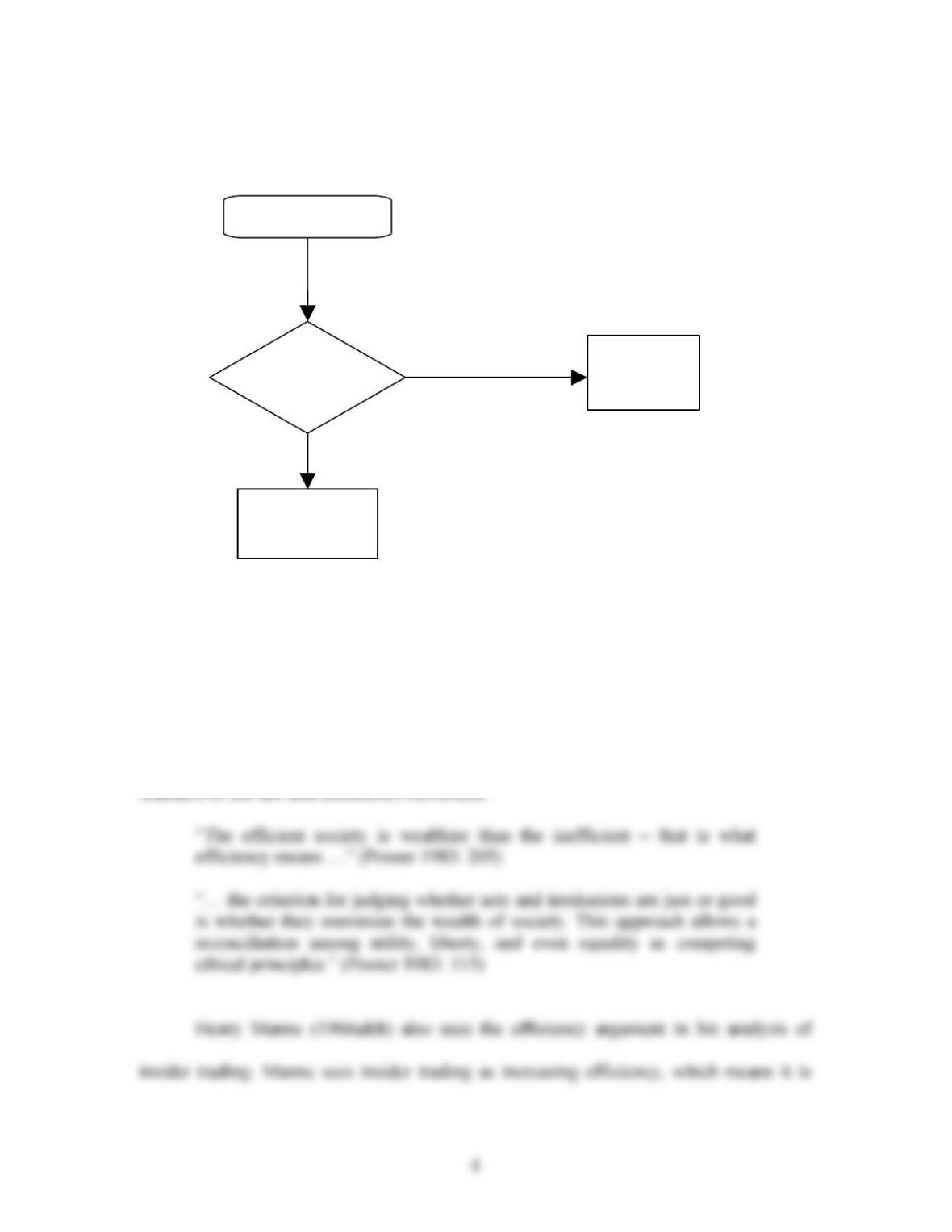
A flowchart summarizing the utilitarian approach would look like the following:
3
A modern variant of utilitarian ethics is the efficiency argument. Something is
ethical if it increases efficiency. One of the principal exponents of this strand of
utilitarianism is Richard Posner (1983; 1998), an American jurist and also one of the
START
GAINS
>
LOSSES? ETHICAL
UNETHICAL
Yes
No
MODERN UTILITARIAN
ETHICS