9–603–048
OCTOBER 22, 2002
________________________________________________________________________________________________________________
Professor Richard Bohmer and Bradley Campbell (MBA ’02) prepared this case. HBS cases are developed solely as the basis for class discussion.
Cases are not intended to serve as endorsements, sources of primary data, or illustrations of effective or ineffective management.
Copyright © 2002 President and Fellows of Harvard College. To order copies or request permission to reproduce materials, call 1-800-545-7685,
write Harvard Business School Publishing, Boston, MA 02163, or go to http://www.hbsp.harvard.edu. No part of this publication may be
reproduced, stored in a retrieval system, used in a spreadsheet, or transmitted in any form or by any means—electronic, mechanical,
photocopying, recording, or otherwise—without the permission of Harvard Business School.
RICHARD BOHMER
BRADLEY CAMPBELL
A Father’s Love: Novazyme Pharmaceuticals, Inc.
We knew that if the unthinkable happened, the only way we would be able to live with ourselves was if we
had done absolutely everything humanly possible to save our kids.
— John Crowley, CEO, Novazyme Pharmaceuticals
As John Crowley considered the document prepared by his Morgan Stanley bankers, he found it
hard to believe that just three years earlier he was simply a father trying to care for his two severely
ill children. Now, as CEO of Novazyme Pharmaceuticals, Inc., he had the responsibility to choose
which of two deals proposed by Genentech and Genzyme would yield the best results for his
investors, for the company, and most of all, for his children and the rest of the tiny patient population
that would benefit so greatly by a cure for a terrible disease.
Background
Crowley, a health–care litigation attorney, entered Harvard Business School with the January
cohort of the class of 1997. He and his wife, Aileen, brought with them their son, John Jr. While in
school they had a daughter, Megan. Crowley and Aileen led typical business school lives, and their
children seemed healthy and happy.
Crowley was elected class day speaker for graduation. During his speech he spoke of the many
burdens that might be thrown upon the shoulders of him and his fellow classmates. He advised his
peers that, as graduates of Harvard Business School, they had all earned a special privilege and
power, and that they should use these new trappings as often as necessary, but wisely, to deal with
these burdens. Later that day, Crowley walked up to accept his diploma with his infant daughter in
his arms. The dean gave Megan a teddy bear and, as Crowley recalled, upon receiving the toy “she
almost flopped over right there on stage.” Later, Crowley and Aileen would realize that they had
received their first clue to the challenging future that lay ahead.
Floppy Baby Syndrome
Upon graduation, Crowley and his family moved to San Francisco, where he began work at a
small strategy consulting firm. In the fall of 1997 the Crowleys’ young daughter began to exhibit
For the exclusive use of P. Bhaskar, 2021.
This document is authorized for use only by Partha Bhaskar in EntMgt722_Spring2021 taught by Phil Greenwood, University of Wisconsin – Madison from Jan 2021 to May 2021.

603–048 A Father’s Love: Novazyme Pharmaceuticals, Inc.
2
signs that something was wrong. At less than a year old, Megan was generally very healthy, but she
was failing to meet some key developmental milestones, such as holding herself up in her crib or
walking. When this condition continued to advance and their pediatrician could offer no explanation,
the Crowleys took Megan to a neurologist. In early January the doctor ran blood tests that showed an
elevated CPK,1 indicating something was wrong in Megan’s muscles. His initial guess was that she
had some type of myopathy, often referred to as “Floppy Baby Syndrome,” a catchall name for a
number of muscular diseases that cause infants to be weak and limp. Eventually the neurologist
performed a deep muscle biopsy, and on March 13, 1998, Megan was diagnosed with Pompe disease.
Crowley recalled, “The doctor had never diagnosed or treated a patient with Pompe disease
before. He had to go on Medline to give us any real information.” The neurologist estimated Megan
had somewhere between three and six months to live. The doctor also warned that Patrick, the
Crowleys’ third child, born five days earlier, might also have the disease. That night Aileen fell asleep
crying. Crowley stayed up surfing the Internet for any information he could find about this strange
and terrible disease.
Pompe Disease
Pompe (pom-pāy) was an extremely rare disease that fell in a broader family of ailments known as
lysosomal storage disorders (LSDs). LSDs were recessive autosomal diseases characterized by the
lysosomal accumulation of glycogen in a variety of tissues, which caused muscle dysfunction,
degeneration, and eventually death in most patients.2 More specifically, patients with Pompe lacked
the enzyme acid alpha–glucosidase (GAA) that enabled their cells to convert glycogen (sugar) into
energy and other usable matter. The unprocessed glycogen built up in the cells of smooth and
skeletal muscles, leading to extreme muscle atrophy. This atrophy usually became so severe that
patients were eventually unable to eat, breathe, speak, walk, or perform many other muscle–
dependent activities without aid. Patients in medium to advanced stages of Pompe often ate through
feeding tubes, breathed with the aid of ventilators, spoke in sign language, and got around by
wheelchair. Mortality was typically caused by cardiac failure from debilitated muscles or respiratory
failure.
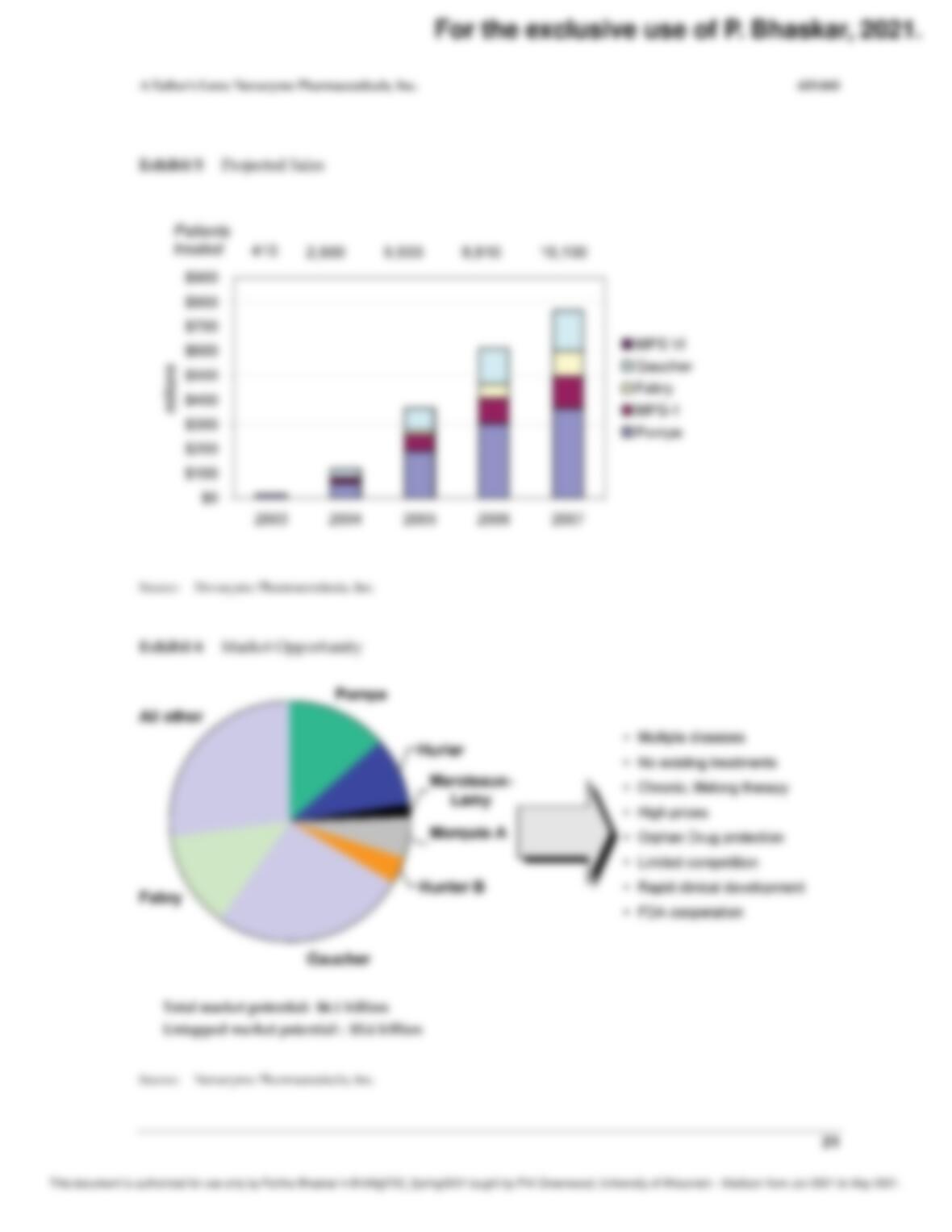
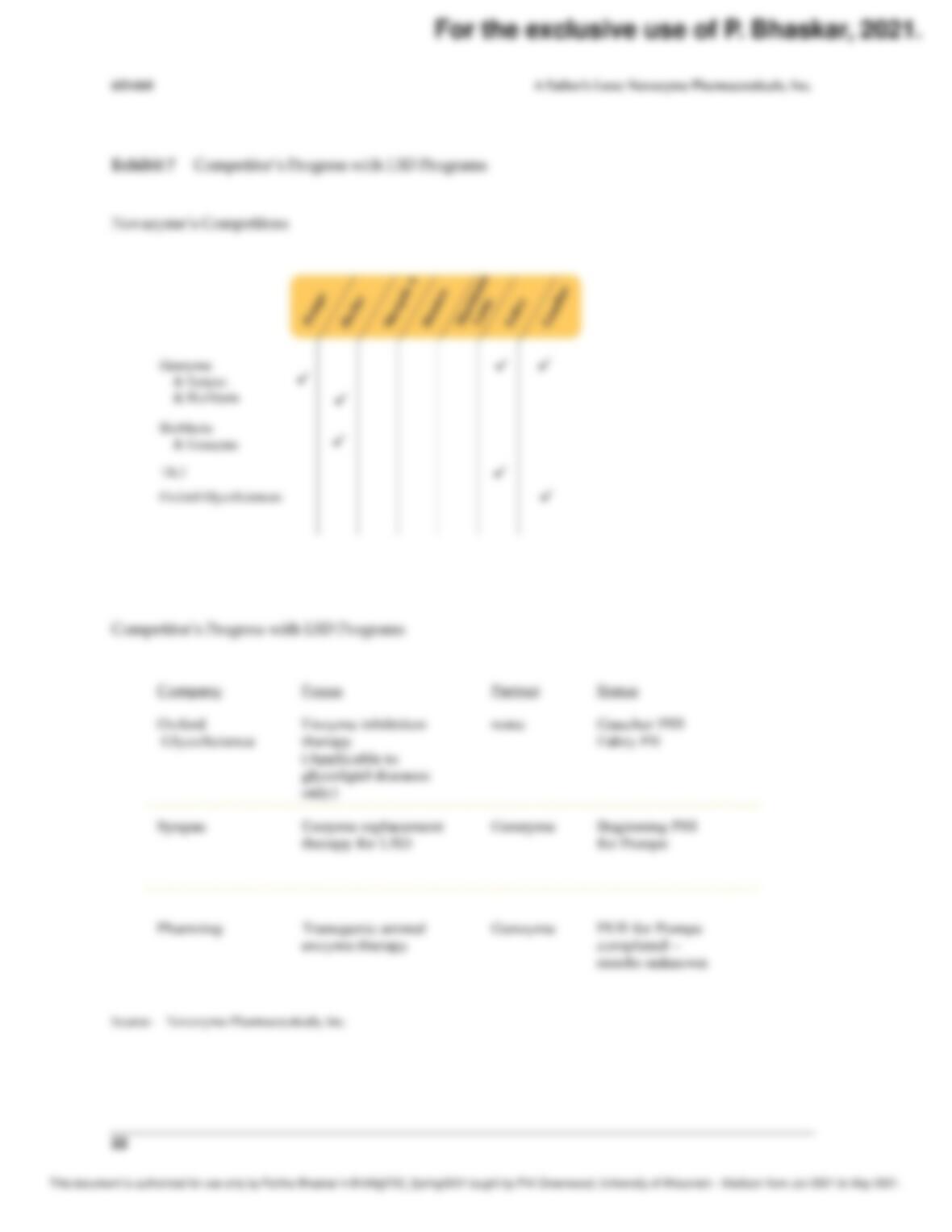
Pompe disease was just one of 49 known LSDs including Fabry, Tay–Sachs, Gaucher, and MPS-I
(Hurler). While each of these disorders differed in its specific enzyme deficiency—and thus in the
way its symptoms ultimately manifested themselves—they had some similarities. First, they all
shared a common biological pathway leading to the accumulation of matter in certain organs and
tissues. Second, they all had extremely low levels of incidence, with Pompe affecting an estimated
5,000–10,000 people worldwide, Fabry 4,000–6,000, Gaucher 3,000–5,000, and MPS–I (Hurler) 3,000–
5,000. Finally, there were very few pharmaceutical treatments for these ailments (which contributed
to the high mortality rate); Gaucher was the only LSD with U.S. Food and Drug Administration
(FDA)–approved medications, Ceredase and Cerezyme, both manufactured by Genzyme.
1 CPK (creatine phosphate kinase) is a key enzyme in muscles. High levels of CPK are virtually diagnostic of muscular
diseases.
2 Lysosomes are structures within cells that are one site of glycogen breakdown.
For the exclusive use of P. Bhaskar, 2021.
This document is authorized for use only by Partha Bhaskar in EntMgt722_Spring2021 taught by Phil Greenwood, University of Wisconsin – Madison from Jan 2021 to May 2021.

A Father’s Love: Novazyme Pharmaceuticals, Inc. 603–048
3
There was huge variability within each LSD according to the age of onset and the type and
severity of symptoms. Pompe manifested in one of six life phases: infant, late–stage infant, juvenile,
adolescent, early–onset adult, and late–onset adult (see Table A, below). Age of onset was inversely
correlated with severity of symptoms, so that adults with Pompe tended to have much longer life
expectancy and better functionality than juveniles, who in turn were better off than infants. Because
of the difficulty of diagnosing Pompe, it was unclear which form of the disease was most prevalent—
infantile or juvenile/adult. Infants with the disease may have been more easily diagnosed because of
the early onset of their symptoms and early death.
Table A Life Expectancy According to Type of Pompe and Average Age of Diagnosis
Infant
Late–Stage
Infant
Juvenile
Adolescent
Early–Onset
Adult
Late–Onset
Adult
Average age of onset
0
1
2
12
20
51
Average age of death
1
5
18
30
50
70
Simply recognizing Pompe disease (and all LSDs) was extremely difficult. Given the tiny fraction
(.001%) of the U.S. population that had Pompe disease, most doctors were unlikely to see a Pompe
patient, much less treat one. Moreover, when they did come across a patient with the disease, it might
take days, weeks, or even years before full clinical evaluation and diagnosis occurred.
Once a patient was diagnosed with an LSD, his or her treatment options were extremely limited.
Drug development had been slow because such small patient populations did not attract the
attention of pharmaceutical researchers. Furthermore, the skills necessary to target and treat such
complicated diseases had only recently been developed. Without definitive treatments, physicians
were forced to treat symptoms. With so many different bodily systems affected, patients might see a
pediatrician, pediatric cardiologist, pediatric neurologist, metabolic specialist, pulmonologist,
orthopedic surgeon, nutritionist, and gastrointestinal specialist. When symptoms became extremely
severe, 24–hour care often became necessary. Estimates on the annual cost of care for infant and
juvenile patients ranged between $200,000 and $300,000. (See Exhibit 1 for more detail on the costs
associated with Pompe disease.)
Tragedy and Hope
Unfortunately, little information on Pompe disease and LSDs was available to Crowley the night
he began his research. What he did find was a small number of scientists who were working to
develop a cure for Pompe disease. Within a week, Crowley had contacted several researchers on the
East Coast and a team in Europe.
While Crowley and Aileen knew that there was a 25% chance that Patrick would have the disease,
as Crowley put it, “Patrick seemed so much stronger than Megan was at his age, we didn’t really
want to think about it being true.” In July of 1998 one of the specialists Crowley had contacted
For the exclusive use of P. Bhaskar, 2021.
This document is authorized for use only by Partha Bhaskar in EntMgt722_Spring2021 taught by Phil Greenwood, University of Wisconsin – Madison from Jan 2021 to May 2021.

603–048 A Father’s Love: Novazyme Pharmaceuticals, Inc.
4
performed a fibroblast test3 on Patrick and diagnosed him with Pompe as well. He refined Megan’s
diagnosis to the late–stage infant form of Pompe; she could reasonably hope to live to the age of five
or so. While reeling from the news of Patrick’s diagnosis, the Crowleys took Megan’s longer outlook
as a piece of positive news.
The Children’s Pompe Foundation
One theme Crowley heard repeated during his meetings with these specialists was that, if they
only had more money, they could possibly get to clinical trials in the near future. With the help of
fundraising chairpersons from each of the sections from his business school class, Crowley
immediately raised $100,000. In six months he, Aileen, Aileen’s father, and a number of close friends
had incorporated the Children’s Pompe Foundation (CPF), dedicated to “driving science toward a
cure for Pompe disease.”4 CPF began funding the various doctors and scientists researching Pompe
disease. In 1999 alone, CPF raised over $1 million for Pompe research.
Bristol–Myers Squibb In the summer of 1998 Crowley decided to leave the West Coast
consulting company he had joined after graduation to spend more time with his family and learn
more about Pompe. A family friend put Crowley in touch with a contact at Bristol–Myers Squibb
(BMS) in New Jersey, where there was an opening at the director level. Crowley related, “I liked
BMS. I liked their mission statement, they had good health insurance and a healthy respect for family
life. They seemed to understand my situation, and it seemed like a great opportunity for me
professionally.”
Dr. William Canfield
Around the time Crowley learned about Pompe disease, Dr. William Canfield, an internist and
biochemist from the University of Oklahoma Health Sciences Center in Norman, Oklahoma, was
working on the issue of enzyme absorption for LSDs. (Although enzymes needed to treat LSDs had
already been identified, getting cells to accept and take up the enzyme was proving problematic.) In
late 1998, Canfield made a breakthrough and was urged by a friend at the National Institutes of
Health (NIH) to come to Bethesda, Maryland, for a symposium on Pompe.5 At the conference he met
Crowley and learned of his struggle.
Crowley invited Canfield to New Jersey to talk more about his research. They met in August of
1999 with Crowley’s father–in–law (ironically, at a bar called The Alchemist and Barrister), where
Canfield told Crowley that he needed an additional $250,000 to move forward with his research.
Intrigued, Crowley asked Canfield to present his case to CPF before its first major fundraising event
in New York in September 1999.
3 The fibroblast test is a diagnostic procedure in which fibroblast skin cells are biopsied in order to measure the efficiency of
GAA and enzyme activity in the cell.
4 “Main Page,” CPF Web site, <http://www.pompe.org/pompemain.htm> (accessed February 2002).
5 Geeta Anand, “When Drug Research Is Personal,” The Wall Street Journal, July 30, 2001, p. B1.
For the exclusive use of P. Bhaskar, 2021.
This document is authorized for use only by Partha Bhaskar in EntMgt722_Spring2021 taught by Phil Greenwood, University of Wisconsin – Madison from Jan 2021 to May 2021.

A Father’s Love: Novazyme Pharmaceuticals, Inc. 603–048
5
Presentation to CPF Canfield’s presentation began with a description of Genzyme’s drugs,
which had proven enzyme replacement therapy (ERT) was effective in treating Gaucher disease.
However, each LSD required a different enzyme therapy for treatment. The Pompe enzyme had been
identified, and several research teams were working on ways to manufacture the enzyme ex vivo
(outside the body) in a format that the patient’s body would accept once the enzyme was infused.
Canfield’s breakthrough was in developing a trigger mechanism that would effectively “tell” the
lysosomes in the cells of appropriate tissues and organs to accept the enzyme as if it were naturally
produced by the body. (See Exhibit 2 for a more detailed explanation of the trigger mechanism.)
Once the cells absorbed the enzymes, normal function would be restored, and the sugar buildup
could be halted and even reversed. Without an effective trigger, the strategy was to flood the patient
with the enzyme and hope that the cells would take it up from sheer volume. The disadvantage of the
method was the huge amount of enzyme necessary to provide such a therapy.
By attaching the proper mannose–6 phosphate to the enzyme, Canfield was able to improve
internalization of GAA, the Pompe enzyme. The promise of Canfield’s results was an ERT (known as
highly phosphorylated acid alpha–glucosidase, or HP–GAA6) that was both effective and efficient and
could possibly be applied to many of the other diseases in the LSD family. Canfield finished his
presentation promising results within the next four months. Crowley, the CPF board members, and
the audience were extremely excited by Canfield’s presentation. The fundraiser ultimately raised
over $500,000. Canfield had the funding necessary to move forward with his research.
Research in the university setting Academic research centers provided their scientists an
environment free from the pressures and deadlines of the business world and access to a university’s
lab space, equipment, and graduate students to assist in their research. However, university scientists
typically paid a price for this arrangement: All the intellectual property developed on university
grounds with university resources and equipment belonged (at least in part) to the university.
Although a scientist was free to accept outside grants to fund her research, if she wanted to
commercialize some element of her findings, she had to negotiate an arrangement with the
university’s technology transfer office. A typical response from a transfer office included an up–front
payment with additional milestone payments agreed to, royalty payments (often 2%–6% for early–
stage, preclinical discoveries), and, possibly, sponsored research agreements. Revenues must be
shared between the university and the scientist.
Confident in the magnitude of his breakthrough, Canfield became determined to strike out on his
own. He approached the University of Oklahoma’s Technology Transfer Office, and when asked
what the commercial potential of the drug was, he replied that it would likely apply to about 2,000–
3,000 patients in the United States. Instead of a standard deal, the University of Oklahoma took a
more entrepreneurial approach and agreed to take an equity position in exchange for releasing the
rights to future royalty and milestone payments. Canfield was now the sole owner of the patent
rights for his new technology.
6 GAA was the enzyme that Pompe patients lacked; HP–GAA was the drug developed by Canfield to treat GAA–deficient
patients.
For the exclusive use of P. Bhaskar, 2021.
This document is authorized for use only by Partha Bhaskar in EntMgt722_Spring2021 taught by Phil Greenwood, University of Wisconsin – Madison from Jan 2021 to May 2021.

603–048 A Father’s Love: Novazyme Pharmaceuticals, Inc.
6
Targeted Therapy
Originally called Targeted Therapy, Canfield’s tiny company was founded in late 1999 with one
secretary and one research assistant. In part because of Crowley’s urgings and in part because
Canfield knew he did not have the business experience to run the company for the long term,
Targeted Therapy immediately began searching for a CEO, without success. As Crowley put it, “Here
was a company located in Oklahoma, with only four part–time employees outside of Canfield,
targeting a tiny group of patients. . . . You do the math.” He continued, “Dr. Canfield got really
downcast. I think it started sinking in for him that he might be forced to proceed without a CEO, so I
told him almost in passing, ‘Hell, I should just come out and run it.’ At the time, I didn’t think he
took my comment seriously.”
Canfield did take Crowley seriously, and within the week he offered him the position. Excited
with the idea of bringing Canfield’s therapy to reality, Crowley did not want to let his personal
motivation lead him to the wrong decision. However, his superiors at BMS were overwhelmingly
supportive. One of Crowley’s mentors there put it this way: “If it works, your kids get better, a lot of
other people get better, and you make more money than you need to take care of your family. If it
fails, you always have a place back here.” Crowley was convinced, and on March 24, 2000, he
accepted the position as CEO of the renamed Novazyme Pharmaceuticals.
Novazyme Pharmaceuticals, Inc.
Crowley immediately began spending four or five days a week in Oklahoma. He stayed in a $39
per night motel and commuted 12 hours weekly door to door from New Jersey to Oklahoma so he
could spend as much time as possible with Canfield and his staff. As always, Crowley’s primary
objective was to bring a cure for Pompe to his children and to all Pompe patients as quickly as
possible. Now, as CEO of the company that promised to be the vehicle for that objective, Crowley
was faced with the task of transforming the fledgling start–up into a world–class biotechnology
company.
Novazyme’s overall strategy was to quickly develop the Pompe enzyme for clinical trials and
launch a drug as soon as possible. Novazyme would then exploit the Pompe program and Canfield’s
phosphorilation process to develop and launch other LSD drugs. Despite the seeming simplicity of
this plan, Crowley and his team (Exhibit 3 lists the original management team) quickly identified a
number of critical factors for the company’s ongoing success, including funding, regulatory issues
and clinical trial strategy, manufacturing, and commercialization.
Funding
For the first months Novazyme operated off an initial $100,000 given by CPF, $200,000 in pre–seed
money raised by Canfield, some state resources, and “the prestigious VC firms of Visa and
MasterCard.” However, Novazyme’s cash quickly depleted. In the subsequent “angel round” it took
six weeks to raise $300,000, one week to raise another $300,000, and two days to raise the last
$600,000. While this initial round of financing was a great start, Crowley knew that Novazyme would
need a lot more cash going forward, so he began seeking professional funding.
For the exclusive use of P. Bhaskar, 2021.
This document is authorized for use only by Partha Bhaskar in EntMgt722_Spring2021 taught by Phil Greenwood, University of Wisconsin – Madison from Jan 2021 to May 2021.
A Father’s Love: Novazyme Pharmaceuticals, Inc. 603–048
Shortly thereafter, Novazyme received a $500,000 investment from the biotechnology company
Neose Technologies, in Horsham, Pennsylvania. Crowley then presented his case to Catalyst Health
and Technology Partners, a small health–care fund where one of his business school classmates
worked. Catalyst was quick to commit $2 million. In early August, Crowley approached Dennis
Purcell of Perseus–Soros Biopharmaceutical Fund in New York City. After two weeks, Parcell
committed $2 million to the venture (this later turned into $3 million). Finally, Crowley approached
HealthCare Ventures, based in Princeton, New Jersey. The venture capitalists there were extremely
interested, but only if they could invest at a level that was equal to that of the largest investor in the
Series A round. At this point, both Perseus–Soros and HealthCare Ventures committed $3 million
apiece. In an increasingly difficult venture capital market in mid–2000, Novazyme’s Series A round
had raised a total of $8 million, with a pre–money valuation of $18 million.
Novazyme’s Clinical Trial Strategy
By May 2001 Crowley and his management team had solidified two main objectives for
Novazyme’s clinical trial strategy: 1) Obtain rapid approval for the Pompe enzyme for all patients
with Pompe disease; and 2) Set a higher standard for clinical programs in the LSD area.
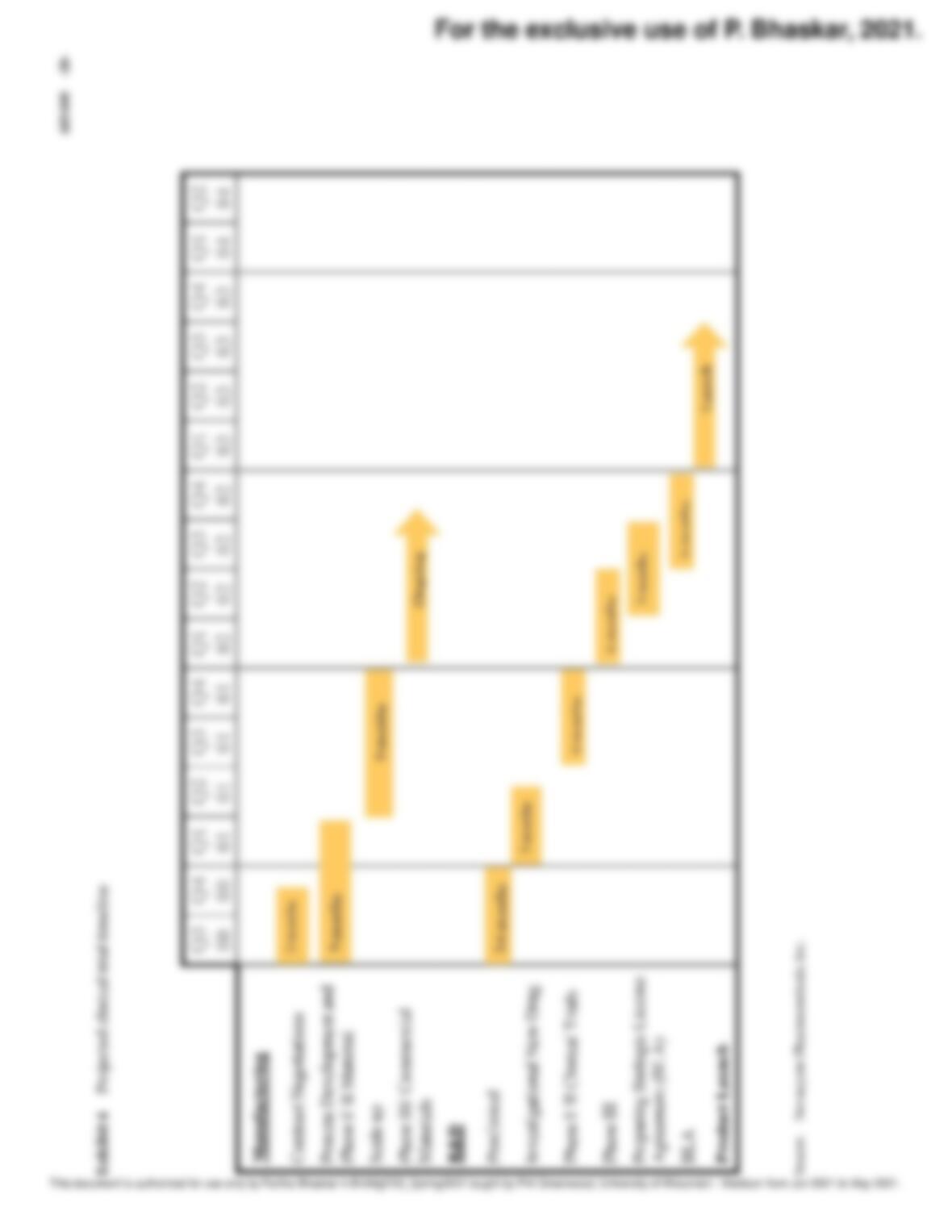
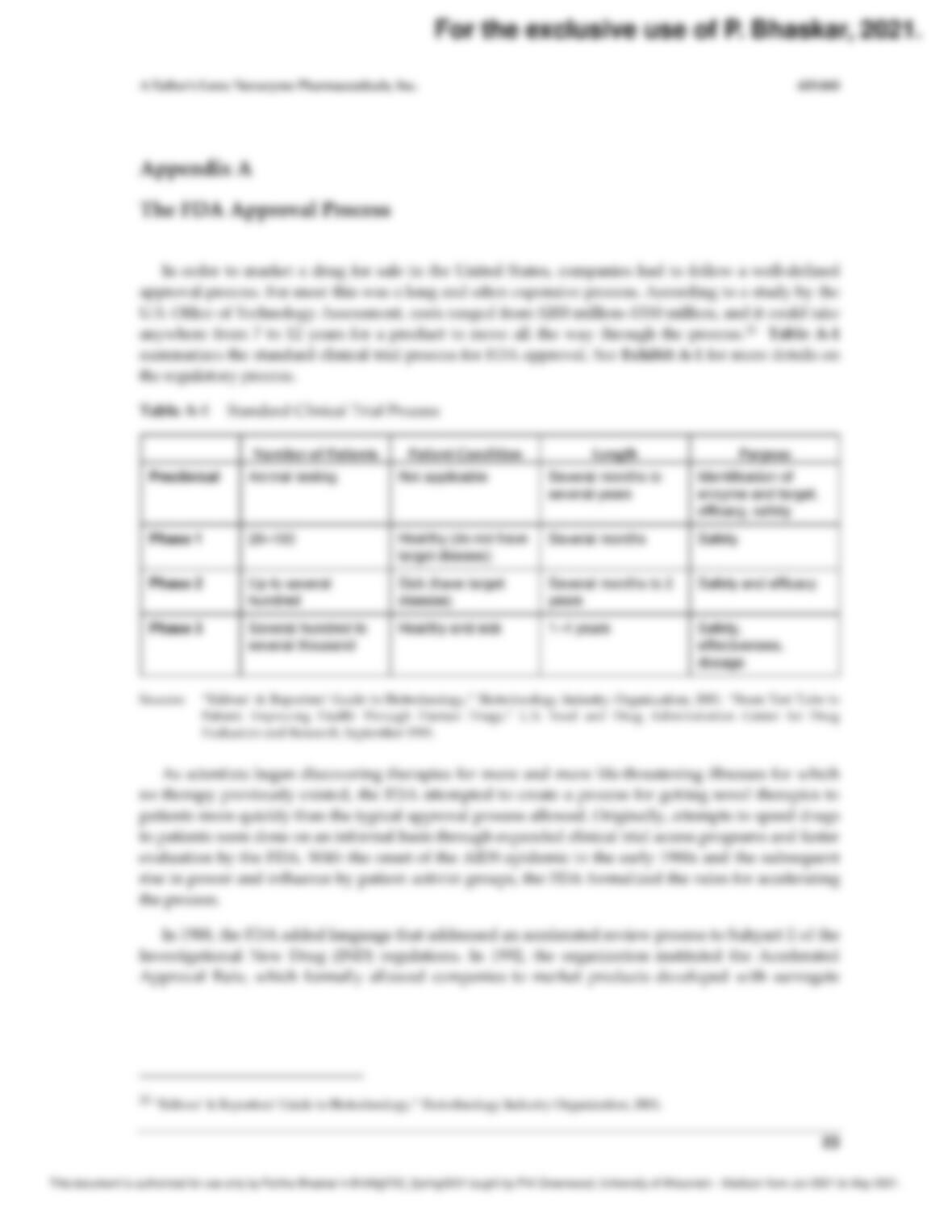
Novazyme would attempt to get Accelerated Approval and Priority Review (see Appendix A for
a description of the FDA approval process for HP–GAA). With extremely positive preclinical data and
a patient population in dire need of treatment, Pompe clearly met the qualifications for the
accelerated review programs (“Fast Track”). In designing the trials and working with the FDA,
Crowley hoped to gain approval to treat all patients with Pompe, not just those whose demographic
For the exclusive use of P. Bhaskar, 2021.