A critique on the emergence and effects of fake news
Bella McKinnon, 11S&C
With the advent of social media technologies, fake news is growing ever more widespread, most evidently in
America and Eastern Europe. It impacts all societal levels (micro, meso and macro). Fabricated news has
power over people’s emotions, so much so that it disrupts family environments, brainwashes communities and
breeds distrust in a general population.
Fake news has the potential to completely alter a person’s way of thinking and seeing other people. In her
2015 documentary “The Brainwashing of My Dad”, Senko tells a story of her own father (Frank Senko) who –
through absorbing fake news through various media outlets – grew hateful and unempathetic towards people.
First, he was listening to The Rush Limbaugh Show, then watching Fox News. Soon, “He started forwarding
emails…full of lies…about...how horrible Democrats were”. (Jan Senko, 2015) Eventually, Senko’s children
blocked him online and he had to sleep separately from his wife. In constantly consuming fake news, he
became “miserable, angry and paranoid”. The conditions in which they began to live became fraught with
tension, annoyance and a loss of closeness to each other. Thus, fabricated news directly impacts the micro–
level of society as it has the means to divide even the closest families.
On a broader scale, fake news also adversely affects the meso society (small communities). One distributor is
Westboro Baptist *Church (WBC). The religious cult is most infamous for picketing against homosexuals and
indoctrinating adherents to believe in false, extreme ideas, including: gay people cause natural disasters,
terrorist attacks, and school shootings
1
, God hand-picked them to represent divinity, and picketing at funerals
is the perfect time to remind people to repent. They preach these ideas through their website via
communications technologies. Consequently, members are uneducated about the world outside their cult. So
much so that they picket daily against anyone who does not abide by their doctrines. Therefore, fake news
within close-knit communities is especially dangerous, as members are less likely to deviate from the
environment, and remain following the false teachings that consume them.
Furthermore, fake news has the power to impact the social environments of entire nations, from the
inconvenience of being somewhat confused to the frustration in not knowing what is true. A 2018 study by
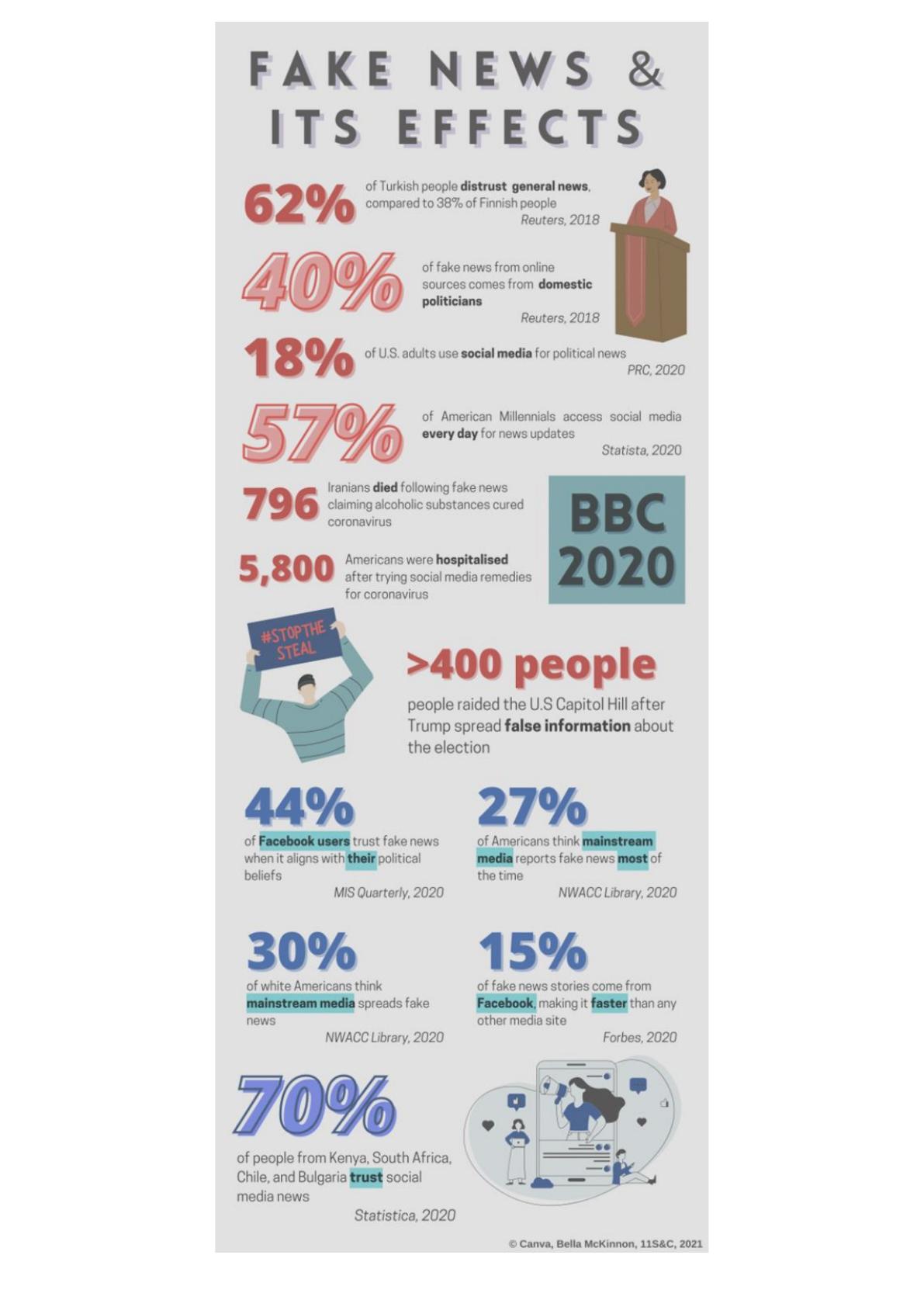
Reuters found that 49% of Turkish respondents viewed fabricated news via a number of communication
medias in the week of completing the survey.
2
Further, 62% distrust news in general
3
, compared to only 38%