Nang Yan Business Journal (v. 6 no. 1 – 2017) Page 1
10.2478/nybj-2018-0001
A Case Study of Supply Chain Management in a
Manufacturing Company in China
Renfei Luo
1
University of Macau, Macau
Jiedan Huang
2
University of Macau, Macau
Jimmy Lee
3
University of Macau, Macau
Philip Pun
4
University of Macau, Macau
Published online: 20 July 2017
© Nang Yan Business Journal 2017
ABSTRACT: How to manage inventory is becoming an increasingly crucial issue for most
manufacturing companies. R&D is a foreign direct investment (FDI) company engaged in producing
electronic components. As the prices of raw materials and operation costs increased, R&D was
challenged to maintain a smooth relationship among level of inventory, customer satisfaction and
production efficiency. This paper first discusses the key factors that affect R&D’s inventory level. It
then combines recent supply chain management theories and relevant quantitative methods to arrive
at optimal ordering policies and strategies to reduce overall costs, while at the same time satisfying
customers in terms of service.
Keywords: Inventory management, safety stock, case study, VMI
JEL codes: L84, O14
1
Faculty of Business Administration, Macau. Email: yb470006@umac.mo.
2
Faculty of Business Administration, University of Macau, Macau. Email: lisaofyou@umac.mo.
3
Faculty of Business Administration, University of Macau, Macau. Email: jimmylee@umac.mo.
4
Faculty of Business Administration, University of Macau, Macau. Email: pstpun@umac.mo.
The authors would like to thank the anonymous referees for the valuable comments and suggestions which have
helped to improve the presentation of this paper. This research is funded in part by the University of Macau under
MYRG2016-00016-FBA and Macau FDCT under FDCT/027/2016/A1.

Nang Yan Business Journal (v. 6 no. 1 – 2017) Page 2
1.0 Introduction
1.1 Background
Traditionally, companies in a supply chain network focus mainly on their own processes and pay
less attention to their suppliers or customers. However, globalization and the development of
intensive relationships among companies have induced paradigm shifts in modern business
management, including the management of supply chain networks (Lambert et al., 2000). Since
holding inventory is expensive, effective inventory management is critical to supply chain
operations. Uncertain demand and economies of scale underline the importance of keeping some
inventory.
However, different functions of a company may disagree over inventory level. Marketing may
want to keep inventory as high as possible, so that customers’ demand can be satisfied
immediately. Production may also want to maintain a high inventory to support long production
runs and to realize economies of scale. Finance, however, may prefer a low inventory to reduce
the current asset levels. Obviously, such conflict generates a question: what level of inventory
should we maintain in order to simultaneously satisfy customers’ demand and minimize
operational costs?
Many foreign manufacturers in China have faced similar problems and this undermined their
efficiency badly. Therefore, how to optimize inventory is a crucial issue that needs to be
resolved. This paper aims to discuss the issue by analyzing the case of a selected company in
order to suggest ways to tackle the issue using inventory management tools, such as the safety
stock model.
1.2 Problem statement
The company selected for this case study is a foreign direct investment manufacturer
headquartered in Germany, to which we have assigned the pseudonym R&D. It is in fact one of
the largest manufacturing companies in the world producing electronic components, modules and
systems. It has approximately 26,300 employees in its 20 different locations engaged in design
and production. A comprehensive range of products are offered by R&D in the areas of
information and communication technology, automotive electronics, industrial electronics and
consumer electronics.
R&D’s manufacturing locations and sales offices are distributed widely: from Europe, to Asia, to
South and North America. The main production branch, which is located in Zhuhai, Guangdong
province, makes piezo and protection devices, film capacitors and sensors. The Zhuhai factory
has approximately 2,800 employees and was founded in 1998. On one hand, the broad
diversification of products offers customers a range of choices and increases the company’s
market share, but stocking up on materials in preparation for uncertain demand and new project
roll-outs have led to inventory management problems, including:
Nang Yan Business Journal (v. 6 no. 1 – 2017) Page 3
1. Early inventory with high service level.
2. Late inventory with low service level.
There are several reasons why we chose this company as a case study. First, R&D is
representative of most foreign direct investment companies because it is an electronic
components manufacturer that depends heavily on manpower. Second, this company used one of
the most popular enterprise resource planning (ERP) systems — SAP — carry out customer
order planning and inventory evaluation. It is a relevant for investigating information system
application and inventory management tools.
1.3 Research objectives and contribution
This study sets out to:
1. Identify the key factors affecting inventory level and costs.
2. Investigate how to maintain a high level of service while keeping inventory levels low.
As more and more FDI manufacturing companies enter China, they will face similar issues to
R&D which involve e local suppliers and distributors. Demand forecast is not accurate as
demand fluctuates during different periods. Moreover, customer order time is typically short but
production lead time is constant. Therefore, factories normally face two kinds of situations:
production is unable to meet demand or supplies exceed demand. By analyzing the case
quantitatively and qualitatively, we will use it as an example to solve problems related to
inventory. We hope that this paper will act as a reference for companies that encounter problems
similar to our case.
2.0 Literature review
Traditionally, supply chain management is viewed as a vertical integration of marketing,
distribution, planning, manufacturing, and purchasing departments within an organization.
Beamon (1998) divided a supply chain into two integrated processes: production planning and
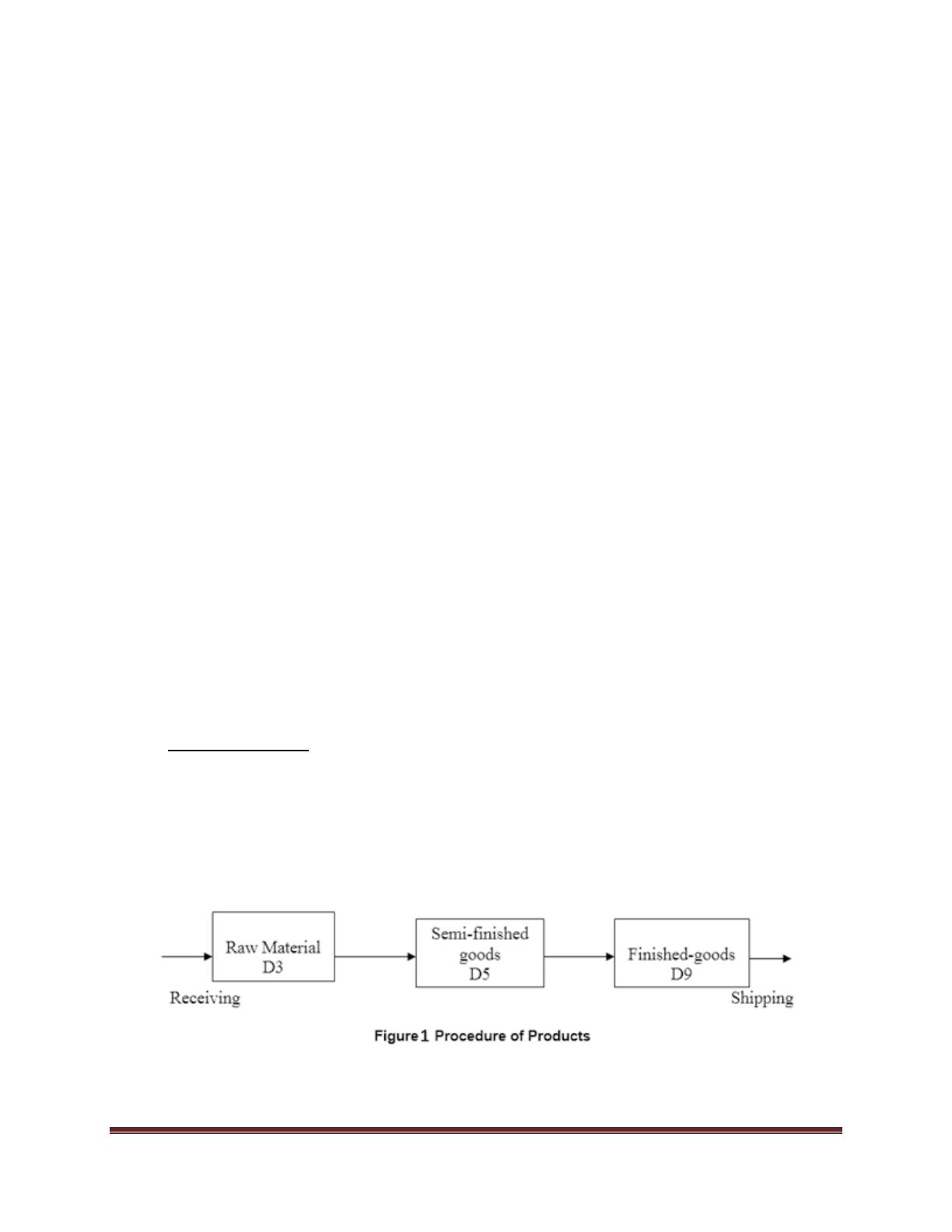
inventory control process, and distribution and logistics Process. The processes and movements
of raw materials into finished products are illustrated in Figure 1.
With the development of supply chain management, advanced modeling approaches have been
used to improve the efficiency of supply chains. Williams (1981) developed a dynamic

Nang Yan Business Journal (v. 6 no. 1 – 2017) Page 4
programming algorithm which can minimize the average costs per period over an infinite
horizon. Ishii et al. (1988) developed a deterministic model to prevent stock outs and minimize
the amount of inventory. Newhart et al. (1993) designed an optimal supply chain to minimize the
number of distinct product types held in inventory. Inventory holding costs can be between 20 to
40 percent of their values, so efficient inventory management is crucial in supply chain
operations. Ballou (1998), Lin and Huang (2014) indicated that inventory management is a
balance between customer service, product availability and the cost of inventory. Many
companies working on inventory management recognize that too much inventory represent high
risks and high costs. As shown in Figure 1, the channel from suppliers and manufacturers to
distributors and retailers involves different kinds of inventory. Simchi-Levi et al. (2003) and
Muniappan et al. (2016) explained the reasons why companies need to hold inventory, including
unexpected changes in customer demand, uncertainty in the quantity and quality of supplies, lead
times and economies of scale. Having considered the importance of inventory, it is necessary to
define factors that determine inventory costs.
Chopra et al. (2007) divided the inventory costs into three parts: material costs, holding costs and
ordering costs. There is some tradeoff between the cost of investing in and holding excess
inventory. We need to buffer the effects of both demand uncertainty and production lead time.
Fitzsimmons et al. (2001) introduced the notions of safety stock level and reorder point to deal
with such problems. Safety stock is a level of extra stocks that is maintained to overcome
uncertain demand and supply. Kouki et al. (2016) pointed out that an effective safety stock can
help to prevent stock outs by combining cyclical volume planning and fair share mix decisions.
The higher the level of safety stock a company keeps, the better it can satisfy its customers, but
the more it costs to maintain its service level. Whenever stocks fall below specific level, the
factory needs to reorder. The timing of the reorder is important: an early one will build up extra
stocks, while a late reorder will reduce service level. Cachon et al. (2000) and Baralis et al.
(2015) indicated that reorder point policies were optimal in a serial supply chain with batch
ordering.
Vendor managed inventory (VMI) is a supply chain management tool. In a VMI partnership, it is
not the customers or buyers but rather the vendors or manufacturers who decide when to
replenish inventory. In other words, the buyers’ or consuming organizations’inventory level is
determined by the vendors or manufacturers through shared information and electronic data
exchange. This reduces inventory risk and provides a stable level of service. Waller et al. (1999)
pointed out that through centralized forecasting via EDI linkage between factory and supplier,
the factory can reduce stock outs and inventory through limited production. At the same time, the
factory can guarantee the materials will not be in shortage. As a result of higher product
availability, buyers can reduce the cost of a lost sales caused by uncertain demand. The reduced
costs apply not only to inventory but also to production through optimizing production and
transportation.
Claassen et al. (2008) found that positive buyer perceptions of VMI implementation saved costs.
Holmstrom (1998) indicated that VMI can solve problems of both vendors and retailers. To
maintain high service levels, distributors and retailers may feel the need to buffer against supply
disruptions, which can distort/enlarge the actual demand of end customers, leading to producers
receiving incorrect information. This, in turn, will lead to inventory surplus in factories.
Moreover, supply factories and retailers spend a lot of time and money on administration prior to
implementing VMI, such as communicating order placements, customer demand, inventory
level, delivery schedule etc. However, after implementing VMI, vendors will oversee these
administrative tasks. Also, delivery charges will be reduced because of the stable mutual
partnerships formed. If a vendor is the only supplier that offers VMI, it means that vendor will
gain a competitive advantage among its competitors.
Simchi-Levi et al. (2003) explained that in a push-pull strategy, different stages of a supply chain
use their own strategies. For example, the initial stage employs push strategies while the
remaining stages operate pull strategies. The push-pull boundary is the interface between the
push-based stages and the pull-based stages. Push-pull strategies combine the advantages of both
push-based and pull-based strategies. At the same time, inventory costs are reduced and service
levels improved. Kim (2008) noted that there are three primary benefits of push-pull strategy: (1)
it reduces costs by keeping inventory at more generic levels and decreases its total value. (2) It
offers greater security and less risk of salvage and obsolescence. (3) It enhances forecast