Chapter 1
BUSINESS COMBINATIONS
Answers to Questions
1A business combination is a union of business entities in which two or more previously separate and
independent companies are brought under the control of a single management team. Three situations
establish the control necessary for a business combination, namely, when one or more corporations
become subsidiaries, when one company transfers its net assets to another, and when each combining
company transfers its net assets to a newly formed corporation.
2The dissolution of all but one of the separate legal entities is not necessary for a business combination. An
example of one form of business combination in which the separate legal entities are not dissolved is when
one corporation becomes a subsidiary of another. In the case of a parent-subsidiary relationship, each
combining company continues to exist as a separate legal entity even though both companies are under the
control of a single management team.
3A business combination occurs when two or more previously separate and independent companies are
brought under the control of a single management team. Merger and consolidation in a generic sense are
frequently used as synonyms for the term business combination. In a technical sense, however, a merger is
a type of business combination in which all but one of the combining entities are dissolved and a
consolidation is a type of business combination in which a new corporation is formed to take over the
assets of two or more previously separate companies and all of the combining companies are dissolved.
4Goodwill arises in a business combination accounted for under the acquisition method when the cost of
the investment (fair value of the consideration transferred) exceeds the fair value of identifiable net assets
acquired. Under GAAP, goodwill is not amortized for financial reporting purposes and will have no effect
on net income, unless the goodwill is deemed to be impaired. If goodwill is impaired, a loss will be
recognized.
5A bargain purchase occurs when the acquisition price is less than the fair value of the identifiable net
assets acquired. The acquirer records the gain from a bargain purchase as an ordinary gain during the
period of the acquisition. The gain equals the difference between the investment cost and the fair value of
the identifiable net assets acquired.
©2009 Pearson Education, Inc. publishing as Prentice Hall
1-1

1-2 Business Combinations
SOLUTIONS TO EXERCISES
Solution E1-1
1a
2b
3a
4d
Solution E1-2 [AICPA adapted]
1 a
Plant and equipment should be recorded at the $220,000 fair value.
2c
Investment cost $1,600,000
Less: Fair value of net assets
Cash $ 160,000
Inventory 380,000
Property and equipment — net 1,120,000
Liabilities (360,000) 1,300,000
Goodwill $ 300,000
Solution E1-3
Stockholders’ equity — Pal Corporation on January 3
Capital stock, $10 par, 300,000 shares outstanding $ 6,000,000
Other paid-in capital
[$400,000 + $3,000,000 – $10,000] 3,390,000
Retained earnings [$1,200,000 – $20,000] 1,180,000
Total stockholders’ equity $10,570,000
Entry to record combination
Investment in Sip 6,000,000
Capital stock, $10 par 3,000,000
Other paid-in capital 3,000,000
Investment expense 20,000
Other paid-in capital 10,000
Cash 30,000
Check: Net assets per books (book value) $ 7,600,000
Goodwill and write-up of assets 3,000,000
Less: Expense of direct costs (20,000)
Less: Issuance of stock (10,000)
$10,570,000
©2009 Pearson Education, Inc. publishing as Prentice Hall

Chapter 1 1-3
Solution E1-4
Journal entries on Pan’s books to record the acquisition
Investment in Set 10,200,000
Common stock, $10 par 4,800,000
Additional paid-in capital 5,400,000
To record issuance of 480,000 shares of $10 par common stock with a fair
value of $10,200,000 for the common stock of Set in a business
combination.
Additional paid-in capital 60,000
Investment expenses 180,000
Other assets (or Cash) 240,000
To record costs of registering and issuing securities as a reduction of paid-
in capital, and record direct and indirect costs of combination as
expenses.
Current assets 4,400,000
Plant assets 8,800,000
Liabilities 1,200,000
Investment in Set 10,200,000
Gain from bargain purchase 1,800,000
To record allocation of the $10,200,000 cost of Set Company to identifiable
assets and liabilities according to their fair values, and the gain from
the bargain purchase,computed as follows:
Cost $10,200,000
Fair value of net assets acquired 12,000,000
Bargain purchase amount $ 1,800,000
©2009 Pearson Education, Inc. publishing as Prentice Hall
1-4 Business Combinations
Solution E1-5
Journal entries on the books of Pan Corporation to record merger with Sis
Corporation
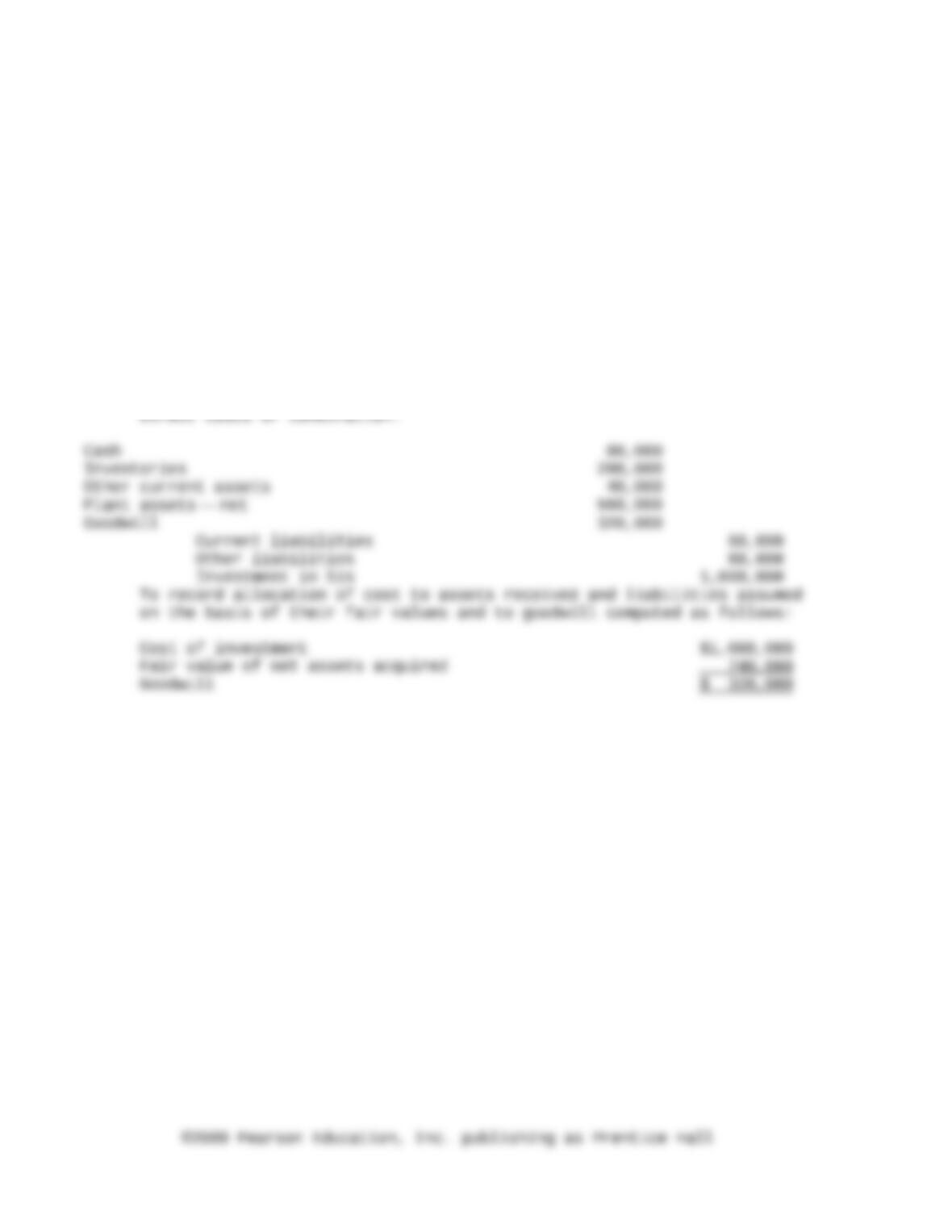
Investment in Sis 1,060,000
Common stock, $10 par 360,000
Additional paid-in capital 300,000
Cash 400,000
To record issuance of 36,000 common shares and payment of cash in the
acquisition of Sis Corporation in a merger.
Investment expenses 140,000
Additional paid-in capital 60,000
Cash 200,000
To record costs of registering and issuing securities and additional