9Chapter
Understanding
Individual
Behavior
9-1
1

Learning Outcomes
After studying this chapter, you will be able to:
•Identify the focus and goals of organizational behavior (OB).
•Explain the role that attitudes play in job performance.
•Describe different personality theories.
And …
9-2
After studying this chapter, you will be able to:
•Identify the focus and goals of organizational behavior (OB).
•Explain the role that attitudes play in job performance.
•Describe different personality theories.
And …
2

Learning Outcomes (cont.)
•Describe perception and the factors that influence it.
•Discuss learning theories and their relevance in shaping
behavior.
•Discuss contemporary issues in OB.
9-3
•Describe perception and the factors that influence it.
•Discuss learning theories and their relevance in shaping behavior, and
•Discuss contemporary issues in OB.
3
9-4
4
Organizational Behavior
9-5
Organizational behavior (OB) is the study of the actions of people at work.
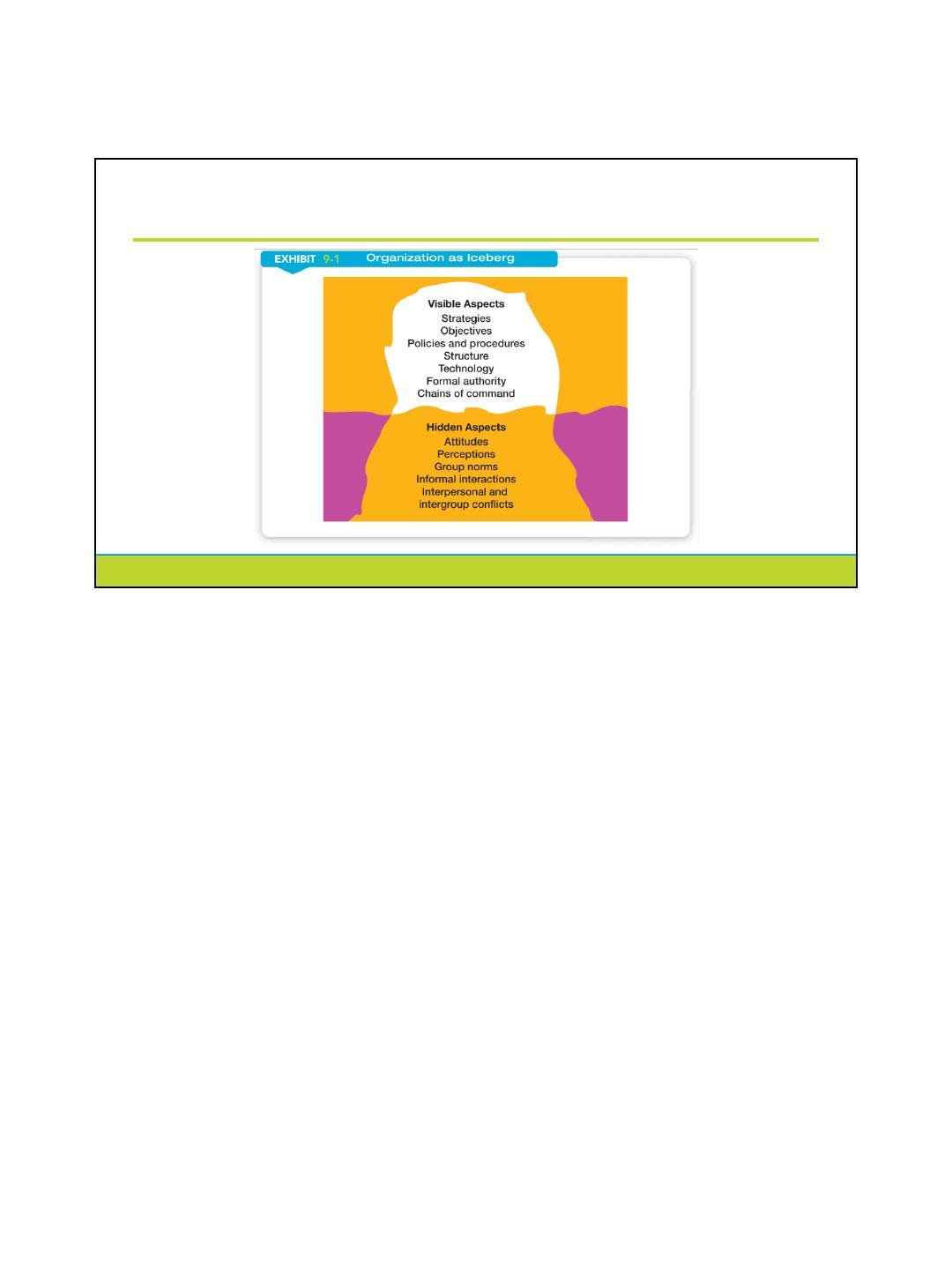
One challenge in understanding organizational behavior is that it addresses issues
that aren’t obvious. Like an iceberg, OB has a small visible dimension and a much
larger hidden portion—as seen in Exhibit 9–1.
When we look at an organization, we see its visible aspects—such as strategies,
objectives, policies and procedures, structure, technology, formal authority
relationships, and chain of command. But under the surface are other elements that
also influence how employees behave at work.
Organizational behavior focuses on three major areas:
1. Individual behavior, which includes attitudes, personality, perception,
learning, and motivation.
2. Group behavior, which includes norms, roles, team building, leadership, and
conflict, and
3. Organizational aspects, which include structure, culture, and human
resource policies and practices.
5
Goals of Organizational Behavior
Managers need to explain,
predict and influence these
behaviors:
1. Employee productivity
2. Absenteeism
3. Turnover
4. Organizational citizenship
behavior
5. Job satisfaction
6. Workplace misbehavior
9-6
The goals of OB are to explain, predict, and influence behavior. Managers need to be able to:
•Explain why employees engage in some behaviors rather than others.
•Predict how employees will respond to various actions and decisions, and
•Influence how employees behave.
The employee behaviors that we are specifically concerned with explaining, predicting, and influencing are:
1. Employee productivity
2. Absenteeism
3. Turnover
4. Organizational citizenship behavior (OCB)
5. Job satisfaction, and
6. Workplace misbehavior.
Employee productivity is a performance measure of both work efficiency and effectiveness. Managers want to know what
factors will influence the efficiency and effectiveness of employees.
Absenteeism is the failure to show up for work, which costs organizations an average 35 percent of payroll.
Turnover is the voluntary and involuntary permanent withdrawal of employees from an organization. This can be a particularly
costly problem due to increased recruiting, selection, and training costs and work disruptions.
Organizational citizenship behavior (OCB) is discretionary behavior that’s not part of an employee’s formal job requirements,
but which promotes effective functioning of the organization. Examples of good OCB include helping others on one’s work
team, volunteering for extended job activities, avoiding unnecessary conflicts, and making constructive statements about one’s
work group and the organization. Organizations need individuals who will do more than their usual job duties and research
shows that organizations that have such employees outperform those that don’t.
Job satisfaction refers to an employee’s general attitude toward his or her job. Satisfied employees are more likely to show up
for work, have higher levels of performance, and stay with an organization.
Workplace misbehavior is any intentional employee behavior that is potentially harmful to the organization or to individuals
within the organization. Workplace misbehavior shows up in organizations in four ways: deviance, aggression, antisocial
behavior, and violence.
6
9-7