7Chapter
Managing
Human
Resources and
Diversity
7-1
1

Learning Outcomes
After studying this chapter, you will be able to:
•Describe the key components of the human resource
management process and the important influences on that
process.
•Discuss the tasks associated with identifying and selecting
competent employees.
•Explain how employees are provided with needed skills and
knowledge.
•And …
7-2
After studying this chapter, you will be able to:
•Describe the key components of the human resource management process
and the important influences on that process.
•Discuss the tasks associated with identifying and selecting competent
employees.
•Explain how employees are provided with needed skills and knowledge.
And …
2

Learning Outcomes (cont.)
•Describe strategies for retaining competent,
high-performing employees.
•Discuss contemporary issues in managing
human resources.
7-3
•Describe strategies for retaining competent, high-performing employees, and
•Discuss contemporary issues in managing human resources.
3
7-4
4

Human Resource Management
7-5
The quality of an organization is to a large degree determined by the quality of the
people it employs. Human resource management (also known as HRM) is the
management function concerned with getting, training, motivating, and keeping
competent employees.
In many organizations, a number of the activities grouped under the label human
resource management (HRM) are done by specialists. In other organizations, HRM
activities may be outsourced to other companies, either domestic or global. Many
small business managers, for instance, must do their own hiring without the
assistance of HRM specialists.
But all managers, even those in larger organizations, are involved in recruiting
candidates, reviewing application forms, interviewing applicants, orienting new
employees, making decisions about employee training, providing career advice to
employees, and evaluating employees’ performance. Therefore, even if an
organization provides HRM support activities, every manager is involved with human
resource decisions in his or her unit.
5

HRM Process and Influences
7-6
Exhibit 7-1 introduces the key components of an organization’s HRM process. It represents
eight activities (the yellow boxes) that, if properly executed, will staff an organization with
competent, high-performing employees who are capable of sustaining their performance
level over the long term.
The first three activities in the HRM process address employment planning: adding staff
through recruitment, reducing staff through downsizing, and the selection process.
Once you select competent people, you need to help them adapt to the organization and
ensure that their job skills and knowledge are kept current—which is accomplished by the
next two activities in the HRM process: orientation and training.
The last steps in the HRM process identify performance goals, correct performance problems
if necessary, and help employees sustain a high level of performance over their entire work
lives. The activities involved include performance appraisal, compensation and benefits, and
safety and health.
Notice that the entire process in Exhibit 7-1 is influenced by the external environment. Many
of the factors introduced in Chapter 2 directly affect all management practices, but their
effect is felt most in managing the organization’s human resources because whatever
happens to an organization ultimately influences what happens to its employees.
6
The Legal Environment
7-7
The primary environmental force that affects an organization is the legal
environment, particularly employment and discrimination laws. HRM practices are
governed by laws, which vary from country to country, and further vary within state
or provinces. As a manager, it will be important for you to know what you legally can
and cannot do.
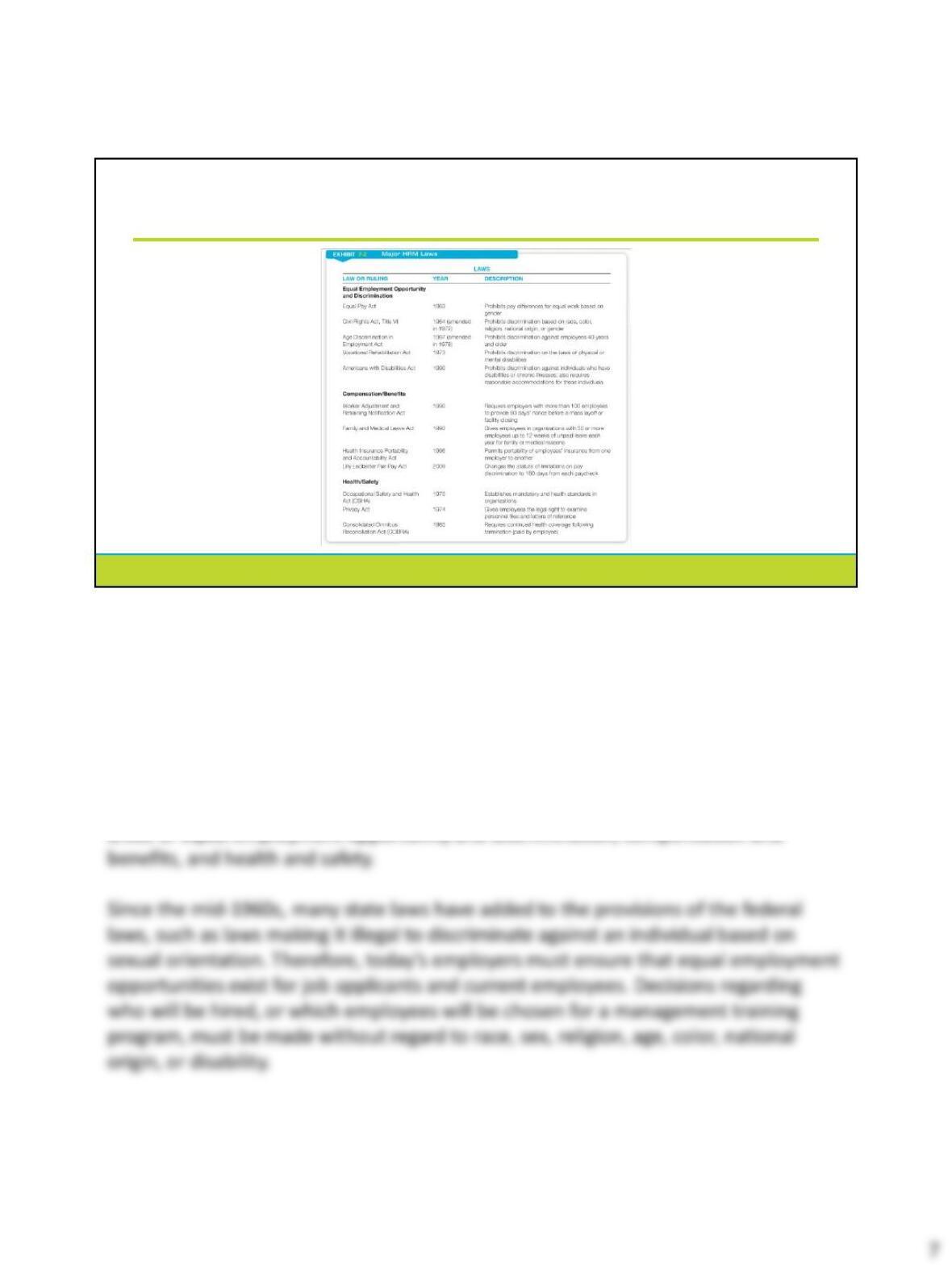
The primary U.S. Laws affecting HRM are seen here in Exhibit 7-2, which reflects the
federal government’s expansion of influence over HRM since the mid-1960s in the