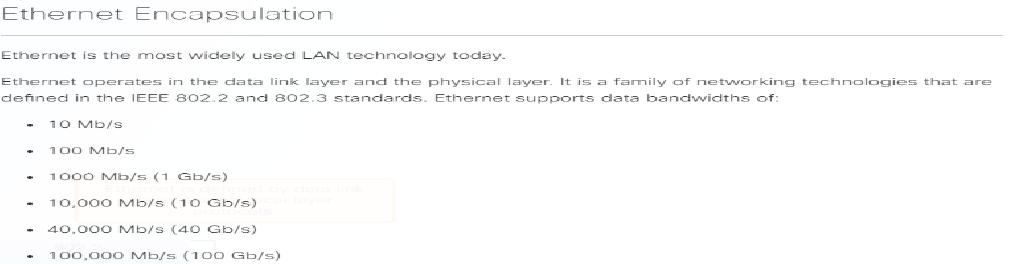
Ethernet
Ethernet Protocol
Ethernet relies on the two separate sublayers of the data link layer to operate, the Logical Link
Control (LLC) and the MAC sublayers
Ethernet is a contention-based method of networking. A contention-based method means that
any device can try to transmit data across the shared medium whenever it has data to send.
The Carrier Sense Multiple Access/Collision Detection (CSMA/CD) process is used in half-
duplex Ethernet lans to detect and resolve collisions
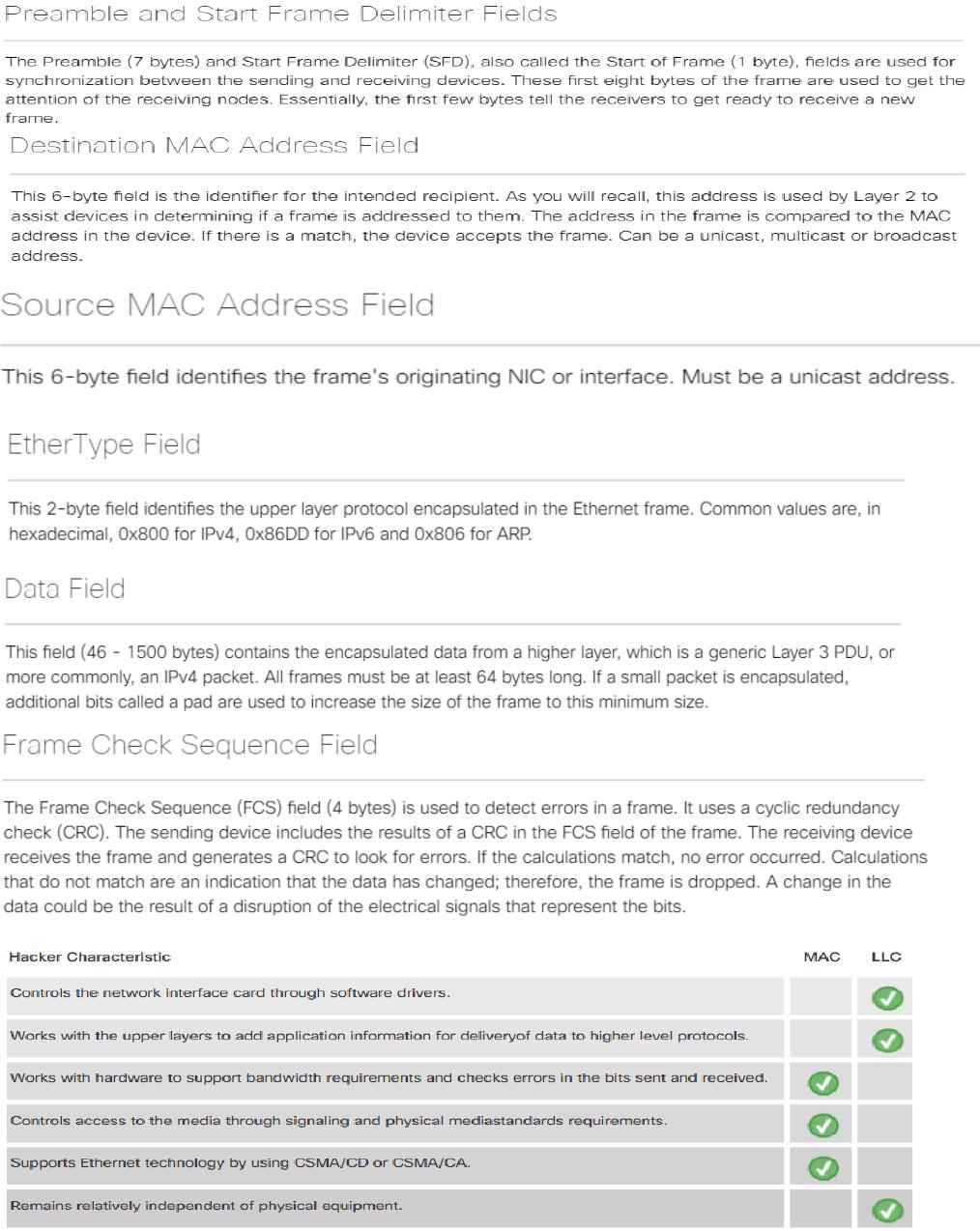
The minimum Ethernet frame size is 64 bytes and the maximum is 1518 bytes.
Includes all bytes from the Destination MAC Address field through the Frame Check Sequence
(FCS) field.
Any frame less than 64 bytes in length is considered a “collision fragment” or “runt frame” and
is automatically discarded by receiving stations.
Frames with more than 1500 bytes of data are considered “jumbo” or “baby giant frames”.
LLC sublayer
The Ethernet LLC sublayer handles the communication between the upper layers and the lower
layers.
The LLC is used to communicate with the upper layers of the application, and transition the
packet to the lower layers for delivery.
LLC is implemented in software, and its implementation is independent of the hardware.
In a computer, the LLC can be considered the driver software for the NIC.
The NIC driver is a program that interacts directly with the hardware on the NIC to pass the data
between the MAC sublayer and the physical media.
MAC sublayer
MAC constitutes the lower sublayer of the data link layer. MAC is implemented by hardware,
typically in the computer NIC.
The Ethernet MAC sublayer has two primary responsibilities:
Data encapsulation
Media access control
Data encapsulation
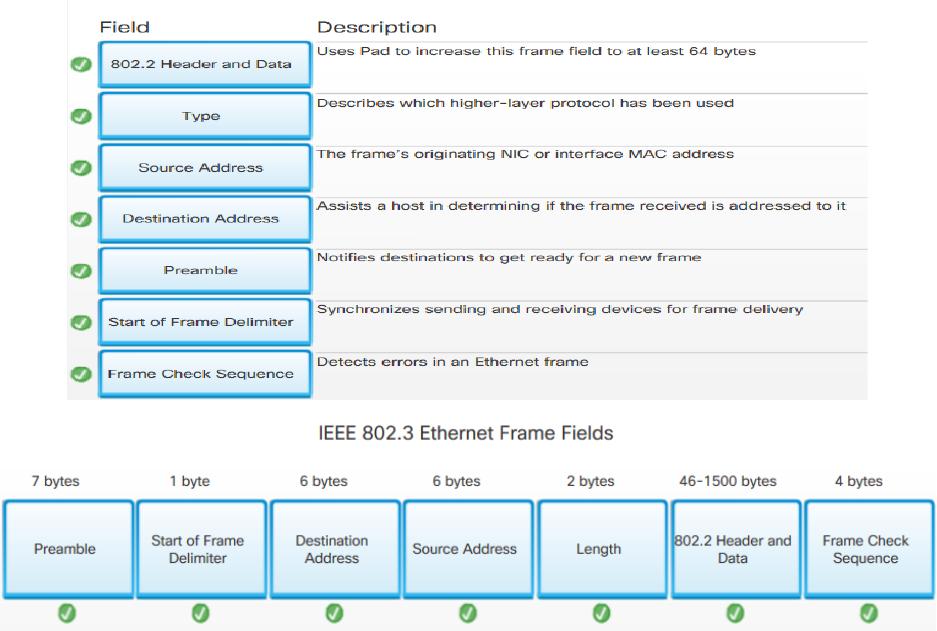
The data encapsulation process includes frame assembly before transmission, and frame
disassembly upon reception of a frame. In forming the frame, the MAC layer adds a header and
trailer to the network layer PDU
Data encapsulation provides three primary functions:
Frame delimiting – The framing process provides important delimiters that are used to identify a
group of bits that make up a frame. These delimiting bits provide synchronization between the
transmitting and receiving nodes.
Addressing – The encapsulation process contains the Layer 3 PDU and also provides for data link
layer addressing.
Error detection – Each frame contains a trailer used to detect any errors in transmissions.
Media Access Control
The second responsibility of the MAC sublayer is media access control.
Media access control is responsible for the placement of frames on the media and the removal of
frames from the media.
MAC Address and Hexadecimal
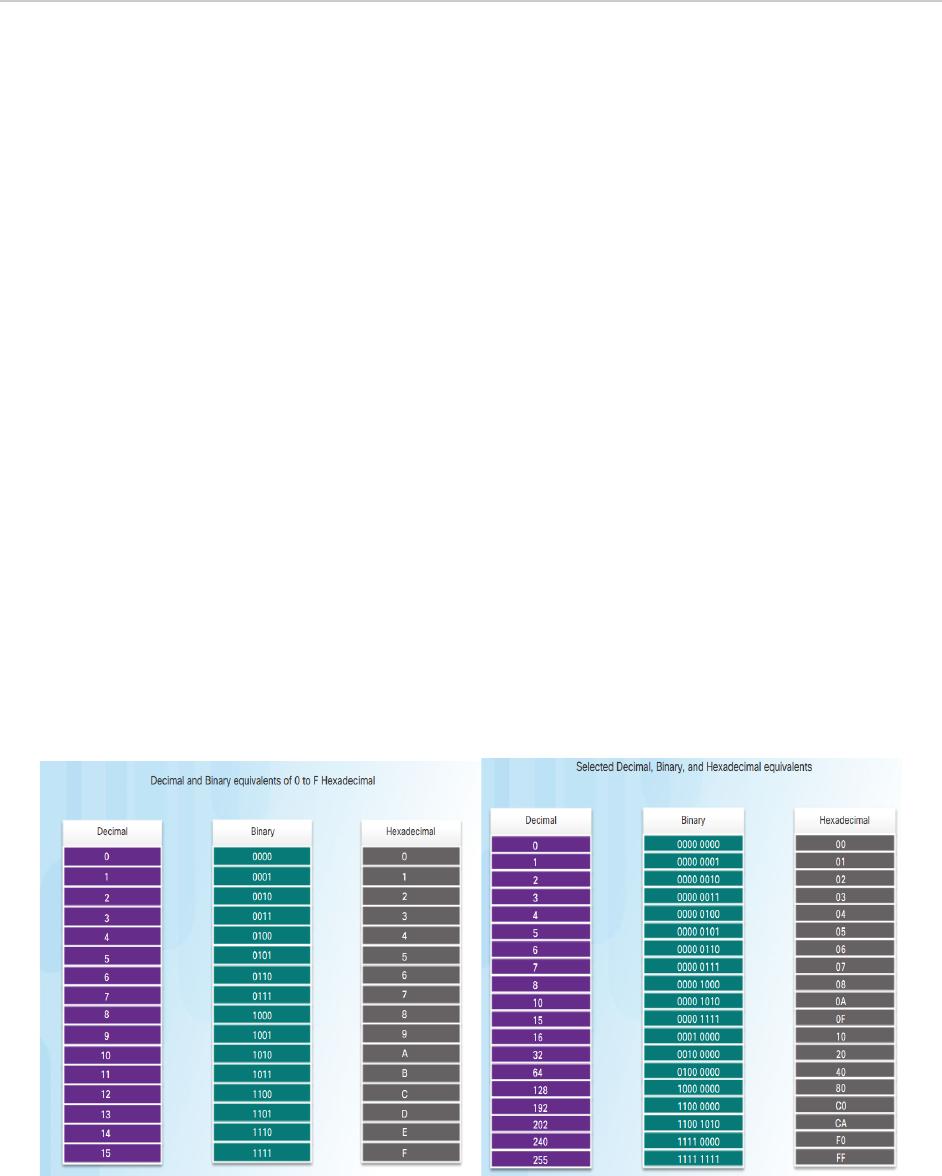
An Ethernet MAC address is a 48-bit binary value expressed as 12 hexadecimal digits (4 bits per hexadecimal digit).
Just as decimal is a base ten number system, hexadecimal is a base sixteen system. The base sixteen number system uses the
numbers 0 to 9 and the letters A to F. Figure 1 shows the equivalent decimal and hexadecimal values for binary 0000 to 1111. It
is easier to express a value as a single hexadecimal digit than as four binary bits.
Given that 8 bits (one byte) is a common binary grouping, binary 00000000 to 11111111 can be represented in hexadecimal as
the range 00 to FF, as shown in Figure 2. Leading zeroes are always displayed to complete the 8-bit representation. For example,
the binary value 0000 1010 is shown in hexadecimal as 0A.
Note: It is important to distinguish hexadecimal values from decimal values regarding the characters 0 to 9, as shown in the
figure.
Representing Hexadecimal Values
Hexadecimal is usually represented in text by the value preceded by 0x (for example 0x73) or a subscript 16. Less commonly, it
may be followed by an H(for example 73H). However, because subscript text is not recognized in command line or programming
environments, the technical representation of hexadecimal is preceded with “0x” (zero X). Therefore, the examples above would
be shown as 0x0a and 0x73 respectively.
Hexadecimal is used to represent Ethernet MAC addresses and IP Version 6 addresses.
Hexadecimal Conversions
Number conversions between decimal and hexadecimal values are straightforward, but quickly dividing or multiplying by 16 is
not always convenient. If such conversions are required, it is usually easier to convert the decimal or hexadecimal value to
binary, and then to convert the binary value to either decimal or hexadecimal as appropriate.
MAC Address Structure
The MAC address value is a direct result of IEEE-enforced rules for vendors to ensure globally unique addresses for each
Ethernet device. The rules established by IEEE require any vendor that sells Ethernet devices to register with IEEE. The IEEE
assigns the vendor a 3-byte (24-bit) code, called the Organizationally Unique Identifier (OUI).
IEEE requires a vendor to follow two simple rules, as shown in the figure:
• All MAC addresses assigned to a NIC or other Ethernet device must use that vendor’s assigned OUI as the first 3 bytes.