SUGGESTED ANSWERS – EXTRA ATTEMPT, MAY 2014 EXAMINATIONS 1 of 9
STRATEGIC MANAGEMENT ACCOUNTING – SEMESTER-6
Marks
DISCLAIMER:
The suggested answers provided on and made available through the Institute’s website may only be referred, relied upon or treated as a guide and substitute for professional
advice. The Institute does not take any responsibility about the accuracy, completeness or currency of the information provided in the suggested answers. Therefore, the Institute is
not liable to attend or receive any comments, observations or critics related to the suggested answers.
Q. 1
(a) Break-even points in 2014:
Ratio of air filters to oil filters = 70,000 : 140,000 = 1 : 2 1
Total fixed costs: Rs. ‘000’
Manufacturing overhead 5,600
Selling and administrative 20,800
Total 26,400
1
Contribution margins: Rs./ Unit
Air Filters Oil Filters
Selling price 300 450
Variable costs 160 190
Contribution margin 140 260
1 + 1 = 2
Weighted average contribution margin (Rs. ‘000’) {1/3 (140) + 2/3 (260)}
220
Break-even in total units (26,400,000 ÷ 220) 120,000
1
Break-even in air filters (120,000 x 1/3) 40,000
1
Break-even in oil filters (120,000 x 2/3) 80,000
1
(b)
2015 fixed cost = 26,400,000 + 1,140,000 = Rs.27,540,000 1
Contribution margins: Rs./ Unit
Air Filters Oil Filters
Selling price 300 400
Variable costs:
Material 72 72
Direct labour 44 66
Overhead 40 40
Total 156 178
Contribution margin 144 222
1 + 1 = 2
Workings: Rs. ‘000’
(a)
Material – air filter (80 x 0.9) 72
(b)
Material – oil filter (90 x 0.8) 72
(c)
Labour – air filter (40 x 1.1) 44
(d)
Labour – oil filter (60 x 1.1) 66
1

SUGGESTED ANSWERS – EXTRA ATTEMPT, MAY 2014 EXAMINATIONS 2 of 9
STRATEGIC MANAGEMENT ACCOUNTING – SEMESTER-6
Marks
DISCLAIMER:
The suggested answers provided on and made available through the Institute’s website may only be referred, relied upon or treated as a guide and substitute for professional
advice. The Institute does not take any responsibility about the accuracy, completeness or currency of the information provided in the suggested answers. Therefore, the Institute is
not liable to attend or receive any comments, observations or critics related to the suggested answers.
The weighted average contribution margin changes in 2015 because of the Rs.400
selling price for oil filters and the prediction that 80% of sales will be from them
compared with 75% in 2014.
The sales mix will be the same for all volume levels. To find the sales mix in units for
each product, we can use the sales mix in Rupees.
For example, if the new sales Rupee percentages had prevailed in 2014, the sales mix
ratio in units would have been 1:3, computed as Unit ‘000’
Oil filters (84,000 x 0.80) 67,200 ÷ 400 168
Air filters (84,000 x 0.20) 16,800 ÷ 300 56
224
1
% of oil filters 168,000 / 224,000 75%
% of air filters 56,000 / 224,000 25%
1
Units
Weighted average contribution margin
0.25 (144) + 0.75 (222) 202.5
Break-even in total units 27,540,000 ÷ 202.5 136,000
Break-even in air filters 136,000 x 0.25 34,000
Break-even in oil filters 136,000 x 0.75 102,000
2
(c) Sales revenue needed in 2015 to earn a profit of 15% on sales after taxes:
Rupees
Weighted average sales [300 (0.25) + 400 (0.75)] 375
Total sales revenue 375 where ‘S’ the total units sold
Profit goal (375 x 0.15)/0.65 86.54
1
Total sales in units:
202.5(S) = 27,540,000 + 86.54S (202.50 is the weighted average
contribution margin)
115.96(S) = 27,540,000 = S = 237,496 units 1
Sale of air filters (units) (237,496 x 0.25) 59,374
1
Sale of oil filters (units) (237,496 x 0.75) 178,122
1
Rupees
Oil filters (59,374 x 300) 17,812,200
Air filters (178,122 x 400) 71,248,800
Total 89,061,000
1
Thus the company needs sales revenue of Rs.89,061,000 to achieve its profit goal of
15% on sales after taxes.
(d)
Contribution margin rate:
Product-A (300,000 ÷ 1,200,000) 25%
Product-B (108,000 ÷720,000) 15%
Product-C (24,000 ÷ 480,000) 5%
Product-A should be promoted because of its highest contribution margin rate (25%). 2
SUGGESTED ANSWERS – EXTRA ATTEMPT, MAY 2014 EXAMINATIONS 3 of 9
STRATEGIC MANAGEMENT ACCOUNTING – SEMESTER-6
Marks
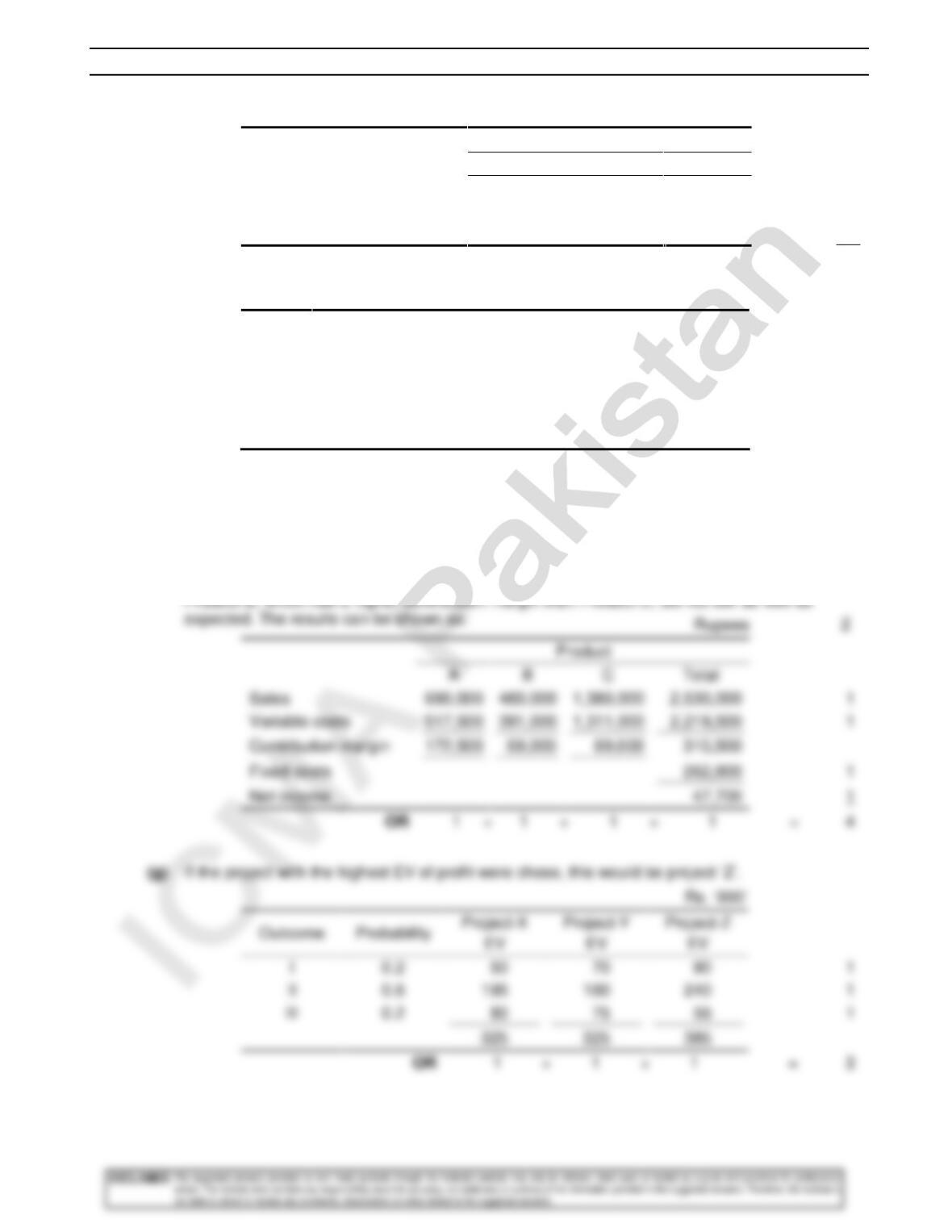
(e) Recommendation to change the supplier or not: Rupees
Product
A B C
Decrease in sales 180,000 (a)
108,000 (b)
72,000 (c)
1
Decrease in cost of good sold
72,000 (d)
50,400 (e)
38,400 (f) 1
Decrease in net income 108,000 57,600 33,600 1
OR
1 + 1 + 1 = 3
Workings: Rupees
(a) 1,200,000 x 0.15 180,000
½
(b) 720,000 x 0.15 108,000
½
(c) 480,000 x 0.15 72,000
½
(d) 720,000 x 0.10 72,000
½
(e) 504,000 x 0.10 50,400
½
(f) 384,000 x 0.10 38,400
½
The company should not change any of the products’ suppliers because to do so would
result in a loss of income.
(f) Net income was lower than projected because of the actual sales mix. Product A, which
earns the highest contribution margin rate, did not sell as well as expected, and Product
C, the product with the lowest contribution rate, sold far better than exported. Also,